
Download your FREE copy of: The Ultimate Guide to Passive Real Estate Investing.
—
Americans are losing the money game. Freedom is our innate human tendency, yet that beacon of Americanism has dimmed over the last decade. It’s an abstraction to some and a fantasy to others. Our society has replaced the foundational principles of self-reliance and entrepreneurship with security and dependency. The price we’ve paid for this transfer responsibility continues to compound. It’s evidenced by these incredible statistics. The US national debt is at an all-time high and has been for a very long time. It’s currently over $20 trillion. Half of our earned income goes to taxes when you start to factor in sales tax, property taxes, utilities and inflation. Both Medicare and Social Security now comprise over 200% of our GDP, the gross domestic product. The retirement savings gap is at a staggering $14 trillion. Consumer debt is also at an all-time high at $20 trillion or over $20 trillion.
45% of the workforce has $3,000 saved for retirement, almost half of our workforce has only saved $3,000. Our outstanding student loan debt is over $1.5 trillion and to make that worse, student loan default rates are over 50%. This is a big problem that the government is going to have to step in and deal with. Employment satisfaction and engagement, which are critical because you need to love what you do and have a passion for it, are staggeringly low. If you don’t believe me, just ask ten of your friends, but there is hope. The opportunity to achieve financial freedom and a life of fulfillment is available to more people now than ever before. We have the speed of communication, technology and the internet. Things have been democratized.
We have a great opportunity. The opportunity to create financial freedom is far more available than it has been for your parents and their parents’ parents. It all starts with your financial education and your mindset. You may need to question everything about money, wealth, investing and retirement. I love the blockbuster movie, The Matrix. I use this movie as a metaphor all the time. Picture yourself in a similar seat as Neo with Morpheus extending his hand to you, offering you the following choice. He says, “You take the blue pill, the story ends, you wake up in your bed and believe whatever you want to believe. You take the red pill, you stay in Wonderland, and I show you how deep the rabbit hole goes.” It all starts with your mindset and financial education. You may need to question everything you know about money and wealth investing in retirement, but it’s available to you.
If you missed our last episode, be sure to listen to 7 Steps for Picking a Strong Real Estate Market.
Enjoy the show!
– – – – – – – – – – – – – –
Learn more about Your Roadmap to Real Wealth.
Download your FREE copy of: The Ultimate Guide to Passive Real Estate Investing.
Get your FREE coffee mug by leaving us a Rating and Review on iTunes. Here’s how.
See our available Turnkey Cash-Flow Rental Properties.
Please give us a RATING & REVIEW (Thank you!)
SUBSCRIBE on iTunes | Stitcher | Podcast Feed
Heads I Win, Tails You Lose with Patrick Donohoe
It’s my pleasure to welcome Patrick Donohoe to the show. Patrick is the Founder and CEO of Paradigm Life and PL Wealth Advisors. These are companies founded to educate clients to reach their financial freedom by building wealth, creating cashflow and establishing a legacy. Since 2007, they’ve helped thousands of individuals in all 50 states and every province of Canada efficiently grow their wealth by using financial strategies outside of the typical Wall Street solutions. He’s been honored by Investopedia as one of the nation’s Top 100 Most Influential Financial Advisors. Patrick, welcome to the show.
Marco, it’s awesome you asked me to be with you.
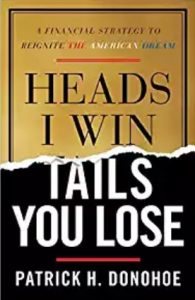
I’m glad you’re on the show. I’ve been meaning to get you on for a long time since we went out on a cruise with Robert Kiyosaki. We’ve had some great conversation and I knew you were a smart and knowledgeable guy. Now that you have your new book is out, Heads I Win Tails You Lose, I figured that this is an opportune time to get you on the show. We could talk about some of the ideas and concepts you have in that book. Let’s start off with you. Tell us a little bit about yourself.
I grew up in a middle-class family in central Connecticut. I played hockey in school. I got some bad injuries since I don’t have the body type that’s meant to play hockey. I played in college for a couple of years and got injured. Then I decided to go on a service mission for my church, came back and decided to move out to Utah because my parents were retiring to Cape Cod, Massachusetts. I finished school at the University of Utah and about two months before I left, one of my best friends growing up introduced me to Rich Dad Poor Dad back in 2002. That book made me think about life, my future, career, school, and everything with a much different perspective.
When I arrived in Utah, I got a job in sales even though I hated sales. I graduated with a degree in Economics and I fell into a couple of financial jobs like real estate, consumer finance and mortgage finance. I was smitten with one of Kiyosaki’s original financial advisors, Kim Butler. She was gracious enough in 2005 and 2006 to teach me what she was doing. At that time, she was a financial planner and with the help of Kiyosaki, she looked at finances, planning and strategy differently. She showed me the ropes. In 2007, I started Paradigm Life and from there, things were going good for six months. The whole business that I was a part of that helped me get Paradigm Life off the ground fell apart in 2008, 2009. They almost went bankrupt and I almost went bankrupt. There were a number of times where my wife was like, “Go get a job at 7/11 down the street because that’s going to pay more than you’re bringing in.” I had some rough lessons, but I hung on and that’s what I’ve been doing since.
The book is the culmination of over a decade’s worth of experiences with clients, my personal experiences, the knowledge I gained through studying the economy and what caused the business cycle to collapse in 2008 to 2010. It’s been an awesome journey and the book is something I wanted to do to leave a legacy for my kids so that they know what the journey was. It’s a cohesive message of the podcast, webinars and events that I’ve done over the years. I’m grateful that I was able to get the book done and tell the story.
You answered my question about what the impetus for was and why did you want to put it all on paper. It’s a combination of leaving a legacy and doing a brain dump from all your experience. That was a great thing to do and it was well done.
I’ve come to realize over the years that human beings have a desire to leave their mark on the world, especially if they have kids. I went through so much and I realized that it was unique to the normal path that most people are on a from a professional standpoint. It took over two years to write the book, but it helped keep me motivated and inspired to finish it.
For many people, the American dream, at least the way many of us had been brought up, is to own their own home, but it’s not something that everybody wants, especially with Millennials. It’s also a liability, especially after drinking the Robert Kiyosaki Kool-Aid. It’s also not even affordable for many of us in many of the US markets. Can you comment on the origins of the so-called American dream? What is the American dream and what should it be?
I felt strongly about sharing how that label that we place on different things has changed drastically over the years because most people would associate the American dream with getting a good job and owning a home. The original American dream was the philosophy behind how this nation was created. People, at least me growing up, didn’t acknowledge how significant the stake in the ground that the founding fathers laid by putting their lives in jeopardy just to get their principles, values, and what they believed would be the foundation of a prosperous society on paper and into a constitution. There wasn’t a constitution that ever existed until that. The impetus behind it was essentially the desire to be free.
That desire to be free from the King of England had been expressed by a lot of different philosophers and revolutionaries over in Europe. They would be killed and hung on the gallows. These were criminal offenses back then. The reason why pilgrims came over to the new world was for property ownership and freedom and we’ve lost that. We’ve delegated the responsibility for our wellbeing to other people, namely the government, our employer, Wall Street firms and our 401(K) instead of taking responsibility for our lives, success and wellbeing. The true American dream has totally gone in a different direction. Almost the opposite of what the intention truly was.
We are feeling that now because of the high amount of taxes that we pay both in the actual tax itself, plus inflation. We’ve given up what those foundational beliefs were for security and we’re paying the price for it. That’s why our social security and retirement system is a wreck. The pension system in all municipalities, even at the federal level, is a wreck. We have placed the power on those that are governing us to care for us instead of us caring for ourselves. That’s why I say in the book that we should reignite the American dream instead of pursuing retirement or even the definition of financial freedom, which most in our circle use, that is more about passive income than expenses.
True financial freedom is where you discover something that you’re meant to do and you provide that service to the world. It could be in a business or in the arts or whatever. Investing plays a role in that because it gives you a foundation to build what you, as an individual, and your unique abilities and talents are meant to do. That’s where the most fulfillment, joy and happiness comes from. It’s not because your bills are paid by your rental properties, but that is a huge component of it. I try to state in the book, “Here’s the philosophy and context and here are the various tools, whether it’s business ownership or finding a career that aligns with who you are or investing in property.” With what we do, which we consider the foundation of financial freedom with some of the products that we sell insurance-based, it’s stating the context first and then showing the how later.

Financial freedom allows you time freedom, which allows you to follow your passion. It allows you to pursue what you were meant to do on this Earth. If it’s to help other people achieve the same thing, find their financial and time freedom, and achieve their financial goals and passions in life, it allows you to do that. That’s why I do what I do and I know that’s why you do what you do. It allows you to help other people achieve their goals. I know you don’t believe in retirement as it’s typically defined because you should keep doing what you love to do and don’t call it work. I can’t remember who quoted the saying, “If you love what you do, you’ll never work a day in your life.”
In some parts of the book, I break down the idea that the desire to retire comes from the desire to be free. If you look at the idea around retire, it came about with the Prussian system of trying to get old people out of the workforce. The idea of retirement didn’t exist until the 1960s, 1970s, but that idea of stopping retirement is to take them out of service and that’s not natural to a human being. That’s why you have a lot of depression and issues going on with that upper age range of society. They bought into this idea that they’re going to sacrifice their life now for a better life in the future, but when they get to that future, they’re going to realize that playing golf and being by the pool every single day is not fulfilling. We’re meant to create value and that sense of worth and being is rarely talked about, if ever talked about, in typical financial services. It’s unfortunate.
What we refer to as Wall Street is this enormous financial institution. I call it The Blob. What is the problem with Wall Street and how do we get away from it?
First, you have to distinguish between the stock market and Wall Street. The stock market has a significant role. It’s how companies raise money. It’s also an accountability system for certain companies to continually innovate because their market value is based on supply and demand. Wall Street was the delegation of the retirement system away from pensions and insurance companies into investment banks. Wall Street has been given this infinite stream of income in the form of retirement contributions. If you look at the stock market pre-1980s, it was relatively small and there was a transition. One of those variables that made that big transition was the IRA and the 401(K), which came about mostly through RISA.
That is where companies would obligate themselves to take care of their employees through a pension and that was a liability to them. They were taking on liabilities and paying people down the road that weren’t working for them any longer. They couldn’t get rid of that. It was a contractual obligation. It bankrupted a lot of companies. It’s bankrupted municipalities. What happened was from the defined benefit plans, which were pension plans, we went to defined contribution plans, which were 401(K)s, qualified plans, Keoghs and 403(B)s. There’s a lot of them that fit under those categories. Those were plans where a company was able to provide what seemed like the same benefit as a pension, but with none of the liability.
It started to go from low-risk investment to high-risk investments. That’s when Wall Street essentially figured out ways in which they could use leverage to maximize their benefits and clouts. The whole thing just got out of control. Now, Wall Street is so big and financial media is wrapped up in that web. The whole world economy is wrapped up around that web. If you look at the clout and influence that they have on Washington, DC and with their lobbying power, they control a lot of legislation. They control the narrative associated with what people should do with their money. Wall Street has this power to control the narrative so that people only have one solution when it comes to what they do with their money.
That’s why I like to refer to it with the technical term, The Blob. It’s essentially a widespread financial institution that you could call almost a disease because it’s penetrated so far and deep into our society and even our culture. Everybody thinks that investing means investing in the stock market, Wall Street, stocks, bonds, mutual funds, and then everything else is loosely referred to as Alternative Investments. It wasn’t until late into the century that it’s become the mainstream investment and everything else has been kicked to the side as an alternative.
If you go back hundreds of years, for the longest time, real estate was by far the best investment that anybody could make. It was the best asset class. It was true wealth where wealth was created and it was where wealth was stored. Now, it seems to be all these paper assets. The reason I wanted to ask you this question is I wanted to get people thinking about what we see as investing and investments and move away from that because there are so many other better things you can do with real estate and insurance products wrapped around that.
It comes down to the degree of control and how risk is associated with that. If you look at a property or a business or insurance, there’s a degree of certainty that comes about by whether guarantees in contract or control. If you look at Wall Street, it’s a game of risk where you don’t control anything. You’re betting on the fact that some fund manager knows what they’re doing and they’re not going to lose all your money and then hopefully, it will be worth something at some future date. It’s a hope and risk. There’s a client that I have that makes millions of dollars in Las Vegas. He’s a professional gambler. To him, that game of risk isn’t a risk because he’s an expert at it. He studies it and he understands psychology.
When you have an education and you use that education to control something, you know more or less what the outcome is going to be. When it comes to Wall Street, there isn’t that control. It’s all a game of, “I hope this is going to turn out this way.” This is going back to the stock market, I have good friends that are very successful in the stock market. They have education and knowledge, they can use leverage, and they subsequently control that. It’s much different than the typical way in which people invest. Real estate is one of those things where I had a lot of property before 2008, 2009 and I got hosed as far as values, but I kept them and their rents kept coming in. Real estate is one of those things where you control more if you do it the right way and you benefit in multiple ways. There’s a section of the book where I advocate the use of rental properties that you control as a starting point to become educated before you get into syndications and other types of investments. In there you have less control, but sometimes you can mitigate your risk by education.

A lot of it is education, but there’s also the mindset. Education and mindset are critically important. People who are rich and wealthy think a little differently. Becoming wealthy has a lot to do with mindset, so how we think drives a lot of what we do and the results that we ended up getting in life. Financial success starts with what’s between your ears, which is the mindset. Can you elaborate on that?
It’s the diametric opposite of hope and risk. You delegate the responsibility for the wellbeing of your wealth to somebody else. When you look at education, you essentially take responsibility for the wellbeing of your wealth. As far as the mindset is concerned, it’s completely different. I would even argue that if a person took what they were willing to put away for their “retirement” and took a course every year on improving their ability to lead or manage or market or whatever they felt like they had some strength in, that would give them a huge return on investment. “I’ll do anything that the stock market or Wall Street’s going to do.” If you acknowledge that you are your best asset and keeping it healthy, whether it’s from a physical or mental standpoint, so that you can make a difference for others, that is the basis of wealth. If you get a lot of money by doing the wrong thing, that’s not wealth. Wealth is essentially creating a tremendous amount of value for others in which they’re willing to pay you for. It happens between your ears. There’s never an end to that investment and it’s always going to be your best return.
Wealthy people use insurance as a strategy and tool, and this is so misunderstood. When people hear insurance, it’s so narrow in their scope of understanding. There’s a whole industry wrapped around insurance, but wealthy people use insurance as a strategy and a tool. What are one or two of the biggest myths related to insurance?
There is a similar mindset in the insurance world like the one in Wall Street, the mentality is very similar. It’s unfortunate because it’s an industry that has math and science that produces a guaranteed outcome, but yet there’s stuff that’s not done the right way. I wouldn’t exonerate the insurance industry from being wrapped into this whole Wall Street idea because that there are some major issues there. For me, insurance is a foundation. We advocate a specific type of life insurance where it has a savings component. It’s structured in a way where there’s an acceleration of that savings component and because of its tax benefits and its degree of certainty, it’s better than anything else that’s out there if you think about from an accounting standpoint. However, it’s not the end all be all.
Insurance, from a foundational standpoint, is a multidimensional tool where it does more than one job. The first job, especially for those that are younger and building their assets and wealth, it’s one of the best places to save money. You still control that wealth and money so that you can participate in other investments. That’s why we call it the End Asset as it pertains to real estate. Then the other angle is there are some asset protection features. You also have a built-in type of legacy feature, which is a death benefit because in the end, that’s the one thing that nobody can avoid.
This locks in your ability to pass on a legacy. It helps you when it comes to deleveraging real estate in the future and deleveraging in other assets. This becomes what you pass on as a legacy so that you can utilize the other assets you have to spend while you’re alive. It does a few other things as well, but from a real estate standpoint, the feature that attracted me to it was that you could save money and earn interest in this specific account. You have guarantees and certainty around it, but then the underlying insurance company will give you a line of credit against it. At the same time as you have an account that’s earning interest, you can go to the insurance company and ask for a loan from them against that value, so collateralized by that value.
The value keeps growing and it keeps earning interest. Now, you have the use of this line of credit to invest in yourself, make business investments, capitalize a business, and make real estate investments. You have a built-in leverage associated with the savings product. As I talk about it in the book, that’s just the foundation. Nobody’s going to build a foundation of their house and sleep on the concrete. There are other parts of the construction that creates something that you can live in and that requires your business, investing in yourself, investing in other assets, and so forth.
It’s like a savings account, but it’s far better. If you’re saving money to invest, you put it in an account, deploy it, and you have nothing left in the account since you’ve moved it into an asset. You have a savings account where you put the money in and you’re earning interest on it. Instead of deploying that into an investment, you’re borrowing against it with almost the same amount that you put in. You still have the original principle earning interest with the added benefit of having insurance of a death benefit. On top of that, it’s almost free but it comes as part of the policy. You can still leverage your investment capital that stays in your account and put it towards investments.
Over the course of time, the policies earn a good yield. It’s not double digits, but it’s between the 4% or 5% or 6% and it’s been higher historically but it’s tax-free. If you look at how that return is created, it’s not a risk. Insurance companies are masters at what’s called Actuarial Science. They know what to charge somebody because they know, with a big group of people, who are going to get into a car accident, who’s going to be disabled, who’s going to pass away prematurely. They have all those statistics and the benefit of the type of policies and structures we use is that you’re paid based on your ownership in the company.
We use mutual companies that are not publicly traded or publicly owned. They’re private companies that if you purchase a specific type of policy, you get a pro rata share of their profitability and it’s not huge overtime. This is one of the only vehicles that are out there that has a compound interest. Other vehicles out there, even real estate, most people think that because you have a specific cash-on-cash return over time that there’s compounding. That’s not necessarily true because if you invest money and get a 10% cashflow on it, to be compounding that cashflow would have to go right into something that was burning 10%.
I would argue that because of inflation and because of monetary policy, the value of the home can compound, but we all know that there are cycles and fluctuations. If you put money into a bank account and deplete it, you’ve now lost any compounding power that that money had for the future because you’ve allocated it somewhere else. This is a vehicle that continues to compound. Even though it’s 4% or 5% and tax-free, it’s significant over the course of time. That’s just one aspect of a wealth strategy.

The other aspect is how you utilize that loan provision. If there’s education behind it, that is where it gets exciting. There are those that use this system or purchase that type of product that doesn’t have an education. They utilize that alone and lose the money. That’s where the strategy doesn’t always work out in the end. It doesn’t remove the importance of a person understanding that in the deployment of that loan provision, they need to have some education behind it. Whatever they’re using it for pays a return and a return of principal too.
The interest you earn at 4% or 5% is a hedge against inflation. All you’re doing is keeping up with the real rate of inflation if it’s actually that low, but I call it an inflation hedge because you’re keeping up with inflation.
If you look historically at bond rates and whether you use CPI or the personal consumption index, if you track those over the course of time, they all follow a line. If you go back to the high-interest rates of the late ‘70s and ‘80s, the dividends for these types of policies were in the double digits. If you look at how inflation occurs over time, there is a very close correlation between what this yield as well as what inflation is.
We know that the wealthy use the various benefits of insurance policies like these as an ideal storage for their money. How does this work as a real estate investor? I’m a real estate investor, I have a policy, and I put money in there. In my first year, I seed it once I opened it up, and now it’s capitalized. Take it from there. How do I, as a real estate investor, take advantage of this product to continue to invest in real estate?
I’ll take one step back and explain how I use it. I own a business, I own a lot of insurance, and all I invest in is real estate. I take a percentage of the money that I make and it capitalizes insurance year in and year out. It’s a discipline-type of a way to get me to allocate some of my earnings. I have a threshold, a reserve for my family, and also a reserve for my business. After 2008, 2009, my wife did not have the greatest experience when we had no money coming in and we had little kids. She has this dollar amount that she settled on it that she always wants available. That dollar amount plus a reserve for my business, I keep 90% of it in insurance policies and cash value.
Anything above and beyond that that’s available becomes my opportunity fund. It plays a role of your reserve and savings and then an opportunity fund, which is the money above and beyond that. That money is where I start to look for opportunities, whether it’s a real estate deal or improving a property that I have. Once I have an opportunity at hand, I will get a loan from the insurance company. I’ll document that loan and I’ll put that money into the entity that is going to own the underlying asset. I create the documents around that. I document it as a loan, you put it in the corporate minutes, and make sure you have amortization schedules and the actual note things are signed. You don’t have to do that. If you ask for a loan, the insurance company will wire you the money. This is for standard procedures when it comes to good business practices. I’ll capitalize on the investment. Once it’s in the entity, I purchase the investment which could be a property or ownership in a partnership. When the returns come in, I’ll take that return and I will keep some of it and use the rest to pay down the loan.
I love that you used the term opportunity fund because a lot of people will say, “I’ve got a savings account. I’m saving to purchase X or invest in Y.” These are all opportunities.
Human beings need discipline. There are some unicorns out there that are naturally disciplined, but human behavior has shown me that you have to have a system to operate within. The system that we’ve created is simple, but it helps when it comes to human behavior. When you have an investment opportunity and you have money in a bank and the money in the bank earns nothing, “I have this investment. I have to get my money out of the bank and in this investment.” It creates issues when you skirt due diligence, you trust too much in the person giving you the actual proforma. It’s one of those things where having a system, “Here’s your opportunity fund. Here are the rules you set for your family and for yourself associated with deploying that money,” you’re going to look at that investment differently. You’re going to ask better questions and you know that you’re making the right decision. Oftentimes, it helps to mitigate some of the human behavior that messes investments up.
There are a lot of people that are going to say, “I have an existing financial plan. I’ve got some plan in place, which may or may not include insurance products.” How does someone incorporate this into their existing financial plan?
It does work in theory by taking the person out of it. I’ve done enough of this where it improves every situation, but it doesn’t work for everybody. There is a level of education that’s required to understand what you’re doing. I do everything online. My reputation online is very important and this is a lifelong commitment. When a person does this, I create a relationship with them. If we have 6,000 some odd clients, we have a relationship with them forever. This is something where we put a lot of energy into education. Once there’s a foundational level of education, then we show if this would benefit them or not.
If somebody does have a financial planner or financial strategy, that’s awesome. If they don’t think that they need this, that’s fine too. I would say that because of the education that we provide and in all of our consultations are complimentary. If it works, great and if it doesn’t, at least you learned something. It’s one of those things where I’ve found it valuable for me and other people. I would be the first to tell you that not everybody that we talked to does business with us for a variety of is reasons, but at the same time, it’s something that I’ve seen work for a lot of people.
We, as humans, have limited time. We are compelled to grow, but we have limited resources and limited time. When you think about taking control of your financial future, what advice would you give?
A question I often ask myself, and I like to ask clients as well, “Is there something keeping you up at night? Is there something that gives you a level of anxiety?” I look at that. That level of anxiety, in a sense, is preventing you from optimizing as you put in your time. Time is what everybody is trying to get more of and it’s what drives society. The rational optimist does a brilliant job of talking about how much money a person had to earn for the light that they had during the day. He means candlelight and how significant that is when it comes down to getting food. People don’t have to work as much as they did before. Society is pushing to have more time but during that time, the level of anxiety can be offset by certainty. Control gives you certainty, but the lack of control gives you anxiety.

Control is correlative to education and your understanding. If you have anxiety about something, it’s because you’re gambling and taking a risk. It comes down to how can you get an education or do something different. Whenever you’re betting on somebody else to take care of you in whatever respect, that’s the first place to start. I’m a big proponent of using your career, even if you work at a company, to figure out what you are good at and what you like doing. Then figure out ways in which you can improve that, get certifications, and enhance the way you can provide value to others. Chances are you’re going to find something in the company you’d love to be at and you can work on your own terms. That is a tremendous opportunity, especially in our day and age with the vast amount of employment that exists and the type of employment. Then you go to your investments. When you’re investing, you’re betting on somebody else for your wellbeing. That’s where it also starts in. The reason why I love insurance is that it’s based on a contractual certainty where the only thing that is inevitable in life with us graduating.
There are scientists out there that have spent hundreds of years figuring out how to price that inevitability and that’s actual variable science. The certainty associated with insurance companies, bar none to anything else that’s out there. When I’m able to understand that I have control over the situation, that reduces my level of anxiety and fear. That allows me to capitalize on the time that I have without having to worry.
Jim Rohn has a tremendous number of excellent quotes and one that you were making me think of is, “You don’t get paid by the hour, you get paid by the value you bring to the hour.” One of the things you were talking about is, “How much value can you bring to other people and to yourself?” Part of that is having control over what you do and what you offer.
It’s also understanding the definition of money. Money is a receipt of value and people don’t look at it like that. If they did, then they’d just go figure out how to provide more value to more people and have more money.
The more value you provide, the more money you get. It comes back. Is there anything else you’d like to share?
We have a similar philosophy and it’s a step. Whatever nugget of wisdom, you can act on it. I would say, and this may seem contradictory to some of this stuff I said in the past, take the step. Taking a risk on yourself is the best risk. That risk is doing something that you’re not doing right now to improve yourself, that stretch is guaranteed to make you grow. Kyle Wilson, Jim Rohn’s business partner, exudes in pushing beyond your limits and stretching yourself. It always pays a dividend. They should keep studying, keep reading, question your assumptions, and pay attention to what makes you feel afraid. That’s a clue in which you can take the education that you have and apply it.
The best investment you can make is the investment in yourself. Tell our audience how they can find you and get more information about you and what you do.
The book website is HeadsOrTailsIWin.com. You can access our social media there and we have a free study guide that you can access there that has some additional education in there. The book is on Amazon, Audible, as well as Kindle.
Patrick, it’s been awesome having you on. Thanks for coming on and thanks for your time.
It was a pleasure. Thanks, Marco.
– – – – – – – – – – – – – –
Download your FREE copy of: The Ultimate Guide to Passive Real Estate Investing.
Get your FREE coffee mug by leaving us a Rating and Review on iTunes. Here’s how.
See our available Turnkey Cash-Flow Rental Properties.
Please give us a RATING & REVIEW (Thank you!)