
Welcome to Passive Real Estate Investing.
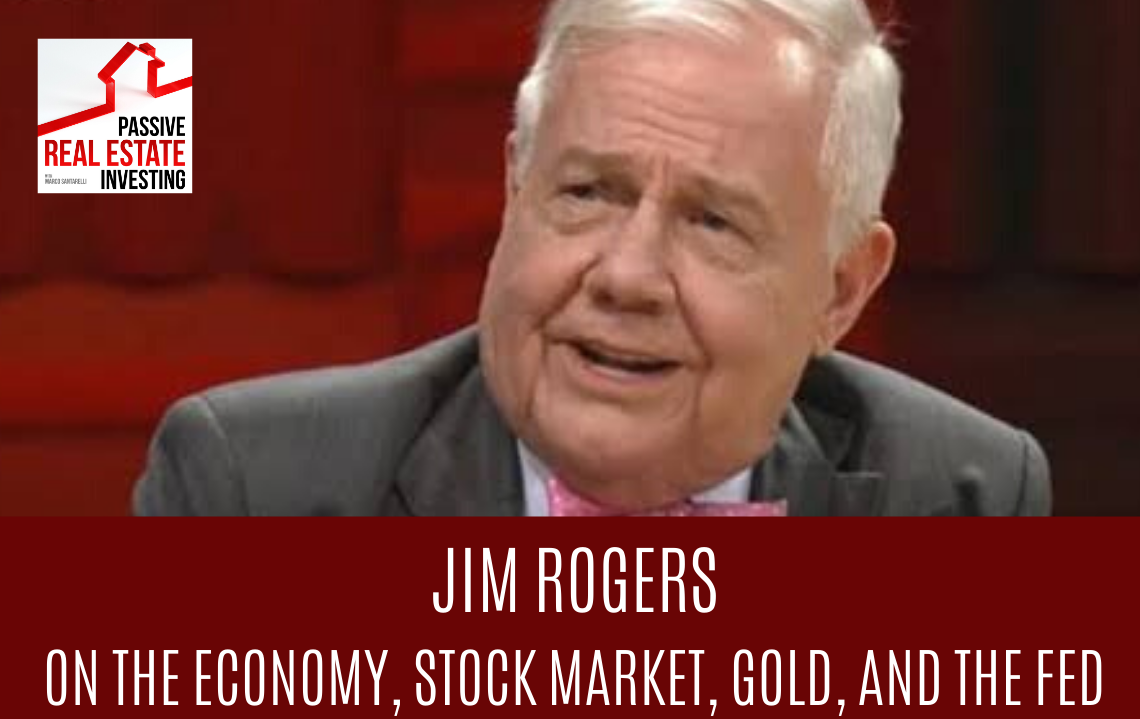
I’m your host Marco Santarelli. Well if you are watching this on video, you can see the windows behind me in my office here are completely black. And the reason for that is it’s 2:05 am Monday morning early in the morning. So the reason I’m up so late it is because I just finished an interview with the one and the only Jim Rogers. He is one of the world’s greatest and most renowned investors. Jim is the guy who co-founded the Quantum Fund with his partner George Soros. And he established a very strong reputation as an authority on investing and the markets he recommends saving money, cultivating good habits, working hard, studying and thinking about the future. And it’s because of this that he had such tremendous success. And I actually suggest you go and look him up. Um, you can go to his website, it’s jimrogers.com, but if you look them up on Wikipedia among other websites, you can learn a lot about his, uh, supposedly net wealth.
I think his net worth as much higher than what’s stated on a lot of the public websites, but, he’s extremely successful. He lives in Singapore. Uh, and this was just a great interview and a must-listen for a more macro and global perspective on investing in the markets. And for those of you listening to this and are sitting heavy in the stock market, you might pick up a few insights from my interview and my conversation with Jim. You know, one of his quotes is I don’t think I own any US stocks and if I do, it’s very few, so few, I can’t even remember. So maybe that’s a hint, but I think it’s worth listening to what he has to say. And he’s gotten many great books out there. So you’re going to enjoy this interview with Mr. Jim Rogers, the one in the only, and we’ll be right back after this message.
Download your FREE copy of: The Ultimate Guide to Passive Real Estate Investing.
Identify great tenants using SmartMove. Visit www.TenantScreening.com and Save 25% using podcast code NORADA25.
Try LandGlide FREE for a week by visiting www.LandGlide.com/PassiveInvesting
—
If you missed our last episode, be sure to listen to Market Spotlight: Kansas City, Missouri
Enjoy the show!
– – – – – – – – – – – – – –
Download your FREE copy of: The Ultimate Guide to Passive Real Estate Investing.
Get your FREE coffee mug by leaving us a Rating and Review on iTunes. Here’s how.
See our available Turnkey Cash-Flow Rental Properties.
Please give us a RATING & REVIEW (Thank you!)
SUBSCRIBE on iTunes | Stitcher | Podcast Feed
It is my pleasure to welcome Mr. Jim Rogers to the show. Jim is an American businessman and financial commentator based in Singapore. You’ve probably seen or heard him on the media. He’s a frequent guest on radio and TV including worth Fox News and CNBC. He was the co-founder of the Quantum Fund, a global investment partnership where over a 10 year period, the portfolio gained an amazing 4200% while the S and P 500 rules, just a measly 50%. He has established himself a great reputation as an authority on economics, investing in the markets. And Jim is also the author of a number of great books, including A Bull in China, a Gift to My Children, and more recently Street Smarts to name a few. Jim, welcome to the show.
I’m delighted to be here, Marco, or we don’t need all that introduction. Let’s just go.
Well, it’s an honor to have you on the show. Jim. You know, you have a very colorful and successful life and many people admire you. I’ve been following you for years. Um, you know, some people might chuckle, but you literally started by selling peanuts at the age of six.
I did indeed. Actually I started at the age of five picking up the empty bottles at the games. Oh wow. Then I started my own business when I was six. So yes, yes. It’s been a long story.
So you, you’ve had a long journey and I’m sure we could fill hours about, you know, your, your life’s journey as a businessmen investor. Can you just kind of give us a 40,000-foot view so our listeners have some perspective of your life’s journey as a businessman?
Well, after college and after the army I went to wall street. I had a successful career. I, I made more money than I knew existed in the world. remember Marco, I grew up in a small, poor town and a small, poor state in that Alabama. So it didn’t tell you much money to dazzle me. I retired when I was 37 because I always wanted to have more than one life. I wanted an adventure. I went around the world on my motorcycle, which had wanted to do for a long time. And then I went around the world in the car, cause it wasn’t enough on the motorcycle. And now I live in Asia. I have $2. I never wanted to have children. I thought children were a horrible waste of time. I used to feel so sorry for all those SAPs who had children. I was wrong. I was totally wrong about children. So now I live in Singapore so that my children will know Asia and speak Mandarin and here we are.
Oh, that’s amazing. Another amazing thing is you set, not one, but as far as I know, two Guinness world records and you’ve traveled around the world on a motorcycle, you’ve covered six continents and then the second time you went around the world you hit 116 countries. I’m curious just what inspired you to do such a thing?
Oh, is actually that would, that was my third Guinness record going around the world in a car when I was in university, I’d set up or get we my rowing team, da set a Guinness record at the Henly Royal Regatta, but that was a long, long, long, long, long time ago. Marco. No. Ever since I remember I wanted to see the world. You know, I grew up in the backwoods of Alabama. I once remember saying to my 16-year-old girlfriend, gosh, I’m 16 I’ve never been anywhere. And she said, Oh, I’m 16. I’ve been to Birmingham, I’ve been to Montgomery. I’ve been Mobile for she was concerned, she’d seen no before, whatever reason had a wanderlust. My wife says I’m a gypsy. Uh, I wanted to see the world for as long as I can remember.
Wow. So kind of just to kind of start to sink our teeth in here onto some of the things that I know I’m curious about and other listeners are, you know, more and more people today are expressing concern about the US stock market and the economy in general. And I think you might agree with me that we’re overdue for a correction or even a recession. At least that’s how I feel about it. Do you think we are on borrowed time right now or do we still have a ways to go?
Well, Marco, we have the longest, uninterrupted economic expansion and stock market expansion we’ve had in American history. So we’re certainly not at the beginning of good times. Uh, we’re certainly overdue, but I mean, who knows, maybe we’ll go 20 years. It doesn’t have to end after 11 years. Uh, or even after eight years, which it usually did in the past. I suspect we’re on borrowed time. The central banks around the world led by the American Central Bank have driven interest rates to the lowest level in recorded history. Never have they been this low. People have been borrowing staggering amounts of money in the last 10 or 11 years. Everybody’s talked about austerity, but nobody’s practiced austerity. So you give me a trillion dollars and I’ll show you a good time or coal. That’s what’s been going on. You know, the American government deficit this year, their trillion dollars, that’s what the T, not with a B. That’s with the T so of course people are having a wonderful time and the central banks around the world are printing huge amounts of money. The Japanese central bank has said, we will print their word unlimited amounts of money and every day they go to work, print money and buy stocks, buy bonds. I mean, this is all insanity. It’s going to end someday. And when it does, we’re all going to be very, very sorry.
Well, I agree with you. I mean for the past 10 plus years, the fed has just been printing staggering. It’s a mouth, amounts of money and it’s, I mean, they’ve just kept pushing rates down lower and lower and longterm. That’s just not gonna work. I mean, the bottom line is, is that there’s gonna be a terrible price to pay. None of us have a crystal ball, but I’m going to throw questions out at you that you know, allow you to look into the future, but what’s the price that we’re going to ultimately end up paying with this loose monetary policy?
Well, at one point, Marco, the previous head of the Central Bank in America, her name was Janet Yellen, said, go, don’t worry. We have it under control. We’ll never have hard times again, sorry to laugh. But if you book now, by the way, she has a Ph.D. in economics from Yale University. Whew. Wow. So maybe you should listen to her. I on the other hand, no, she’s wrong. No, we are going to have hard times again in the world. They’re already starting in some parts of the world. It always starts when you’re not looking at a small place and it works its way until finally it’s on the evening news or you know, maybe even Marco Santarelli talking about it eventually when it gets that big and that’s what’s going to happen. The price. Well, you know, in 2008 we had a problem because of too much debt. Marco, since then, the debt has skyrocketed everywhere. So it’s going to be the worst economic times of my lifetime and I can tell I’m older than you, so it’s going to be the worst of your lifetime too. You should be worried. You should listen to Marco Santarelli and listen to other people who were urging you to learn what’s happening.
Well, I, I agree with you. I mean in 2008 the problem was simply just too much debt. And since then the debt has just skyrocketed. Not just in the US but all around the world. And you know what, what do you think the next bear market is going to look like? I’m sure it’s going to be catastrophic, but how, how bad is bad?
Well, it’s going to be worse than 2008 and 2008 was pretty bad for many, many, many people. Uh, you look around the world, American stock market right now is at an all-time high. So if it goes, goes down, you know, 50%, which is normal in a bear market, uh, at least it’s going to be horrendous. But it’s, you know, other markets are going to get hit very badly in Germany. Now you even have cities which have problems. Germany, Germany, I didn’t say Italy, I didn’t say Spain. I said, Germany, you know, you’re having problems all around the world now, so it’s going to be horrendous and be worried
And there, and Germany is the engine of Europe. I mean, if, if they’re in trouble, then Europe’s really in trouble.
Well, in my lifetime, the Germans for historic and, uh, many historic reasons, uh, have usually been a paragon of virtue as far as debt and place, things like that, overspending. Even the Germans. Now, even, you know, in 2008, we had a problem. The Chinese had a lot of money saved for a rainy day. It started raining, the Chinese started spending their savings and help save the world. Now, now even the Chinese have a lot of debt, so I don’t know who’s going to save us next time Marco.
So a lot of our, most of our audience are US-based and you know, they’re, they’re thinking, Oh, I have a lot of money in the stock market. How bad could it possibly be? A correction, there’s probably gonna be a big correction. Do you see a lot of parallels with the 1920s,1999,2008 what we’re going to see going forward? Or is this just going to be on a completely different level?
Well, I, I’m afraid it’s going to be on a completely different level. You know, in the, in the 30s we had a, on the 20s we had a gigantic Mar stock market bubble, um, which got out of control and then governments started trade Wars, huge straight Wars in America. 2000 economists took out an ad in the newspaper saying, don’t pass trade Wars. Congress passed it anyway. And you know, you know, the rest of the story, if worse, depression, war, et cetera, uh, I’m afraid it looks more like that than anything in my lifetime. But if it’s anything in my lifetime, it will certainly be 2008 was caused by debt. Well, debt everywhere has gone through the roof. There are other problems. We now have trade wars, which we haven’t had since the second world war. You know, the second world war after the second world war, everybody said, we’re never going to do that again. We’re never going to have trade wars to ruin the world. Well, read the newspapers. You’ll see we’re starting to do some of those things again. And I wouldn’t even gotten to shooting or worse yet. We might even have shooting wars again.
And actually my fear is, is a lot of people, including Gerald Celente will say that you know, trade wars lead to hot wars, which is essentially just, you know, uh, an all-out war. And, uh, I, I don’t know if that’s the direction we’re headed, but it actually concerns me.
Well, it often has throughout history that when people start getting into trade Wars, you have economic hard times. And when you have economic hard times, politicians always love to blame the foreigners and you blame the foreigners for all your problems. Easy to blame the farmers. They have different languages, different religions, different food, different skin. I cannot tell you how many times I’ve heard people say, and their food smells bad. They fast, food smells bad. You know, it’s easy to blame the foreigners. Uh, politicians love to do it. Politicians aren’t going to say it’s my fault. So no, it often is led to shooting wars. I’m just this, I’m not, this is not a prediction. I’m just telling you what’s often happened in history and it’s pretty simple to go and read history.
So I, I guess it goes without saying, and I’m, I’m, I’m sure I know the answer to this, but I assume you’re bearish on the US dollar.
No, no. I own a huge, I own a lot of US dollars. The reason I’m, I own the US dollar having just told you America’s the largest debtor nation in the history of the world and we’re going up by a trillion dollars a year, at least a trillion dollars a year. Uh, I own the US dollar because when turmoil comes, people look for safe havens. Now the US dollar is not a safe haven, so I just detonation in history. But people think it’s a safe haven. And as they look around, where are they going to go? There’s no place else to go for the most part. So I own a lot of us dollars on the expectation that during the turmoil, the dollar will get overpriced because people are not going to rush into the British pound or you or even the Euro and cannot buy the Chinese money. Maybe the Japanese Yen, but it’s getting terribly priced. At least the economy is so I own the dollars on the expectation, it will get overpriced depending on how bad it is of Marco, it might turn into a bubble. I hope I’m smart when that happens. To sell my dollars and put the money somewhere else. See how easy it is to get rich, we just did it in 30 seconds.
Well speaking, speaking of wealth, I believe that I know you’re a fan or probably a big fan of gold and silver as am I. And I really don’t consider precious metals to be an investment simply for the fact that they don’t generate cash flow. I’m all about cashflow. I love cashflow. That’s why I’m in real estate. But I do see them as a hedge against inflation and preservation of the purchasing power of, of your wealth. Are you still bullish on gold and silver right now? And if not, why not?
Oh, I own gold and silver, but I haven’t, which I have for years. I’ve never sold any of my gold and silver. I have a bone, any serious gold for since 2011. I’m waiting. I haven’t sold any. Don’t worry. Uh, I’m waiting. If the world evolves away, it might go off and goes down and silver often goes down and you know, big, big drops, big crises, uh, at usually a great buy when that happens. And my plan is that if, and when gold and silver go down again, I will buy a lot with next time around. You know, whenever people lose confidence in money and lose confidence in governments, they have always gone to gold and silver, whether they should or not see the relevance. That’s what they do. And they will again.
I hate to ask you this question, but uh, is there a target price you’re looking for with either gold or silver?
Well, I’m Marco. I’m a horrible market timer. I’m the single worst trader in the world, yeah, under a thousand. If it goes under a thousand, I would probably buy it a lot. But depending on what happens, I mean if America goes to war or the ran, would we buying it at 1700 and begging for more. It just depends, on how the world evolved.
Well, I guess the flip side of that is, is this question, what asset classes are you actually bullish on right now?
Well, uh, agriculture I’m bullish on, you know, sugar, for instance, is down 80% from its all-time high, but that’s not a typo. Its sugar has been a total disaster for a long time. The average age of farmers in America’s 58, the average age of farmers in Japan is 66. I mean, the highest rate of suicide in the UK is in agriculture. Marco. It’s a nightmare. It’s a disaster. Uh, well usually it has been. It’s been that way for a long time. Usually, if you get involved in a disaster, especially one like that, people have to have you use it comes out okay in the end, uh, I’m buying some Russian shares as we speak. Uh, beaten down Russian shares. Uh, Russia’s hated, I liked to buy, I mean America’s Mart stock markets at all-time highs. I don’t like to buy things at all-time highs, but Russia’s hated. So when I find something that is beaten and hate it, I look for opportunities.
So you mentioned farmers here, I’ll take you back to 2012 for a moment here. You had an interview with Forbes magazine back then, and I might paraphrase this a little incorrectly, but you said there’s going to be a huge shift in the American society, American culture and in the places where one is going to get rich, the stockbrokers are going to be driving taxis and the farmers are going to be driving Lamborghinis. The smart ones will learn to drive tractors so they can work for the smart farmers. What exactly did you mean by that?
Well, just what I said, you know, agriculture has been a nightmare. Uh, and throughout history, we’ve had long periods when it produces a real good. So you’ve been on top followed by long periods when the producers, financial types have been on top, followed by long periods. Again, when that produces real goods have been on top, it doesn’t have to happen, but it’s all, it’s happened throughout history. So it probably will happen again. Uh, but it has been a wonderful place for 30 or 40 years now. Agriculture has been a terrible place for 30 or 40 years, that usually doesn’t, it never has lasted forever. So I would be looking now, if you don’t like living in this city and you’d like to say, you might think about starting a new life, you know, learn to drive a tractor. Uh, if you happy lives day internet stay, I see it in print as what it was a horrible place to be and had some success so you can succeed in horrible environments, but it’s easier when you have the wind at your back.
Yeah, no, I agree. So let’s assume for a moment that, um, a correction or maybe a, um, us stock market crash is inevitable. It’s not a question of if it’s going to happen, but when it’s gonna happen and that often has a trickle-down effect into all the parts of the economy. If and when that happens, what do you feel the overall effect would be on, uh, real estate in the US
Well, Marco, interest rates have never been this low in recorded history, right? Interest rates are the lifelong event of a critical with no credit and interest rates. Interest rates are going to go higher and if they just go back to normal, I mean you don’t have to ask me, you know, what’s going to happen if interest rates go back to normal. There are a lot of people who with property and real estate who are extended, maybe not overextended, but extended, and the ones that are overextended are really gonna solver. And Marco, even if you are not overextended at in property, your neighbors are, and when your neighbors have to dump, that affects your property. Even though you’re perfectly solid, you have no debt, you’re no, you’re sitting there with a smart outlook on life. But your neighbors, they made mistakes and now they have to dump. And so that affects your property as well as everybody else. Yeah.
So we’re not, you’re talking about property values, not so much necessarily the cash flows from those properties or the yields, but certainly the market value.
Well, yes, so the market value, but unfortunately, that affects a cashflow because when people going bankrupt or meaning forced to close their offices or their shops, cashflow would diminish as too because you know, people, can I keep this shop going? Can I keep his office going? He has to reduce the number of people. Yes. Uh, that’s the way the world has always worked and I don’t think it’s changing. Uh, even going visit Yellen says it is okay now.
Right. Right. So, Jim, just a few more questions here. I do want to mention one book I think is an incredible book that you’ve written in. This happens to be a nonfinancial book in many ways and it’s a book you wrote called a Gift to My Children, a Father’s Lessons for Life and Investing. I think that was brilliant. Uh, you have two girls. Um, and congratulations on that. I have a 12-year-old daughter and I’m trying to take her around the world to see the world. We’ve been to Shanghai twice. Um, we’ve been all over Europe. I mean we, we travel and one of the chapters in your book is talking about see the world, don’t just read about it. Um, why did you write this book? What was your, what was your goal?
Well, I kept thinking of things. I wanted to make sure I taught my children. You know, I had my first child when I was 60 Marco. And so I said, well yeah, it may matter better. Make sure she gets all of this. So I started writing down things I wanted to make sure she learned. And actually it started, the Japanese magazine started publishing these things. I wrote down for my daughter and they decided to make it a book. And so I said, well let’s do the whole thing. Turned it into a book for my daughters to make sure it was written down. And for what it’s worth, I’ve recently revised it. It’s a much better book now. It’s been read, it’s been published in Japanese, Korean, Chinese, I guess into English as well before long. But it’s a much better book I’ve got, cause I’ve learned more.
You since I’ve been a father and since I’ve gotten older, I’ve learned more things about life. For instance,, I explained it to him. Don’t get a tattoo. Tattoos are hot right now. Very hard. But I know a doctor in Singapore who spends his whole practice removing tattoos. Wow. People come from the tattoo borrower help. What have I done? So I’ve, I’ve just, there’s some of the lessons that I learned as I’ve gotten older, uh, that I’ve added in a new book. Hope freedom come out in English too someday, right? [inaudible] great. It’s just I’ve learned more.
Yeah. I have the first edition. I didn’t know you had a second edition to it, so I’m going to have to update my, my copy of it.
Well, you have to be able to read Japanese, Chinese, or Korean at the moment.
Got it, got it.
It’s only most three languages so far,
Jim. So let’s, let’s wrap up with three quick questions here because always curious to ask people who have your level of success, who their greatest mentor was. Who did you learn from? Who inspired you?
Well, I’m, I’m afraid I don’t have, an answer to that question. It’s something I’ve thought about and I wondered. I just, I don’t, my parents taught me, you know, you have to work hard, did money is hard to get and you have to save your money. I’ve tried to teach my daughters one of the first, I got them all six, piggy banks when they were born. And I wanted them to learn that money is to be saved, not to be spent. Guess I probably got that from my parents. it’s better to save for the future and I, as I say, I got you six. I’m not trying to teach them these currency speculators. I just want to know that all monies there is different money and all of it should be saved before it spent. But I don’t, I’m afraid I don’t really have an answer.
Can I push back on what you just said a little bit? So I had the same advice here. We’re doing an interview. That’s what you’re supposed to do. All right. So I, I had similar advice from my grandparents and, and I think before 1971, that was good advice because we were on a gold standard, or at least, you know, the partial gold standard. But, uh, when we went off the, uh, the, uh, gold standard and now all currencies became free-floating, we be, we entered in this phase of inflation. And so saving for the sake of savings just mean means that you are, um, losing purchasing power on your, uh, on your, on your cash. So I believe savings should be for the sake of redeploying that as quickly as possible into investments that generate a greater rate of return than the real rate of inflation. So I, I’m not a believer in saving other than emergency capital. Do you feel the same way or am I off on that?
Well, there’s nothing wrong with what you just said, especially at inflationary times. The past few years we’ve had inflation. I mean, governments lie about it. They love to lie about it because it’s to their benefit to lie about inflation. But no, of course. But my children know about gold and silver. They have gold and silver coins. I mean they’re 11 and 16 but they know about gold and silver. They know their family, their mother and father, and they have gold and silver and they know that you know, sometimes you have to invest. I’m not trying to teach them investment now Marco well and waiting for them to come to me and say, Oh, tell us what this is all about. I have learned people who don’t want to learn something, who are forced to usually don’t learn very well. Well people who are eager to learn something are very keen and they learn it much better. So even when they come to me and so what is this thing about stocks and investing and what are you talking about? Then I plan to teach them.
So would you say saving was the best advice you ever received? Or was it, was there some other advice that you would say is the best advice you’ve ever received about investing?
Well, I, yeah, well I guess to take that another step, but the best advice is figure out, figure out the money. And you’ll figure out what’s really going on in the world. Don’t listen to the TV and the newspapers and the politicians especially. Don’t listen to the politicians. Follow the money flow and whether it’s investing or current affairs or life, you will learn a lot more about what’s really happening. If you can figure out who is going to get the money and how they’re going to get it, you’re more likely to be successful or at least survive.
So for the tens of thousands of people who are going to be listening to this here in a few weeks, what, what is the one attribute that you believe every investor should have?
Uh, be careful to be precise. Do not invest in anything unless you yourself know a lot about it. Don’t listen to me. Don’t listen to the TV. Don’t listen to the news. But maybe Marco you can listen to, but don’t listen to anybody unless you yourself know a lot about. If you want to be successful as investing in anything, you stay only with what you know. If I told you you could only have 20 investments in your life, Marco, you wouldn’t be jumping around. You wouldn’t listen to the latest hot tips or your friends or anything else. It would be very, very careful about what you invested in. And if you invest it, if I told you to buy X and you bought it, you wouldn’t know what to do. You wouldn’t have to do if things go right, you wouldn’t know what to do if things go wrong, because you don’t know why you bought in the first place.
So if you want to be a successful investor, all you have to know is don’t listen to other people. Stay with what you yourself know. And if you don’t know anything to invest in it at the moment, just wait. One of the best attributes of a successful investor to do nothing, do nothing when there’s nothing to do. Don’t be jumping around. I know people who make a mistake, they lose motors. Hell, I’ve got to, I got to do it again. I gotta, I gotta make up my losses now you don’t. You don’t have to make up your losses. And that’s a dangerous time. Just sit quietly, sit quietly until you see money sitting over there on the corner and you know it’s going to work and all you have to do is go over and pick up the money. Right? That’s what you need to know. That’s all you need to know. Marco, if you’re going to be a successful investor.
Sage advice, Jim, I appreciate that. Well, Jim, Hey, thank you so much for taking the time to come on the show today. I greatly appreciate it and I know everyone’s going to appreciate your words of wisdom. Quickly tell our listeners how they can learn more about you. Where can they follow you and find your great books other than Amazon?
Well, my books are on Amazon. They can be ordered from bookstores in Japan. Yeah, I have actually, I, it’s a bit of a shock to me. I have two number one bestsellers in Japan this year. They’re only in Japanese and Korean. Oh wow. This happened on what’s wrong with the Japanese? Literally two, number one best sellers in one year and a big country. It’s about the problem. The upcoming problems in Japan. One of the books is called A Warning to Japan, but I mean most of your viewers don’t read Japanese or Korean or our Chinese. Uh, I don’t have any English books at the moment. New ones I give to my children obviously is one of my favorites. Um, but I’m not really trying to sell anything. Marco, I have very good things about you, so I thought I’d do, I should do this show. Well, I really appreciate that. So thank you ever so much for coming on the show. You’ve been, you know, a wealth of wisdom and, uh, I hope to do this again in 2020.
Okay. Thank you Marco. Bye. Bye. All right, sir, thank you very much.
– – – – – – – – – – – – – –
Download your FREE copy of: The Ultimate Guide to Passive Real Estate Investing.
Identify great tenants using SmartMove. Visit www.TenantScreening.com and Save 25% using podcast code NORADA25.
Try LandGlide FREE for a week by visiting www.LandGlide.com/PassiveInvesting
Get your FREE coffee mug by leaving us a Rating and Review on iTunes. Here’s how.
See our available Turnkey Cash-Flow Rental Properties.
Please give us a RATING & REVIEW (Thank you!)