
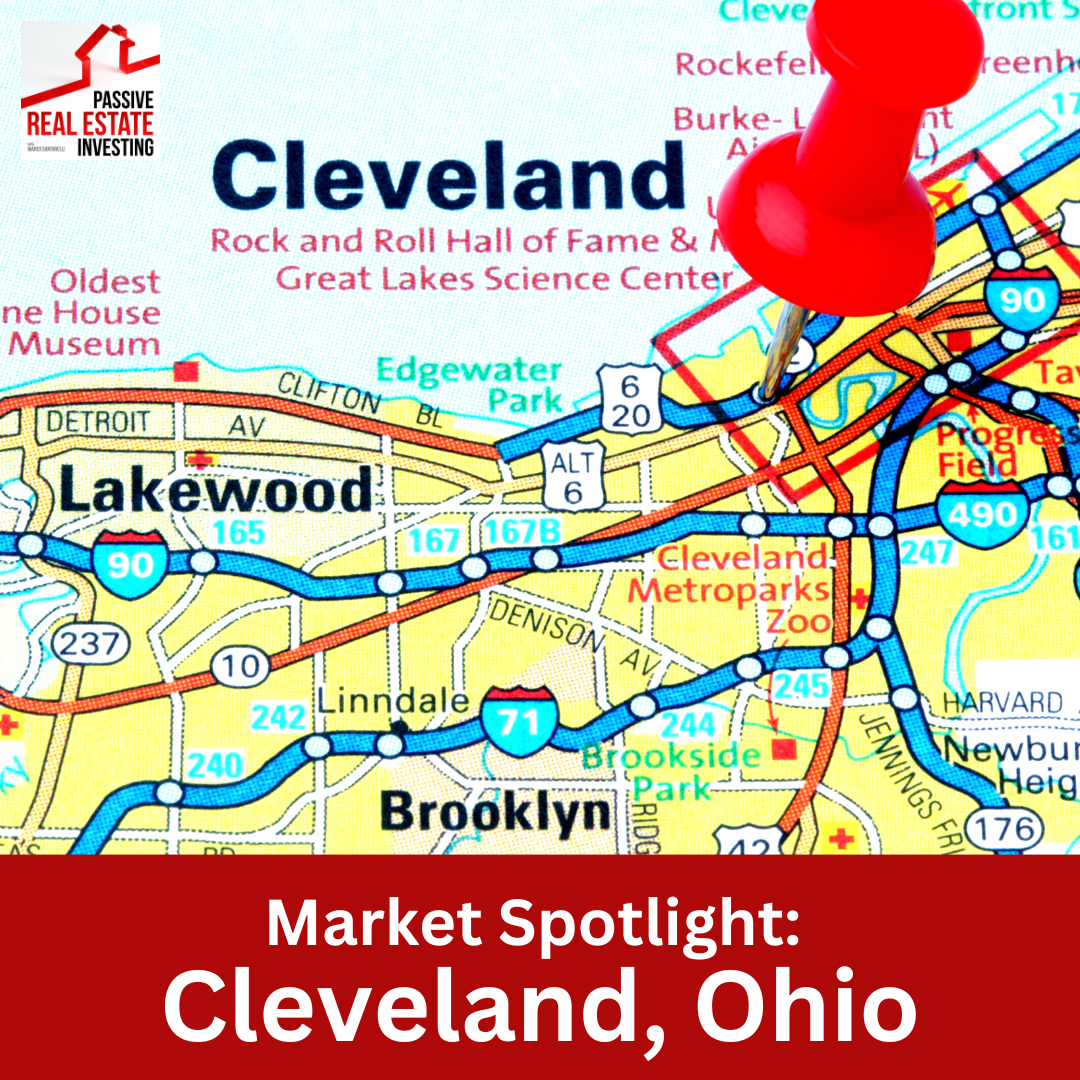
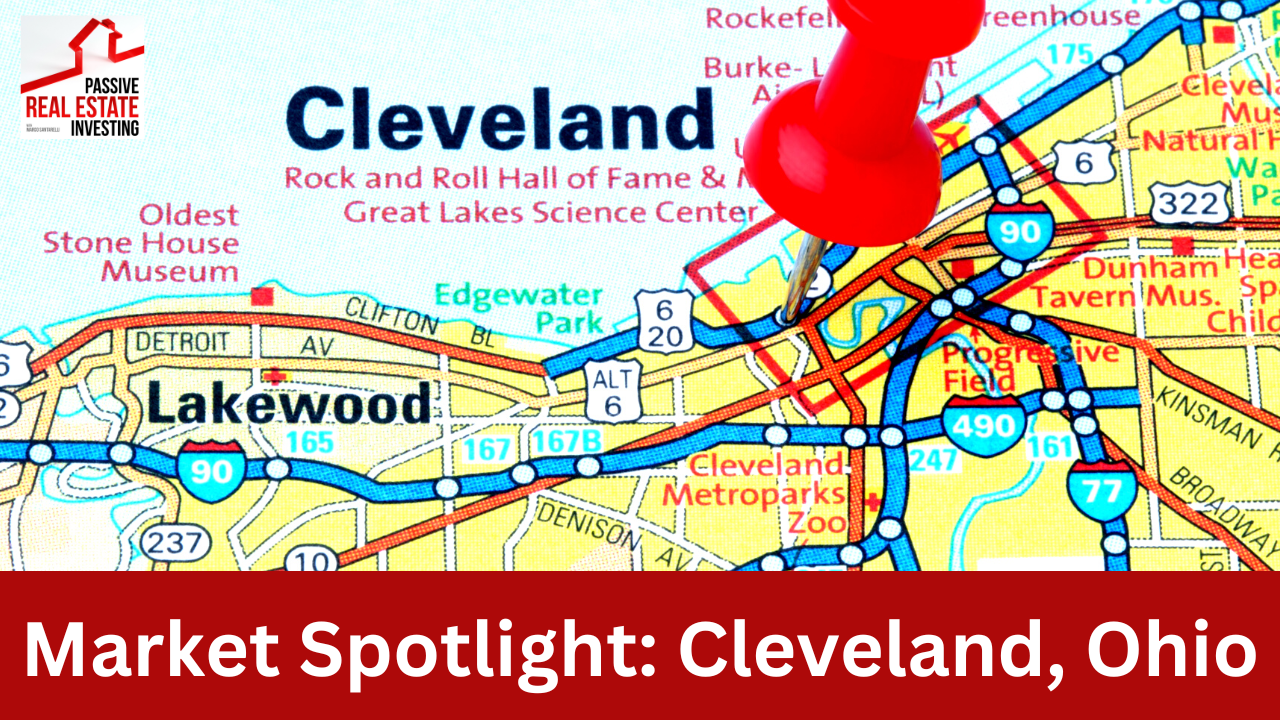
Hello and welcome to another episode of Passive Real Estate Investing. I’m your host, Marco Santarelli. You know, it’s been a while since I did a market spotlight episode and I think we’re overdue. In fact, I recently had a few people tell me, Hey, you should do another market spotlight. So we’ve got two being queued up and I’m doing one interview here today with Tom, one of our property providers, fantastic property providers in the Cleveland, Ohio Metro. And so we’re gonna talk about that market and the opportunities available to you there. My goal is for you to have a better understanding of the Cleveland Metro and why it’s a good market for investing purposes. So I guess let’s just jump right into it.
FREE copy of The Ultimate Guide to Passive Real Estate Investing.
If you missed our last episode, be sure to listen to How to Have it All – Kris Krohn
Tom, welcome to the show.
Hi. Thanks for having me.
Well, it’s great having you on. I, I know you’ve been providing us some good quality product, and one of the things I like about your companies is they’re vertically integrated. You not only find the properties in the right neighborhoods, meaning it’s the acquisition, but you do all the renovation work and also you have a property management company full service. So you hand the property off from one department and company to another, and you’re very close, if you will, to the properties that are available for investors a around the country and wherever else they may be. So let’s kind of start high level. I always like to ask the question, you know, why invest in Cleveland? And maybe you can kind of give us, you know, however subjective or objective answer you want.
I was born and raised here, so I have to tell you, it’s probably one of the better cities in the country. But other than that, you know, property wise, I think we have a consistent and steady growth here, appreciation, steady, we’re not going straight up, so we don’t have the fall or drop off ever. So I believe the steady growth is the answer there.
So it’s a big city. I’m not exactly sure what the population is, but what makes up the economy? I always like to look at markets in terms of how diversified the sectors are within the economy, you know, so it’s not a, quote unquote one trick pony market like, you know, heavily weighted on oil and gas. And when that fluctuates or you have an economic change or recession related to that particular sector, it affects all the people within that market because there are layoffs and it’s got a trickle down effect from, you know, the primary industries to the secondary and tertiary industries. You don’t have that in Cleveland. You have a pretty broad and diverse economic pool, if you will. Maybe you can talk a about that for a minute.
Absolutely. So, you know, historically we’re a very blue collar town manufacturing the steel mills, things like that. However, you know, through the recent decades we’ve taken more of a shift to the, to more of a white collar industry such as banking, hospitals, you know, a a lot of financial institutions are here.
Yeah, that’s pretty interesting. What do you think is driving that diversification? Is it just because real estate is relatively speaking cheap there and, and industries and companies and corporations want to move there? Or is there something else driving that?
You know, I think a lot of it is that, you know, for example, like the Federal Reserve is one of the federal reserves is here. And so I feel a lot of the banking institutions like to surround themselves around that. So we have some larger banks headquarters here along with some, some other industries like Sherwin-Williams, progressive Insurance that, you know, again, are, are heavily white collared businesses. And I think, you know, there’s just the cost of living’s low. It’s easier, I think on employers to get more cost effective employees for that matter then.

Hmm. Yeah, I never thought about, you know, wages cuz obviously human resources and salaries are a major expense for most companies. So if you can control your labor costs, it makes a lot of sense. I guess that’s one of the reasons why so many companies move out of California, two other states like Texas and wherever else, because it’s just not only less expensive, lower taxes, lower real estate prices and human resource costs are, are lowered, especially if you have hundreds of employees, that’s a, a massive saving. And that has actually been a big draw for in the state of Texas. You know, it’s just those factors pulling people out of California and places like that. A lot of markets around the country have been seeing tremendous price growth over the last several years, which to a large degree has been an anomaly, especially in 2021. We’ve seen on average nationwide, you know, 20% appreciation rates, which is unheard of unsustainable. Now we’re seeing, you know, a correction of pullback in most markets, but even rents, rents have been growing tremendously. What have you been seeing in Cleveland? More so on the rent growth side, not so much the price side.
You know, I think it’s similar to the question we opened with, I mean, it’s just a steady appreciation and, and increase. There’s no, no like straight up, you know, like the, the rents I feel are are, you know, would increase ’em $50 a month or year to a hundred dollars a year depending on the property. And I could look back two years and see something that was rent is rented for eight 50 a month now is being, or was rented for six 50 about two or three years ago. And I think we’re gonna stay on that again, steady and consistent growth and, you know, for the rents and appreciation of the property.
Yeah, that’s interesting. And it’s not even an expensive market. I have a tool which I’m hoping to repackage and make available to our audience and our clients, but it, it actually ranks every market out of a pool of about 405 markets where a market stands relative to others. So it’s a relative scale, not an absolute scale. The median house cost in Cleveland is 69%, which means that on a scale of zero to a hundred, amongst those 400 and so markets, the housing cost in Cleveland is 69th, if you will, of all the markets in the country. The other things I look at in this tool is a cashflow potential of the market that’s a 57%, which is very good because it means that it, it’s a market that will allow for cash flow. You know, if you were at the bottom of the list, it wouldn’t work.
But, you know, that’s a San Francisco, a San Jose, you know, one of the many coastal markets. Rent growth hasn’t been, according to our tools, rapid or strong as other markets, but it’s been very consistent and the rent growth is 32% that, that sounds like it’s low, but it’s actually not. That just means that the rent growth is there, but it’s been smoother and steady. It hasn’t been like a rollercoaster where it’s been spiking up. So in terms of national rankings, Cleveland is, is very healthy and attractive. So you’re in a good market and I, I like that because it’s to me it’s kinda like I I jokingly say that boring markets are some of the best markets. You know, I used to say that about me, Memphis, you know, Memphis, Tennessee, and other places. So there’s nothing wrong with that. You know, if, if you’ve got stability, it’s a place to invest you, you’re protecting your capital, you’re taking advantage of, you know, the tax benefits, you’ve got that cash flow, and then you’ve got the equity growth that happens year after year over time, that happens naturally and organically. But also when there are drivers in a market, you know, you tend to see stronger gains. What else do you want to comment on, if anything, about the market, the economy there? You know, I always like to kind of look at big picture, what I call fundamentals and then zoom in.
You know, same as what everything that you’re saying, I, I think we’re on a, a path of just consistent and you know, moderate growth and it’s good. We see some, some new industries coming in, some new businesses coming in that are, you know, gonna allow for that continued growth. You know, as far as like, we we’re really big on ho, you know, our hospitals, the Cleveland Clinics world renowned they’re, they’re constantly expanding. Sherwin-Williams is building a, a new corporate office. You know, all, all those things are, are factors into helping that consistent and steady growth.
Yeah, interesting. So in terms of the, the areas, or you might call them sub-markets or even neighborhoods, which is what I like to focus on, where are you focused on, in other words, where are your acquisitions and renovations speaking in terms of neighborhoods, of course.
Yeah. So Cleveland you know, we’re, we’re on the lake and so basically this, the city’s split in half. You have your east side and your west side, and then you have some southerly suburbs. The east side of Cleveland, you know, is a little bit tougher side of Cleveland, has some good pocket neighborhoods because of the university and the hospital over there. But because it’s a tougher neighborhood, those communities or sub-communities, you know, they have you know, point of sales and they just make it harder on a landlord to do what they need to do over there. Whereas the west side of Cleveland, I feel there is you know, it, it you don’t have the point of sale on the near west side in the metropolitan area. You also don’t have you know a, it is just a better community in general. There’s a lot of pocket neighborhoods that are you know, up and coming and that sort of thing. So I’ve seen a lot of appreciation over, over the past decade and a half on what we call along the shoreway. It’s gone from being, you know, a tougher neighborhood to becoming one of the most highly demanded neighborhoods in Cleveland, where we have a lot of young professionals wanting to buy, you know, even more expensive houses than, than we see in the suburbs.
And so where are you spending most of your time and energy?
Yeah, so, so I, I focus mainly on the west side. In previous years, I would like to say I was a pioneer in what we call the Detroit Shoreway. I did a lot of new construction, high-end remodels for those young professionals and what have you. Since then I’ve been working more so on building out a portfolio on the near west side, which is more of a rental community where you have a lot that study and consistent growth. And I, I can see, you know, just how the city’s growing that these neighborhoods are on the fringe of, you know, being very highly demanded neighborhoods.
So Tom, you, you might have already answered this next question in whole or in part, but I’m, I’m just gonna throw it out there anyway. If I were looking to invest in Cleveland, or if I were you looking to invest in Cleveland, what areas or neighborhoods would I want to focus on? In other words, what would you suggest or recommend in terms of focus, if I am looking out five to 10 years in terms of stability, but also appreciation potential?

So again you know, not to steer everyone to that, that neighborhood, but yes, the west side of Cleveland that ha I, I feel that’s where you’re gonna see the most appreciation. Sure, there’s gonna be pocket neighborhoods in other parts of the city, but I feel overall th that part of Cleveland is just gonna consistently improve and only get better. And that’s why I’m focusing on all my efforts there. And we’re, we’re providing a, a, a quite an inventory for that. And I, I, I would like to say as I was a pioneer in pushing values in the Detroit Shoreway that I’m gonna do the same in, in Cleveland Metro area.
Yeah. Something that obviously you don’t have in front of you, but I’m just looking at my computer screen and some of the tools that I use, which are somewhat proprietary, but I mean, you’ll find this interesting, but I’m, I’m going to talk about this just for the benefit and sake of our audience and the people listening and watching this podcast episode. So one of the things I like to look at and track is the momentum in a particular market price momentum. So again, you know, on a ranking system, if you looked at what I have here as a master score, which kind of is a mashup of all the things I track, a year ago, Cleveland ranked 99 on a scale of zero, well one to a hundred. So it was actually at the top of the list of the 405 or so markets that we track.
So it was right up there. It was just a highly performing market. Two quarters ago, still it was at 99. Currently, a lot of things have slid down just because of rapidly rising mortgage rates. Plus now we’re in, you know, the holiday season, it’s like q4. So right now, you know, things have slowed down, the momentum isn’t quite as strong. And so, you know, we clock it at 55. But you know, what’s interesting is if I look at the momentum scores, it still ranks 95th as a percentile across all the markets that we track across the country. So Cleveland still has a lot of market momentum behind it, which just translates to this, we’re gonna still see continued price growth and appreciation in that market, which is great as an investor cuz you want those appreciation gains At the same time, you know, rents are actually not as growing as fast, but they are still growing.
So that helps investors investing in the Cleveland market because you’re gonna get the cash flows and those will continue to rise, at least for the foreseeable future. Rent growth isn’t that strong in Cleveland, but it is there. The last comment I wanna make, and then I’m gonna, you know, pass the baton over to you is when I look at, you know, the last 30 some years, what we track in one of our tools is wealth phases. And that’s when the market is growing strong and meaning we are seeing appreciation, not depreciation after adjusting for inflation as well. By the way, Cleveland’s interesting because we’ve actually been in a, what I call a wealth phase for the last about seven or so years. In fact, around 2014 is when we entered this strong price appreciation phase or what we call a wealth phase. So currently we’re still in that wealth phase, which means that it’s a green light, it’s a a good time to be going into that market and investing because we’re seeing positive inflation adjusted annual home price appreciation.
And that’s what we want, you know, because that’s one of the benefits of real estate is growing our net worth and equity through price appreciation. And as it sits today, and you know, this obviously changes month to month, we’re at a 5.5% price appreciation. Now it is trending down a little bit, but so what, so if, if over the next 12 months we see heck, you know, a four, four and a half percent price appreciation on average in that market, that’s still pretty good. I mean, historically speaking, it’s in that range. So that just for me personally, it just means I’m bullish on the Cleveland market. It would be a market I would seriously consider because it’s got price appreciation, it’s got cash flow, it’s affordable, it’s growing market. Anyway, I’m just throwing a lot out there, Tom, but I’m, again, I’m sharing this for the benefit of the audience because, you know, these are just tools that I look at, which I hope to share with our audience in the coming year, next year. It’s something, it’s a project I’m working on, hopefully I can get it launched. So let’s jump back to, I mean, I, I don’t know if there’s anything else you want to add in terms of neighborhoods, but if we’re done talking about neighborhoods and areas, then I’ll transition to properties. So is there anything else you wanted to add about that?
No, I think we, we’ve covered it pretty good.
So let’s, let’s kind of talk about the types of properties that you are acquiring and renovating and making available. What are they in terms of size, their single families? Are they 3, 2, 3, 4 bedroom? I mean, just describe, you know, the the mix, if you will, of investment property.
So in general, what I’ve been working to provide is is a consistent amount of property for our clients. And this year I think we’ve provided about 150 or so turnkey properties, and I’m looking to double that in 2023. And that’s gonna be a solid mix of singles, duplexes, triplexes, and, and four units because those are all gonna fall under that residential category. Now, I myself, some might ask, why are you doing such volume? Well, if I do not sell the property, let’s say in, in 90 days, then I’ll refinance it myself. So I like to stay heavily invested in the same market that I’m providing real estate, and I think that’s important, but I’m also taking those profits and proceeds and reinvesting ’em back into the neighborhood and buying 10 and 20 and then and 50 unit buildings and, and so forth to kind of push the mark all as a, a united front.
I like to say where, you know, even in apartment building versus a single family house we’re gonna have that appreciation all in the same direction. Same with the rent prices. I think, you know, kind of circle back what you’re talking about, some of the dollars of rent. You know, a lot of times when I buy a property that is distressed, I mean sometimes there’s a tenant in there and their market rent is at more or less than 50% of where it should be. And you have to have that conversation with people and say, Hey, you guys have been very fortunate, but at the same time they’ve been living in some lesser quality conditions. So we like to provide what I think is a unique product and that turnkey product that gives clients a peace of mind where they don’t have to worry about any major capital improvements.
You know, if the roof’s bad, we replace it. If it’s even old, we just replace it. Same thing with the mechanicals. If they’re over 10 years, even if they’re functioning, we replace ’em. If the panels need updated, we update ’em, we do very good renovations on the properties as a whole, kitchens bath, et cetera. Because I feel if you have a good product for rent, you’re gonna get a better tenant. A better tenant pays their rent, A better tenant doesn’t want to move, you know, and if you, if they’re not moving, that decreases turnover and therefore increases profits. So I think it, there’s huge value in having superior product versus what I like to call the backyard landlord, which is seemingly who I end up acquiring a lot of property from that is just not in good condition.
That was a great, great, I wanna say answer, but I didn’t even ask you the question because one of my biggest questions, which you just answered is, you know, what does a typical renovation look like? You know, in terms of its scope, right? The scope of work and you hit on all the major things, you know, timeframes, the mechanicals, the roof, that kind of stuff. So you, you basically answered a question that I was gonna ask you, but the fact that you have complete renovations is comforting and reassuring because we don’t want deferred maintenance that, you know, creeps up on us. We want to know that the properties in safe, clean, functional condition and the, the big ticket items are already replaced. Either they have a long life left or they’ve been replaced in basically new product. You basically hit on, on some really, really good points in terms of price ranges and monthly rents. What is that range of turnkey rental property or investment property that we’re offering through you? You know, as far as what you’re providing, what is that price range and what are the monthly rents relative to those same properties?

So it’s a term that I hear thrown around in the investment world is the 1% rule. So if I’m getting 1600 a month for, for rent the property’s gonna sell around 160,000. And you know, so that, that might vary for a single family property because here in Cleveland if it’s a single family, the tenant’s gonna pay the water sewer bill, they’re gonna take care of the landscaping and that sort of thing as if it’s their own ho their own property. We like them to try to treat it as if, if it’s their own home for, for the long term. And but I’m, I’m multi-family, you know, you do have some costs associated such as water bills and things like that. But I think it’s healthy to say we stick around that 1% rule, if that makes sense. It, it
Totally makes sense. And most of our audience are familiar with the 1% rule, also known as the rent to price ratio. What’s interesting though is most markets, especially over the last several years, that 1% rule went out the window. And, and I’ve talked about this several times, what used to be 1% in particular neighborhoods and in particular markets for many years over the last decade that kind of went out the window or started to go out the window in 2000 17, 18, 19, and especially in 2020 when property values were appreciating so much so fast, rents were lagging behind that RV ratio dropped what we used to be. 1% became 0.9. And then 0.8, the new norm, if you will, on average across many markets, many neighborhoods has become essentially like a 0.8% target. You know, that 1% rule is now a 0.8% rule. That’s ideally what you’re looking for.
Now, markets are correcting, you know, rents are either catching up or property appreciation slowing down or in some, in many markets not it’s just some markets, many markets there’s a little bit of a correction or a pullback. So we’re starting to see RV ratios trend up a little bit, so we’re getting back towards that 1%. But the 1% rule is not the be all end all. It doesn’t mean that if it’s not a 1% property that you shouldn’t buy it, it’s okay if it’s a 0.9 0.8%. It just depends on what market you’re in, what the actual numbers look like. But what you’re saying is in Cleveland, it’s not uncommon to find something at or close to a 1% rent to price ratio. Correct?
Yes. And on top of that, I’m doing everything I can by purchasing in volume and, and you know, doing this volume, I’m able to kind of keep the pricing down and, you know, we are pushing the rents. We’re, we’re doing a good job at getting those where they need to be in, in that, in that arena.
So just to go back to my question, like as far as the price range, what’s kind of the low end price and the high end price for, let’s say single families or, or I mean, you can kind of share price ranges with anything.
Yeah, so I think you’re looking at, on a lower side, probably cheapest property is probably 125, 130 upward to three, 350 depend, you know, if you’re buying a four unit in that range. So I try to give a, a variety of properties for people to choose from, cuz everyone has their personal preference. Some people love single families, some people love the four units. Mm-Hmm. <Affirmative>, some people love duplexes. I think they’re all great. And also I wanna touch back on, on the 1% rule and relative to that is you have to keep in mind as you go towards the outskirts of the city limits or into other city limits, you’re gonna see, you know, you’re, you’re gonna drop from that 1% rule to the 0.9 or 0.8 because you’re in a better neighborhood. So that’s your trade off. But for a vast majority of what I have on the west side of Cleveland, they’re, they’re all pretty much it fall into that category. Yeah,
Yeah, that’s a very good point. I mean, as you go from c class neighborhoods to B class neighborhoods, your RV ratio is gonna drop. And as you go from a B class to an A class, your RV ratio is gonna drop, which means that your cash on cash return is probably gonna be lower more than likely. But the quality of the property, the quality of the tenant, the stability of, of your property values and the appreciation potential tend to increase as you go from C’S to B’s, B’S to A’s. So y you know, the question is, you need to ask yourself what’s more important to you? Is it, is it a higher cash on cash return focus on a C class neighborhood, or do you want to be in a better or high quality neighborhood where you’ve got better quality tenants, higher appreciation, potential stability, it’s, it’s just a quality neighborhood, great demographics, et cetera, et cetera.
And it’s not to say that one is better than the other, it really comes down to what is your investment criteria. If you’re clear on that, then you can build a portfolio based upon what you need, want and like, so. Alright, Tom let’s kind of wrap things up here with property management, you have a property management company that services these properties. Obviously clients and investors investing in these turnkey rentals can work with any property management company they choose, they can even self-manage if they want. But just give us a brief description of the property management services that your company provides and then, you know, any kind of stats or anything else you wanna throw in there.

Yeah, so our, our property management company, I like to kind of pride ourselves on, I, I feel like we’re probably one of the better ones in Cleveland. I, I believe that we’re, we provide a higher tier, higher class service to our clients and to our tenants. And I, I think that’s important cuz if you neglect your tenant, then you’re, you know, they’re gonna look to move or something of that nature. And I, so I think it’s all about customer service on, on all sides. And, and we like to pry, pry ourselves on that. You know, management’s management, you know, we, we, we try to stay around 10% of the monthly rental collections and all the standard fees and things like that. But where I like to pr help our clients on is because my management company is paired with my construction company, I’m able to offer substantial discounts when it comes to maintenance, if and when that happens.
Not only that, but our expertise, my construction company is the sole vendor for the maintenance for the management company. And so in, in buying a property from us that we’re managing, that we renovated, we’re able to give you, we know the property, we know the tenant we’re, we’re able to do what we need to do, get in and out and you know you know, if, if there is turnover, we’re able to go in there and turn the property amazingly fast, sometimes in less than a week. And, and turnover for us is extremely low. We don’t see it as often as we do on the front end side when I’m buying ’em distressed. And, and we, you know, when we place the tenants, we get a, we get a quality tenant that that stays a long time. So yeah, we have very, very low vacancy rates when our, when our properties are available for rent, they seemingly fill very quickly. We have some very good processes and systems in place.
That’s great. Yeah, low turnovers are important cuz you want your property occupied and cash flowing. And then you brought up a good point that I never really thought about and that is the fact that you can keep costs controlled or lower than other options when it comes to maintenance and repairs is a big deal because over time one of your biggest expenses will become capital expenditures, maintenance and repairs more so than anything else, like fees. Whether a property management has 8, 9, 10, 11, 12% monthly collection fees, it’s really more the maintenance and repairs that cut into cash flows than anything else. So the fact that you can control those costs and keep them as low as possible is actually a big deal. Well that’s good. Tom, is there anything else you’d like to comment on about the market or the investment opportunity there in the Cleveland market before we wrap up here?
Of course I’d like to encourage everyone to buy property in Cleveland. You know, I am heavily invested if, if you haven’t heard, I do stand behind my product in my market substantially, and I, I think I’m gonna continually provide quality products in volume and availability to our clients. So I appreciate your time and everyone thank you for listening.
Yeah, I appreciate that Tom.
So if you have any questions about Cleveland, the Cleveland market, the investment opportunities there or anything else, get you whatever information you need, contact your investment counselor here. If you don’t have an investment counselor, not a problem. Just fill out the form on our website or call our office and we will assign one of our senior investment counselors for you. We have six on our team here. So it’s something that we just love to do and talk about all the time, but we will definitely help any way we can. We’ll get you in touch with Tom and his team if Cleveland makes sense for you and I guess we’ll do another market spotlight here in the coming weeks. But Cleveland is a very good market. It’s very interesting, it’s got a lot of growth, possibility, momentum and opportunity.
So it’s something to seriously consider as one of your markets for your investment portfolio. And if you are just getting started and you don’t even know where to start, just contact our team here for a free strategy session. There’s no cost or obligation with anything that we do, but at least we can help you point your compass in the right direction. If you have a question about real estate investing, that’s not a problem too. Just send that over to me and I’ll cover that in an Ask Marco episode. Just go to our website at passive real estate investing.com, click the Ask Marco button and I’ll do my best to reply or do it on a show. Remember to subscribe if you haven’t done so already, only takes you three or five seconds, share the show with your friends and family. Thank you for listening. We will see you all on our next episode.
Download your FREE copy of: The Ultimate Guide to Passive Real Estate Investing.
Get your FREE coffee mug by leaving us a Rating and Review on iTunes. Here’s how.
See our available Turnkey Cash-Flow Rental Properties.
Please give us a RATING & REVIEW (Thank you!)