

How do you profit from the profound demographic shift that’s coming ahead? If you want to predict the future with accuracy, only one crystal ball will do and that’s people by the numbers. By looking at demographics, we can predict the future from commercial to social to political to cultural trends. Counting people reveals what the trend will be over the next several years. That’s because it’s based on what people are doing from fertility to the location, meaning where they live and to aging. For instance, women are on the rise in the workforce nowadays, shattering glass ceilings. Meanwhile, Gen Y or the Millennials, the largest generation in history, are going to be moving into their own home soon. These are two of the key changes that will be determining the fortunes and futures of many people and what is going to happen over the next several years. Do you want to get ahead in your field or in real estate? Pay attention to the trends we’re about to discuss with my guest, internationally respected demographer Ken Gronbach.
Download your FREE copy of: The Ultimate Guide to Passive Real Estate Investing.
—
How do you profit from the profound demographic shift that’s coming ahead? If you want to predict the future with accuracy, only one crystal ball will do and that’s people by the numbers. By looking at demographics, we can predict the future from commercial to social to political to cultural trends, counting people reveals what the trend will be over the next several years. That’s because it’s based on what people are doing from fertility to the location, meaning where they live and to aging. For instance, women are on the rise in the workforce nowadays, shattering glass ceilings. Meanwhile, Gen Y or the Millennials, the largest generation in history. They’re going to be moving into their own home soon. These are two of the key changes that will be determining the fortunes and futures of many people and what is going to happen over the next several years. Do you want to get ahead in your field or in real estate? Pay attention to the trends we’re about to discuss with my guest.
If you missed our last episode, be sure to listen to 2019 And Beyond – A Lender’s Perspective.
Enjoy the show!
– – – – – – – – – – – – – –
Learn more about Your Roadmap to Real Wealth.
Download your FREE copy of: The Ultimate Guide to Passive Real Estate Investing.
Get your FREE coffee mug by leaving us a Rating and Review on iTunes. Here’s how.
See our available Turnkey Cash-Flow Rental Properties.
Please give us a RATING & REVIEW (Thank you!)
SUBSCRIBE on iTunes | Stitcher | Podcast Feed
Profiting From The Profound Demographic Shift Ahead
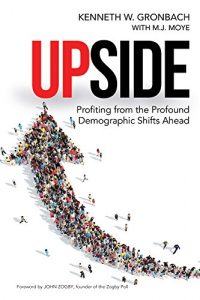
It’s my pleasure to welcome Ken Gronbach to the show. Ken is the President of KGC Direct and is an internationally respected demographer who has been able to forecast societal, commercial, economic, cultural and political phenomena with uncanny accuracy. Ken’s unusual blend of marketing savvy and common-sense demography based on his many years of proprietary demographic study sets him apart. Ken keynotes all over the United States and does customized demographic research. You will find at Ken’s steadfast position that the United States is the best nation on Earth has given him a firm belief that the country’s best days are ahead. Seasoned with his spirited presentations, he has an unmistakable pro-American enthusiasm. Ken’s book, Upside: Profiting From The Profound Demographic Shifts Ahead is an outstanding book. I highly recommend it. I’m excited to have Ken on the show. Ken, welcome.
It’s a pleasure. Thank you very much.
You’re referred to as a demographer, a futurist and you’re also referred to as a generational marketing expert. Tell us a little bit about yourself and your background. How did you get to this point?
I was in the advertising business. I had an advertising agency for 21 years here in Connecticut. We were a retail agency doing about $40 million, which is not a ton but it was a good life. Our signature account was American Honda Motorcycles. In 1986, American Honda Motorcycles all of a sudden, their market evaporated. We could not figure out why. Kawasaki, Suzuki, and Yamaha did the same thing. Harley Davidson suddenly blossomed and it was selling. It was a terrible motorcycle. How did they get into this? We beat our brains out trying to save American Honda for a few years. The business fell 80% and then it shut down. In 1996, I was in my office in October of the year. It was an election year, Clinton versus Dole, and it was an indictment of what I believe to be your generation. It said that Generation X, born 1965 to 1984, was a bunch of lazy, slacker, couch potatoes and they were not involving themselves in the political process.
What was the United States going to come to if Generation X was our future? I had 40 people working for me at the time. At 30, I’m a Gen Xer. I didn’t have any lazy people. I couldn’t figure out what the heck they were talking about. I had some research done on it by our research department, which is one guy. He came back after a few days and I said, “What’s the story about Generation X?” He said, “They’ll never perform at the level of the Boomers.” I said, “Why?” He said, “There are fewer of them.” It was weird. It didn’t go into my head. I said, “What do you mean to fewer of them? He said, “They weren’t born. We had a birth dearth between 1965 and 1984. The Boomers were born ‘45 to ‘64, 80 million. There were only 69 million of these Gen Xers.”
I said, “They’re simply not there.” He said, “Yeah.” I said, “I think we solved the whole mystery with Honda Motorcycles. We knew we sold motorcycles to men 165 to 24. That was it. At 25, they sold the bike, got married and it was over.” Once the Baby Boomers exit at that small, narrow demo it was over. It launched me. I said, “We made a discovery.” We went back and looked at your generation. You shut down maternity wards. You shut down the toy industry. You closed 30% of the public schools. You shut down the motorcycle industry. You shut down bicycles, certainly. You almost shut down the automobile industry and nobody could figure out why, but nobody bothered to count you. You’re a hole in the population. That was the launch. Everything’s spring-boarded from there.

At the time, the Boomers were like a pig in the python. How could you miss it? It’s such a massive bell curve. Even so, when we’re talking about demographics we’re essentially talking about people, more specifically, numbers of people. They cause shifts in everything. You cannot miss that. Especially a marketing department where you worked at, it’s unbelievable that they would not be aware of their clientele. Their customer is either coming and growing or leaving. That’s a huge mistake.
Do you want another example? I was asked to speak to the hospitality industry in Downtown Manhattan. What I was told when I was hired and sometimes I get hired by private companies, individuals or associations. Other times, I get hired by speaking bureaus. This was a speaker bureau job. They were trying to coach me on how to handle this very elite group of chief marketing officers from all over the world. They said, “You’re going to be talking to million-dollar salaries,” and these people are very astute. We looked at your material. We’ve seen your videos. We suggest you elevate the presentation a bit because you’re going to lose them because they already know what you’re talking about.” When somebody tells me that, I’m always cautious.
The hospitality industry, there were only about twenty of them. Sitting around a round table downtown Manhattan. Google was there. American Express was there. Hilton was there, Sheraton and then the Guinness Book of Records and everybody else. I got up in front of this group and I said, “What’s the most important question in marketing? We’re going to go around the room. You guys tell me.” Google said, “It’s understanding social media. If you don’t understand social media, you’ll never understand how to reach Generation Y.” Hilton says, “It’s new products. We’re making our rooms smaller. We’re making our lobbies bigger. We’re getting into the head of Generation Y.” Somebody else said, “It’s psychographics. You have to understand the mindset of Generation Y. We’re carefully studying it.” They went around the room and gave me variations of that. By the time they were finished, I looked at them all and I said, “Nobody here got it.” They said, “What?” I said, “It’s how big is my market is? Is my market getting bigger or smaller?” They went, “Oh.” I said, “That is it.” Everything else is window dressing. If you don’t understand the size of your market, how many people are in it, you’re flying blind. You don’t know what you’re talking about.
We’re talking about demographics. Let’s lay a foundation here for those people who are not familiar with the term or even the concept of demographics. What is it? Why should we care?
The best lesson that was given to me by my daughter when she was fifteen years old. She’s now 26. I’m driving my car. She’s in the backseat with her friend and her friend says to her, “What does your dad do?” and I could hear it. My daughter said, “He’s a demographer,” and there’s always a pause. It’s like, “What is that?” Her friend was astute and said, “Is that like an accountant or an economist?” My daughter said, “No. Accountants and economists count money and stuff. My dad counts people and people are more important than money and stuff.” What is demography? Demography is the accounting of people. If you can understand what an economist does or what an accountant does with money, substitute people and that’s what a demographer does. We look at critical mass and we make calculations, go by formulas and figure things out based on the numbers of people.
I read somewhere that you claim or you say that demographics precipitate economics and not the other way around. If I thought that through logically, I would almost argue that economics precipitates demographics. Only because I would think that if the economy is doing well and people are flush and they’re having babies that drive population growth. You’re saying it’s the other way around. What do you mean by that?
The thing that drives population is parents. If you don’t have a lot of parents and they simply were not born, I don’t care what the economy is. I don’t care how good it is. It doesn’t make any sense whatsoever. For example, a good case in point here would be China. China for 37 years had a one-child-only policy. What was the net result of that? They’re missing a whole population of people that are simply not there. There are 500 million people that are not there under 40 years old. They’re saying, “We made a mistake. Let’s start having babies.” Now you can have three. In some cases, you can have as many as you want. Is that going to solve the problem? It can’t. The problem exists unless you’re going to have babies that are 25 years old, you’ll never fix that. People precipitate money and people precipitate economics. It’s that simple.
We have demographers that are promoting larger families or at least having larger families, but a lot of us have been told whether through the media, friends, or school that the world is overpopulated, certain countries are overpopulated. India comes to mind in that situation. Is that a good thing or a bad thing? What’s the fact and fiction in all that?
You’re going to have a party. Marco’s got a lot of friends. Marco’s got seven billion friends, the population of the Earth. You want to invite seven billion of your closest friends to come to your party and you want to give them four square feet so they can dance at your party because you want your friends to be happy. Do you know what state you could have your party in? Rhode Island. If you wanted to have all seven billion of your closest friends live with the same density as Manhattan Island, you can put them all in Texas. We don’t have a problem. Food, we don’t have a problem. We produce enough food to feed fourteen billion people a day and throw half of it away every day. The problem of getting food to the one billion people that are starving is a distribution issue past corrupt governments. It has nothing to do with production. We were fine.
The thing that concerns me is when people say, “We shouldn’t have kids or we should reduce the number of children that we’re having.” They have to keep in mind they live in a market economy. The United States is a market economy. The EU is a market economy to a large extent. Eastern Europe is even a market economy, not so much Russia. That’s what China is trying to be. If you start tampering with your population, if you start tampering with nature, if you start tampering with the number of babies a woman can have, you’re going to eliminate at least three categories: consumers, laborers and taxpayers.
I even think Japan was tampering with their fertility. It can be argued these countries are in trouble because if they cap the number of new generations that are coming in, it stifles taxes. It stifles productivity and working-age people to replace those who are aging that can no longer produce in the economy. What you’re saying is these countries are in trouble? If they’re not in trouble now, they will be in the decades to come.
Japan is cooked. They know it. Their fertility dropped like a stone on a voluntary basis. It has a lot to do with the level of technology and the replacement of normal relationships with relationships on the internet. Computers don’t have babies. What’s happening in Japan is the serious issue that they have is they don’t have children. They don’t have marriages. People are not getting married. If you’re not going to get married, you’re not going to have kids. You’re not going to have families. The family has disintegrated and it is a totally xenophobic country. They fear and hate strangers. They don’t bring in outside labor. They’re making their older population work longer. Is that going to solve the problem? Japan physically is history.

There’s still welfare. They’re still producing a product but they’re probably going to have to make it in another country. China, on the other hand, because of the magnitude of the error and ironically they were persuaded to go to the one-child-only policy by Henry Kissinger. I wonder if that was intentional. I don’t know. The magnitude of the issue missing 500 million people, there’s nothing they can do to fix that. Does that mean China’s going to go away? Probably not, but they’re not going to be able to fake the 5% or 6% GDP increases anymore. It’s not going to happen. Do you know where you want to be fertility-wise? Right here.
Is that purely because of fertility or is that because of immigration and immigration policy or lack thereof?
It’s because of fertility. The United States is going through a little bit of a baby shortage but that’s because of your generation. There aren’t enough parents in your generation to produce the number of children that we would ordinarily need. The fact that your generation was small has influenced us. One of the things that has happened is because you were not a big enough labor force in the United States, it sucked in Mexicans like a vacuum and the Latinos have babies. We broke a record in 2007 with 4.316 million babies. We broke a 21-year record. We had 4.3 million babies in 1957, Baby Boomers. In 2007, 50 years later, we had 4.316 babies and 25% of which were Latino. Without Latinos, we don’t have a country in 50 years because we wouldn’t have enough of anybody.
If you followed migrations of Latinos in the United States, they literally come in California and then they spread out through the country. We have a high concentration of them in Chicago. I don’t why Mexicans. Nobody’s ever been able to tell me that but we’re in good shape. What is going to happen is the generation right after you, 1985 to 2004, is the largest generation in our history. It is 87 million, which means it’s seven million more people than Boomers. They’re getting married late. They’re having children late. They’re buying their houses late, but they are doing it. That’s going to drive the economy for the next many years.
You’re referring to Gen Y, Millennials. What would you say is the correct replacement level fertility rate in the US? I’ve read different things about this.
2.2 kids per couple.
Where are we at now?
I would say that we’re probably about 1.9.
We’re slowly behind the growth curve that we should be on.
You’re behind the growth curve, but that will self-correct. It is an issue. I don’t think it’s a devastating issue, especially with the number of immigrants that have come into our country. We always need immigrants. We need immigrants for labor. I speak to agriculture. I speak to farming. I speak to forestry. They all need immigrants.
You clearly have a rosy view about the future of the United States and probably North America, at least the Americas in general. Is that because of population growth here, immigration policy? What are the considerations for having such an optimistic view of the Americas?
The best way to look at that is to look at the pessimistic view of other areas. Let’s talk about the EU. Even maze countries like Great Britain. If you don’t have kids, you don’t have teenagers. If you don’t have teenagers, you don’t have adults. What’s happened? That’s the way it goes. There’s a ton of people out there that simply that doesn’t go in. I don’t know what it is. A baby is a baby. They have babies and babies do not stay babies long. Before you know it, they’re walking before you. Case in point, my kids all of a sudden, they’re grown up. It breaks my heart. Across the border Portugal, Spain, France, Germany, or whatever, 1.6, 1.5 and 1.4. They’re not replacing themselves. Those kids that they didn’t have would have been grown up but they don’t have labor. Where do they get their labor? They get it off of North Africa and it comes in the form of a culture that is not homogeneous with Europe’s. It doesn’t mix with Europe’s. Anything you can do to make the Muslim culture and Western culture mix because they don’t.

God bless the Muslims, but they’re different. The Muslims come in. What’s going to happen is because indigenous folks in the EU do not have kids, they have a real problem with their immigrants. Go a little further. Go to Russia. Russia has an old sick population. They’re not having kids. They’re not getting married. No immigrant’s going to go there. First of all, they won’t let them. What does Russia do? Russia’s a gas station that runs on natural resources. They have about 40% of the world’s resources, but unless it’s at $80 a barrel, they’re in trouble. It goes on and on. I could take you around different countries. What’s happening in Australia? Their fertility drops. Wealthy people are bailing out of China. Where are they going? They’re going to the United States, they’re going to Canada and they are going to Australia. Australia will be Chinese. It’s a matter of time. Do you know where the best fertility in the world is? It’s in Mexico. Fertility is almost perfect.
Why is that?
What I learned when I was in Cal State Long Beach. I was from Connecticut. I thought everybody was Italian and Polish. I would go into Denny’s on Sunday morning and there would be the Latino families that push the tables together and I’m saying, “I never had a family like that. That is the most amazing thing. Look at this family. Latino family is important.”
Being an Italian, the family is everything when it comes to European culture especially being Italian. It’s not uncommon to have three or four kids. We’re not Mormon but we still tend to have a lot of kids. That’s changing in this generation though because a lot of the Italian families that I grew up with are not having a large number of kids, generally speaking. Maybe that’s a changing trend, I don’t know. Demographics are about people and counting people and how that affects us and the economy. For me, my focus is primarily real estate because I always look at real estate and how we can use that as a tool to create financial freedom and all that good stuff. In order to segue into that topic, let’s touch on immigration for a moment. The topic of immigration is in the news a lot these days. We’re talking about building a wall on the southern border. Immigration seems to be an ongoing conversation. What would you say is happening with immigration trends? How is that ultimately going to impact real estate here in the United States?
The Generation Y, the Millennials, if we dug into the ethnicity of Generation Y we would find that a good part of Generation Y is Latino, everybody else too. They’re Italians. They’re Polish. We’re mostly German descent here in the United State. What happened? What is the single biggest influence to real estate going forward? We have 150 million housing units in the United States, give or take. That’d be a good number, and I’ve looked at a lot of numbers. There are 330 million people in the United States when you count the illegals and I count everybody. The two largest parts of our population, the Baby Boomers, 80 million and 87 million of their kids essentially live under one roof still. They’re not moved out yet. They have to because the Millennials are not going to raise their families in their parents’ house. They’re going to find their own quarters. They’re going to get married. They’re going to start their own households.
Do you know what the shortage is? 25 million housing units so we need to build. I spoke to an association of loggers up in Oregon about a half a year ago and it can’t cut trees fast enough. What’s going to happen is this need for housing and you see it all over. You see it in Huntington Beach. They’re building apartments and everywhere is apartments. Why? It’s because they have to have some place to live. If you can calculate where these people are going to live, there are incredible opportunities in real estate. 25 million housing units short of our needs. What did we find out in 2008 when we had too many houses? That housing was the economy and the economy was housing. Here we are now and we don’t have enough houses. Do the same rules apply? Yeah, it’s going to go the other way.
We have housing projects going up all over the place in California here that I can see and these are larger multi-unit projects. I would think that density has a lot to do with it here. Not just the demand, but density because real estate is expensive in California. The coastal markets are almost everywhere throughout the United States. We have to lower the cost and make it more affordable simply by stacking people on top of each other through these higher density multiunit projects. There’s a demand for housing. I don’t remember where I read or saw this statistic. It was some research paper. We need somewhere around one million new housing units per year and we’ve probably needed that for a long time. We’re only creating about 750,000 units a year, which leaves us with a pretty large deficit on an annual basis. I don’t know how long that’s been going on for, probably at least ten years if not longer. A major issue going forward is clearly housing, which is sad but at the same time exciting for me and the audience because it leaves a great opportunity for us as real estate investors. The question I’m going to throw out to you is what you see happening over the coming years and decades related to housing?
It’s going to explode. There’s no way around it. There’s no alternative unless you’re going to live in tents. There’s got to be housing units. I’ll give you an example of one that’s a little bit different because I spoke to a company out of Virginia called Caton Companies and what they build is affordable housing, these double wide that you put on a slab. I live in Florida. I do a lot of interviews, not as sophisticated as yours. I speak to a lot of real estate type magazines and I got a call that freaked me out from a lovely woman who called me from Florida. I was up in Connecticut at the time and she said, “Ken, I want you to answer this one question because I’m putting the story together. When is the Baby Boomer influence on Florida going to begin to end? When is it going to begin to pull back?”
I thought for a moment. I said, “It hasn’t started. Do you ever go to a coffee shop in the morning and look around? What do you see? Do you see 65 to 85-year-old people? What do you see?” She said, “You see 75 to 95-year-old people.” I said, “That’s correct. That is the person who has retired, 75 to 95. Baby Boomers are the largest generation ever to retire, 80 million of them are currently 55 to 74. You’re one year away from that hitting you like a tsunami.” She went, “You’ve got to be kidding?” I said, “No, you don’t have enough structure there. You don’t have enough of anything in Florida. You could build all you want along the shorelines, but you don’t have affordable housing. Where are the people?” You drive up and down the street here in Florida, “Help wanted.” What do they want help? They don’t want elderly help. They want people to help elderly people. There’s no place for them to live. That is going to be bigger than the sky affordable housing.
You’re citing Florida a lot. Is what you’re saying true for all states in the US?
I’m almost using Florida as a metaphor because if you started in Virginia, you could. If you go to the Carolinas, come down through Georgia to Florida and then go across the Gulf States to Texas. That’s where you’re going to see huge growth, even in Mississippi will grow huge.
Would you say it’s the Smile States, the Southern pretty much?

California and Nevada. My brother is an investor in Nevada. I know a little bit about that, but Nevada is growing crazy.
My good friend, I had him on the show. He refers to the coming silver tsunami, silver meaning the gray silver hair that a lot of these aging Baby Boomers are having. He’s referring to millions of Baby Boomers. He refers to it as a silver tsunami. What are the implications of that generation, in general, and more specifically to real estate investors? Should we be focused on senior housing or assisted living? What would you say to real estate investors knowing that the Baby Boomers are aging and soon we’ll need all support from medical services right through to hospice?
What’s the magic number? The magic number in age is 75. That’s when the body starts to break. That’s when the death rate accelerates. It’s when you start needing tons of health care and care in general. There are three categories that are about to get hit with a tsunami and they’re not prepared in the slightest. I’m here in Florida learning how to be a senior citizen because it’s a process. You got to hang out at the pool. You got to listen to other people talk. I had some retina surgery recently and I went back for a checkup. It frosh me I have to sit and wait. I was there for two and a half hours. I told the doctor, “Do you have any idea? The generation that you’re currently appealing to is the smallest generation of the last 100 years. It’s called the Silent Generation. They were born from 1925 to 1944. Once that generation dissolves, you’re going to have the most demanding generation in the world hit you like a tsunami from offshore and that’s the Baby Boomers.” It didn’t go in. I watched it. He didn’t hear me say it.
Who’s going to get hit? It’s going to be healthcare. It’s going to get whacked. Adult care or elder care, and then death care as well. For some reason, a noted gerontologist/demographer in the 1990s convinced everybody that the graying of America was happening then. Those Baby Boomers would begin to die en masse in the year 2000. What happened was the exact opposite. Wall Street took him seriously. A lot of investors took him seriously and the death care industry built up only to have the rate of death dropped by a third. We went from three-and-a-half million people a year dying to two-and-a-half. It was based on the number of people that were of the dying age. Now, we have the reverse of that. We have the Baby Boomers. The Baby Boomers are one year away from that magic number and it’s going to hit.
Is it a fair statement to say that when you look at the Baby Boomers specifically and you look at Generation Y, which are the Millennials, you have an opportunity from a real estate investing perspective right across the board from the youngest to the oldest?
You have the people that are going to need the care and you have the people that are going to provide the care and they both need housing.
They all need housing and I see that to be an explosion, particularly with the Millennials because they have opted and chosen to stay home with their parents for as long as they can. They’re the Uber Generation. They don’t want to be anchored to housing. They don’t want to be anchored to a car. They want to have that freedom and mobility, which is as an asset. Now, they’re getting to the point where they’re starting to think of family and they’re going to need to start putting roots somewhere.
We’re human beings. We get married. I don’t want to live in my parents’ basement. I can’t do that. I want to raise my family and I want to raise my family according to my own standards. I’m going to live where I want to live. It’s said that Boomers were supposed to live in cities. They lived in cities until they had their second child and figured that they couldn’t. When they determined they couldn’t educate their kids in a city, they moved to the suburbs. That’s going to be the same thing with Gen Y, the Millennials. The Millennials, a good jag of them are going to live in cities but a good jag of them going are going live wherever you can live. The country is broken down into four parts by the Census Bureau and that is the Northeast, the Midwest, the West and the South.
The Northeast and the West are essentially stagnant in terms of the population but very stable. It hasn’t increased pretty much. South Florida has increased 10% a year. It a huge increase. What’s the point? Wisconsin’s a beautiful place to live. Do you think Millennials will move to Wisconsin? They will because of the quality of life and because of the availability of housing that’s affordable. Texas is amazing and Texas has it both. They have relatively decent weather but very inexpensive real estate. What’s happening in Connecticut? I tried to convince my fellow folks in Connecticut that it’s not the end of the world. What’s happening is that Electric Boat and General Dynamics and Sikorsky have all been given money by Trump. They are on a hiring frenzy of young engineers bringing them in and paying them huge amounts of money, which is perfect. You’re going to see the population distribute and we’re fine. It’s a natural thing that’s happening.
Let me ask you one more thing about Gen Y. There’s a lot of talk about Millennials all the time. It seems to be the hot topic in the news, in politics, economics, you name it. They’re everywhere. What do you think the impact of Gen Y will be across the board? I’m thinking retail specifically, transportation and housing. If you were to put it into a package, what will the impact of Gen Y be going forward?
Be the largest consuming generation in the history of our nation. What do you think is going to happen?
Would you say it’s like Baby Boomers on steroids?
Yeah. Will we view retail differently? Yeah, they will but there are certain things you can’t buy online. The Amazons of the world only provide about 10% of the retail anyway. The rest of the 90% is provided by brick and mortar. We’re going to be fine. This is going to be a crop of kids, a tide that’s going to raise all boats. We’re fine and this is subjectivity. I live in a world of constant numbers. In fact, I’m a little nuts because I’m preparing for a presentation and I need to come up with population numbers from Census QuickFacts, that’s my favorite site. It is part of the Federal government, it’s going slow and they’re not updating. It’s affected me. The place to live and I’ve said this over and over again. Do you like Europe? It’s too late to go to Europe. Europe is not Europe anymore. Italy is not Italy. It’s history. It’s not Italy anymore.
They have such a high unemployment rate, especially among twenty-some-year-olds. It’s over 25%. That’s not a good thing.
I’m willing to bet most of them are Muslim. Here’s what’s going to happen. Things are not good. You’re going to have the best and the brightest and the wealthiest come out of the EU are going to come to the United States. They’re already coming. Wealthiest Chinese, you’re watching them. They’re coming to the United States in huge numbers. They are already in huge numbers. Take a look at Vancouver, a 1,000-square foot condominium sells for $1.5 million. It goes on and on. We’re in a state of change but as long as we don’t become xenophobic, as long as we can understand that we’re a nation from all other nations. The economy of the United States is going to be fine no matter who is in office.
My last question to you maybe not specifically in your wheelhouse, but what advice would you give to our audience who are specifically real estate investors? What would you tell real estate investors now strategically or otherwise?
This is selfish. I told you about my Upside book. We broke down every single state who’s leaving, who’s coming. Read it. Figure it out. You’ll be ahead of the curb and invest.
I started reading it. I’ve gone over the table of contents and I’m in the first part of the book. It’s excellent. Even if you’re not a real estate investor, this is good stuff to know and understand because you live in the US, for most of us in the audience. You need to know what’s going on around you and the direction that we’re going. It’s exciting to be a real estate investor at this point in time. Even though I can say that across the board we’re finding inventory levels low in most markets. Inventories tight and it’s getting tighter. We’re finding it. We have to adopt new markets and move into other areas. A lot of the markets we’re in are starting to become tertiary markets, not the secondary markets that we’re usually in. That’s where we’re finding the returns. Those markets are growing too because there’s still housing demand. Real estate is forgiving. I don’t want to say deaf, dumb and blind and do well in real estate because you need help. There’s a formula for it but the trends are stacked in your favor is the point.
I’ve got a brother a little bit older than me that invested in Hermosa Beach, Manhattan Beach and so forth back in the ‘60s. He begged, borrowed and stole wherever he could get money for a down payment. He did and bought. Boomers moved in and he’s quite happy.
Tell our audience how they can find you and your books. I know you do speaking. Tell us where they can find you and learn more about you.
KGCDirect.com. Everything is there. My books are there. You buy a book from me I’ll sign it and scribe it for you. I speak about 50 times a year. I’m not cheap. I’m often rated the best speaker they’ve ever heard it and it’s not because I’m a super speaker. It’s because the information that I gave you is actionable. You can do stuff with it. I’m not a motivational speaker. I’m a motivated speaker. The book is called Upside: Profiting From The Profound Demographic Shifts Ahead and it was a project where my co-author and myself beat our brains out. It is the Bible for strategic planning in real estate.
I’ve been long overdue to get a demographer on the show. I’ve been thinking about it for a long time. Someone referred me to you and said, “You should look into this guy and get him on your show,” so I emailed you guys. This has been excellent. It’s great. I know that our audience will eat this up because they’re smart, but they’re smart enough to know that a lot of this stuff begins with demographics. If you can see where those trends are and you know what’s going on, you can position yourself to profit from it. That’s the idea with investing. This has been great, Ken. I want to thank you for your time.
You take care.
Thank you for being on the show.
It’s my pleasure.
—
Thank you for reading. This was an incredible episode. It’s important to understand the impact that demography and demographics have on what you do in your career and everything else. Download the free report on our two websites, The Ultimate Guide to Passive Real Estate Investing. It’s a free report. Go to PassiveRealEstateInvesting.com or NoradaRealEstate.com. Do you have a question about real estate? Click the Ask Marco! button on our website and shoot me an email. I will try to get back to you as quickly as I can, but I do take some of those and I put them on an Ask Marco episode of the show here about once every month. Last but not least, help us spread the word. Leave us a rating and review on iTunes. I greatly appreciate that. It helps us spread the word and get the show out to more people who can use this information and would be grateful to have it. Once again, thanks for reading and we will see you in our next episode.
– – – – – – – – – – – – – –
Download your FREE copy of: The Ultimate Guide to Passive Real Estate Investing.
Get your FREE coffee mug by leaving us a Rating and Review on iTunes. Here’s how.
See our available Turnkey Cash-Flow Rental Properties.
Please give us a RATING & REVIEW (Thank you!)