
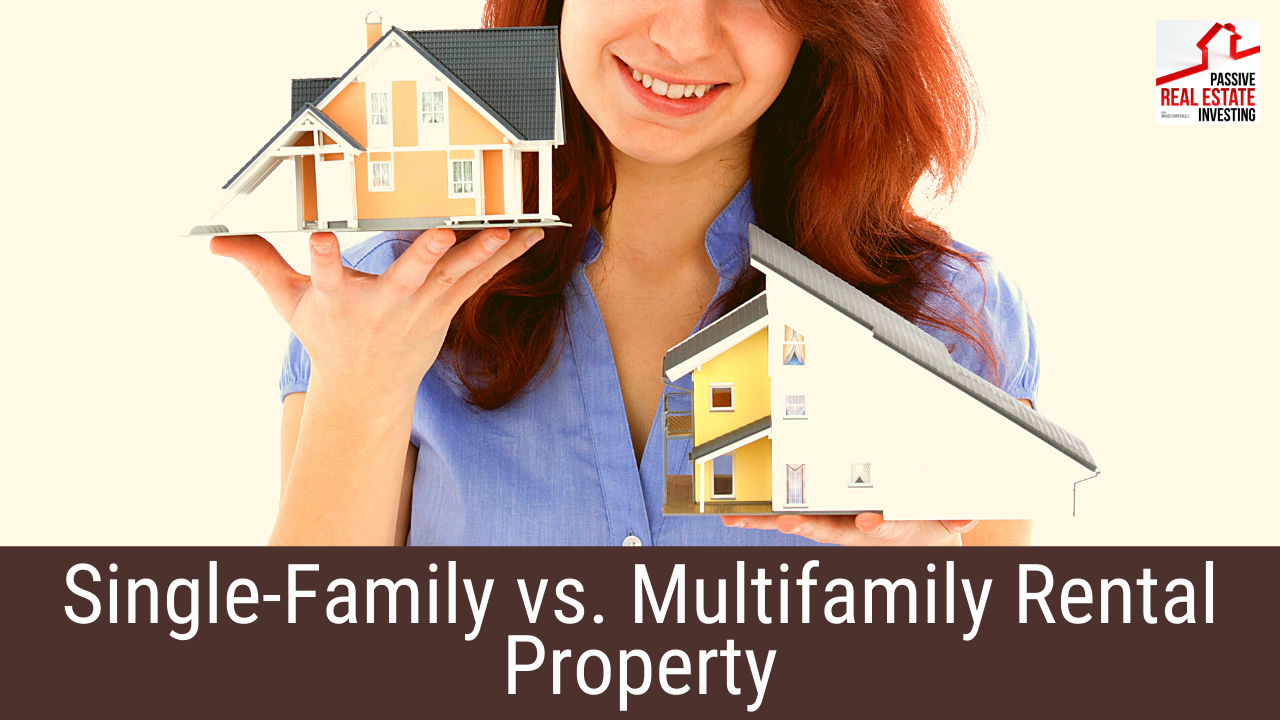
Welcome to another episode of Passive Real Estate Investing. I’m your host, Marco Santarelli, and I’m glad you’re here. So today I want to talk a little bit about this ongoing question and debate, which I see asked all the time and bantered around by many investors, both beginner, newbie, seasoned, and professional. And that’s the whole question of whether I should invest in single-family homes or should I invest in multi-family rental properties?
Download your FREE copy of The Ultimate Guide to Passive Real Estate Investing.
If you missed our last episode, be sure to listen to The Best Books on Real Estate Investing
Enjoy the show!
– – – – – – – – – – – – – –
Download your FREE copy of: The Ultimate Guide to Passive Real Estate Investing.
Get your FREE coffee mug by leaving us a Rating and Review on iTunes. Here’s how.
See our available Turnkey Cash-Flow Rental Properties.
Please give us a RATING & REVIEW (Thank you!)
SUBSCRIBE on iTunes | Stitcher | Podcast Feed
So this episode was sparked by an email I got from a person named Tim and Tim writes in and he says, I wanted to make money with rental properties. Grant Cardone feels it’s safe money to purchase multiunit properties, which has a lower default rate than single-family units. I’ll address that in a moment, but I’m open to hearing what you folks think is the best way for a beginner investor, like myself, to look into this.
Tim, thank you for the question. So, although this is not an Ask Marco episode, I did want to take your question and turn it into more of a full fledged episode, because this is actually a good question. And it’s a good thing to take a look at. So let’s analyze this, first of all, I’m going to say that there’s no right or wrong answer. One is not necessarily better than the other. Although I have a somewhat biased answer to the question of whether I should invest in single family or multi-family, but it’s not just a personal bias. It’s really based on what I’m about to talk about here today. I think there is a slight edge in single family rentals than there are on any type of multifamily, even fourplexes. Although I love single family, duplex, triplex fourplex, because of the financing, which is completely advantageous. You can lock in 30 year fixed rate, conventional loans or financing that you can’t do on commercial properties, which by definition, according to lenders is anything that’s over four units.
So let’s get into all this. So let’s begin by talking about the advantages of multifamily properties. The first thing that investors think about when it comes to multiunit or multi-family properties, those that are five units and above, which could be 50, 500 or more, is that you can scale faster. And there is some truth to that. And this is the big thing that Grant Cardone talks about and, you know, love him or hate him. I know Grant he’s been on my show. I’ve been on his ask the pros show a couple of years ago. You know, the whole thing about scaling faster is that you can complete one transaction and end up with, let’s say 20, 30, 50 units in one purchase under one roof typically, but it could be multiple properties.
But the idea is that you have fewer closing costs. Although the closing costs are significantly higher and a little more complex when you’re purchasing multiunit properties or multi-family properties of that scale. You’re definitely going to be paying a lot more in terms of the appraisals, the inspections, the complexities of it, et cetera, but it’s still one transaction. And so if you’re getting one loan for that purchase, you essentially have fewer total transactions. So there’s some simplicity in that, but there’s greater complexity in the purchase or the transaction itself, but you can scale faster. Now this is assuming everything else is equal, meaning that you are starting with the same investment capital that could be, you know, 200, 500,000, a million dollars as your down payment versus using that same amount of capital to purchase single-family homes or duplexes or fourplexes, but something in the residential space.
So with the same amount of investment capital, it’s fewer transactions, but in terms of the number of units, you can do it either way, but that is the general argument. And sometimes the number one advantage of going the multifamily route over single families or duplexes and fourplexes is that you can scale quicker. And so there is truth in that, just understand that it’s not what you are hearing at face value, meaning that you can scale faster period, full stop. End of story. It’s not exactly like that. You have to understand the other complexities and dynamics that are involved with the purchase of a multi-family property. And also realize that the lending side of this is a little bit different. They’re going to take a much closer look at you, but they’re certainly going to scrutinize the property because they’re typically qualifying the property just as much, if not more than you personally, because they’re looking at the property as a business and they want to make sure that the revenue or the cash flow from that property is more than enough, a higher enough metric that it can service the debt, something they call DSCR or debt service coverage ratio, which is often about 1:2.
And that’s a topic for another day. I don’t want to get into the complexities of it here. I just want to talk about the advantages between the two. So that’s the first thing you can scale quicker. The second benefit of multi-family property has to do with the economics, what economists or professional investors refer to as economies of scale. So when you have more units or more apartments under one roof, you are essentially sharing in the cost of upgrades to the common areas or the mechanical such as the boiler hot water tank or roof. And that cost is spread across all, whatever 20 units, 30, 50 units in that building. So it might be a very expensive repair, a 20, $30,000 roof repair, but you’re dividing that 20 or $30,000 roof repair amongst, let’s say 20 units in the building. So you have the economies of scale.
You have mechanicals and items that are shared as common or common area amongst all the residents and the units in the building. So that reduces the overall cost on a per unit basis. That doesn’t necessarily mean it’s cheaper than the equivalent repair in a single family home. It actually could be a lot more expensive, but the thought there is that it probably will last longer as well, being in a commercial building. Although there’s not always truth to that, but what you often have are one item, one repair, one location, maintenance issues, and inspections are all done at that same place. People are not being dispatched into different locations because you have different properties in different locations around a market. Property management may be completely localized. You may have an onsite property manager. If the building is large enough, usually that’s, you know, 50 to a hundred units.
And above is when you start to have resident managers. If you have a property management company and they’re looking after, let’s say 20 units at a building versus 20 single-family homes or duplexes peppered around the city, it adds some simplicity, but I would argue that it doesn’t matter. At the end of the day, if you’re working with a property management company, that’s managing multiple properties in different locations within a market, that’s what they’re doing for many clients, that’s just built into their business model. And that’s part of what they do, where there is a saving with apartment complexes. And multi-family units is often in the management fees with multi-family properties. It’s not uncommon to have management fees in the 4 or 5, 6, 7% range of that monthly gross rental income that’s collected. Whereas with single-family residences, the street rate, as I say in air quotes is 10%.
But the reality is, is that often, and especially with the property management companies that we work with, uh, in many markets and often that rate is often 8%, sometimes nine and even sometimes 7%. So I don’t know what the average is, but I would guess that the average is probably around 8% as far as the management fee. And especially if you have more than one property with a property management company. So that’s also a negotiable item. So keep that in mind, but there is a saving because of, again, the economies of scale with multi-family properties, especially as they become much larger, meaning a hundred units and above, it’s not uncommon to have a management fee around four or 5% on the low end 6, 7% on the higher end. And you know, that doesn’t mean a lot if you have a small number of units, but it does add up if you are talking about large-scale properties, all right, another advantage of multifamily properties has to do with supposedly higher monthly cash flows.
Again, this is an arguable point because it assumes that all else is equal, but it doesn’t necessarily mean that you have higher cash flow. The basis of this argument by a lot of investors is that if you have, let’s say hypothetically, a 10 unit apartment complex, and you have two vacancies, you’re essentially 20% vacant or 80% occupied. However, you want to look at it. So if you have a vacancy, you don’t have essentially a hundred percent vacancy in that property compared to a single family home where if you have a vacancy, you’re a hundred percent vacant. Well, that is true, but that’s also an unfair comparison. And I see this and I hear this all the time. What they fail to do is compare your portfolio, not just the property. Sure. If I have a single-family property, it’s one property compared to a 10 unit apartment complex, which is still one property.
If I have one vacancy in each of them, it’s the difference between a hundred percent vacant with a single-family home versus being 10% vacant on the 10 unit apartment complex. Those are true statements, but it’s really not taking the true situation into account because I may have 10 single-family homes in that market versus having one 10 unit apartment complex in that market. And if I have one vacancy with the apartment complex and one vacancy in my portfolio of 10 single family homes, I have exactly the same thing. I have one vacancy, one unit is empty on both ends. So I really have the exact same overall occupancy of 90%. So I think this is where people are not being completely truthful in the comparison between multifamily and single-family. So a vacancy is a vacancy and it doesn’t matter where it happens. You have to look at what is my total portfolio size, and then you can make a fair comparison.
Another thing to keep in mind is that the ROI, the return on investment on multi-family properties typically, and especially today, and has been this way for the last several years is actually not as attractive. In fact, it’s usually lower with multi-family properties than single-family homes. And one of the main reasons for that is that capitalization rates on multi-family properties have been compressed over the years. They’re hard to find very few people are selling them and the people who are wanting to buy them are chasing after them with a lot of competition. And because of that, it’s driving the prices up pretty much across the board, all around the country. So multi-family properties have become more and more expensive because of high and growing demand that a lot of apartment buyers and syndicators are chasing after. That’s also somewhat true with single-family homes, but more so with multi-family properties.
And the fact is, is there’s just far fewer of them. So as you get larger and scale larger, the number of units in the property, the fewer and fewer and fewer there are of them. So your monthly net cashflow is just one part of the equation when you’re factoring in what your total return on investment is, but keep in mind that your ROI, your cash on cash and your rate of returns on multi-family properties are typically, and more than likely going to be lower with all else being equal, same market, same types of things. Also, when you have larger multifamily properties, you have common area inside and outside of the building, aside from the shared mechanics and the roof and whatever else. And that usually means that you’re going to find more wear and tear on these common areas and these common mechanics that are in the property.
So your upkeep and maintenance is probably going to be higher and that’s just an added cost. So you have to factor that into the equation as well. Now, when it comes to financing multi-family properties, lenders will take a more rigorous approval process in that financing. So they’re going to look at the property and they’re going to look at the trailing 12 and 24 months of cash flow of rental income of tax returns. They’re underwriting that property as if it was a business. And they look at it as a business and social due, but it is sometimes, and maybe often easier to finance a loan for a $10 million apartment complex than it is to finance a single family home. And the main reason for that is really just the cash flow that comes from the property. Again, a multifamily property is considered a business in the eyes of a lender, whereas a single-family home, even though it may be a rental property and you are truly getting a non-owner occupied loan for that property as if it was a rental property, which is, and will be the lender still looks at the larger multifamily property as a business.
And so they’re going to underwrite it from a cashflow perspective. That’s the most important thing to them. They’re going to look at you as well. They’re going to consider other things like the market value of that property, but they’re going to look at its financial performance because they care about the cash flow and its ability to service the debt, which is what they’re extending to you to make that purchase. So they think of it as a safer bet because of the cashflow. That’s really the bottom line for them figuratively. And literally, the other thing too, is that multi-family properties, the value is based off the income that it generates, what is essentially known as the NOI or net operating income, which is all income minus all expenses, not including the debt service. And so that’s the number that they hyper-focus on to make sure that it meets their underwriting criteria to be able to service that loan ongoing basis, even with some vacancy.
So property values will change with multi-family properties based on the net operating income. Whereas single-family homes will be based on whatever the real market value is of that property based on the comparables in the area that can be determined from an appraisal. So that’s the thing about financing. It can be easier, but keep in mind, these are larger loans with larger down payments and not necessarily as attractive terms as single-family, residential properties last but not least. There’s the concept of house hacking. If you are purchasing a multifamily property, whether it’s 10, 20 units, 30 units, 50 units, a hundred units, you can do this also with a duplex or four-plex by the way. But the concept of house hacking is that you live in one of the units and you rent out all the other units. And so this reduces minimizes or completely eliminates your housing costs for the month.
So your rent or mortgage payment is essentially covered by the operations of the business or that property. So this is a, you know, a nice concept and a great way to get started for many people who are just getting started and they have a minimal down payment, or they want to actually live and manage the property and learn from the experience. Well, they’re purchasing, they’re usually first property, but sometimes it could be even their second or third as they start to stair-step and grow their portfolio and moving from one to another after two years or so, because the tax benefits are there on the capital gains by living in a property for two years or more. So that can be a great benefit for those people who are looking to get started with their first property. And it’s easy to do with a two to four unit property.
You can still call that a multi-family property, less likely to be able to do that with a large multi-family property, especially if you’re just getting started, because you just don’t have the experience. And lenders will look at that. Okay. Now let’s take a look at the advantages of single-family rentals. So first and foremost, and this is going to be pretty obvious is that they are less expensive. A single-family, residential property can range from, let’s say, send the 80,000 on the low end to about 150 to 200,000 on the high end. And I’m just looking at the 20 or so markets that we’re in right now. So if you’re purchasing a single-family, residential property, there’s a wide range of prices because there’s a wide range of markets and neighborhoods within those markets. So the thing with multi-family properties is that a lot of things are going to cost more compared to a single-family home.
The other thing too is the down payments are going to be much smaller with single-family homes. So I always like to use the a hundred thousand dollars property as an example, just because the numbers are easy to calculate, but with a conventional loan, you need 20% down for your down payment and that’s $20,000. So that’s simple math, a hundred thousand dollars property, but when you compare that to a multiunit property or multi-family property, let’s say there’s 20 units, and those are a hundred thousand dollars each. Well, now you got a $2 million property. However, your down payment is typically going to be 25 to 30% down. That’s just what commercial lenders are going to require as far as that financing is concerned. So it’s a much larger amount, both in terms of price and percentages. It can add up pretty quickly because you’re looking at a minimum of 5% and probably 10% more in terms of percentages as far as the down payment.
So you got to keep that in mind, you’re looking at potentially $500,000 as a down payment on that $2 million property. So it’s not as easy to get started unless you have deep pockets. A lot of investible capital. Another thing to keep in mind is what the lenders require as a cash reserve to cover expenses or payments if needed, then they’d call these reserves. And with single-family residential, it could be as little as two or three months’ worth of mortgage payments. Whereas with commercial property and a commercial loan, you will probably need six to as much as 12 months of reserves in order to qualify for that financing. So it’s considerably more in terms of what you need to have in the bank in order to show the lender after you’ve closed, that you’re able to be liquid enough to weather through any kind of storm that comes up.
Another thing with commercial real estate loans is that they typically have higher interest rates. And it’s often about two and a half percent higher plus or minus. It could be two to 3%, but about two and a half percent higher. On average, the terms are just less attractive. And there’s also far fewer banks that you can choose from in order to get that type of loan. And the main reason for that is because there’s a much smaller secondary market out there for them to take that mortgage and sell it off with conventional financing. Often these loans are sold right away, like right after you closed, they’re already put into a package and sold onto the secondary market. So the lender can essentially reload their warehouse line or their capital to make the next mortgage loan. So the financing is a little more difficult and it’s not as widely available or abundant it’s out.
There there’s many lenders out there, but certainly not as many as in the residential space last but not least in the process of getting financing, you are going to need to provide the last two years of financials and the rent rules for the property. As part of the qualification. You don’t need to do this with single family homes, because it really just comes down to your ability to qualify for that mortgage. And I should mention that also with multifamily purchases, the lender is going to want to see that you have at least some prior property management experience, where again, with single family homes, you don’t need that. So the down payments are lower. The rates are lower, the financing terms are more attractive because you can get 30 year fixed rate loans. You can just lock it right in. You don’t need to show property management experience.
And often you’re not the one managing your own property. Anyway, you don’t need to show financials on the property like two years of tax returns or two years of rent rolls. So there’s many advantages on the financing side. So when we say, you know, it’s less expensive to get started, it’s not just about the purchase price. It’s also about the down payment and the terms and the financing overall, by the way, appraisals are also much more expensive on commercial property. But again, you know, it goes back to the concept of economies of scale. It’s much more expensive, but you’re also rolling out that appraisal across whatever 20 units, 30 units, or more the second advantage of single-family homes. And this is something I actually debated a couple of times with grant Cardone is the liquidity. There’s a greater ability to sell, resell, even purchase single-family homes.
It’s just a much, much larger, more liquid market real estate in general, as an asset class is not very liquid. It just, isn’t, it’s a little bit slow to buy and it’s potentially much slower to sell a property, but the smaller, the number of units right down to the single-family home, which is one unit that is the quickest property to sell in the residential space or in the real estate space. So it’s just an easier product to sell because they are less expensive and there’s a lower barrier to entry and you have a much wider pool of potential buyers. So it’s not just real estate investors that are buying and selling homes or real estate in general. But when it comes to single family homes, you have a large pool of wanting to be home buyers, people who want to buy and live in their own home, not to necessarily rent the property.
So when you think about the buying pool, it’s the largest with single-family homes, and then it gets smaller and smaller as you go up to duplexes, triplexes, fourplex, and on up. So obviously you can’t compare a 500 unit apartment complex and the size of the buying pool for that compared to a single family home, it’s a vast difference. And this was my whole argument with rent. And he just, as of the belief that he can sell a 500 unit apartment building much faster than I can sell a single family home. And that debate didn’t go too far. I think I clearly made my point and I’m sure he knows I’m right, but whatever growing demand is also another advantage of single family homes. And I’ve talked about this on and off on the podcast here for quite a long time, the fastest growing segment of the single family space happens to be single family rentals.
It’s just incredibly high in demand. They are selling very quickly. And if you’re working with one of our investment counselors here, you will know that we do have inventory. There is a pipeline, but they do come and go and they go under contract fairly quickly, but that’s a common problem around the country. It’s not just unique to us. It’s just the way it is. So single family rentals have been outpacing, even single family, home sales, but especially multi-family housing. So that’s one thing is just demand is strong. And it’s growing. According to the us census, they estimated in a recent report that the number of single rentals in the U S grew by 31% in the 10 years following the housing crisis of 2007. So that period of 2007 to 2016, had an increase in single family rentals by 31%, you compare that to the growth in the multi-family space, which is five units.
And above it grew by a healthy 14%, but you can see that single family rental demand grew by more than twice, as much as multifamily. So there’s strong demand and growing demand for the single family homes, which is good for you from an appreciation perspective and a liquidity perspective, as well as the future demand for those properties in terms of rentals, sales, and price growth. Also adding to this upside is that single family rentals traditionally have less tenant turnover compared to multi-family properties. And I’ll talk about this a little bit further here in a moment, but I just want to quickly say that another study that came out from the urban Institute, they put out a forecast showing that demand is very strong and continues to grow, especially from the millennial demographic, because they’re now entering that age when they want to start, not only buying their first home, but having kids and the demand on new household formation is very strong and increasing.
So the desire for those single family homes is just increasing year over year, over year. So that’s creating economic pressure and it’s just driving more demand for single family homes and rental homes. And that doesn’t mean demand is not there for multi-family. It’s just incredibly strong for single family from a diversification perspective. Rental markets, as you know, are local dynamics. The economics are predominantly local. So what happens in one market is different than what happens in another market. So it’s easy or maybe easier to build a real estate portfolio. That’s geographically diversified because if you follow kind of my rule of thumb of three to five properties in three to five markets, you could quickly or relatively quickly build a portfolio of three, five houses or even duplexes or fourplexes, but three to five single family homes in one particular market. That makes sense for you from an investment perspective and then move to another market, geographically different, usually in another state where you continue to build your portfolio, adding another three to five properties there, because you’re dealing with single units, it’s easy to diversify geographically.
Whereas if you take that same investment capital that you use to build up that portfolio diversified across three to five markets and put it into one, let’s say a 20 or 30 unit apartment building, you’re stuck to one market you’re rooted there with all your units. And the only way to diversify geographically is to have additional investment capital where you can now start to acquire other properties, whether single families or multi-families in other markets in other States. So it’s just easier to grow and diversify your portfolio in multiple markets using single family homes. And I guess anytime I say, single family homes here, I’m also adding in duplexes and fourplexes. I think you got that by now. So the final point I want to make is the benefit of single family homes is that both anecdotally and statistically, they have lower tenant turnover. And I saved this till last, because to me, this is probably one of the biggest advantages.
And one of my favorite things about single family rentals is the lower tenant turnover. For me, that is critically important because I am all about having long-term tenants. I want to have tenants that are on at least a one-year lease, ideally a two year lease. I don’t need anything longer than that, but I want them to stay and be happy where they live and, you know, enjoy the property, enjoy the neighborhood and keep renewing their lease for as many years as possible. Because the bottom line again, figuratively and quite literally is that tenant turnover is expensive. It’s costly. It takes money and time. You know, there’s a cost to a turnover and there’s downtime. So here’s lost rental income. So I don’t want the lost rental income. I don’t want to pay my property manager all too often for that turnover because they’re going to make a fee on that turnover.
And they also have to take the time where it’s vacant to clean repair, any damages, take care of wear and tear market, and show the listing, you know, screen applicants. So, you know, you may only have a downtime of three, four days in a really hot market, but just assume that it’s probably going to take two weeks or maybe three. And so you’re going to have a month of vacancy plus the first month, or maybe the first half months of rent going to the property manager as the cost of that turnover. It’s not the cost of the turnover, but it’s the lease-up fee. So, but that’s not going in your pocket. That’s going to your property manager for the service of turning over that property and releasing it. So turnovers are costly. It’s actually probably the biggest cost in owning property and you budget for this, of course.
So it’s not like it’s a surprise expense. You budget for maintenance and repairs and you budget in your performance for vacancy and turnover. So you’ve already factored it in, it’s baked into the cake, you’ve accounted for it, but the less turnover you have, and that’s my point, the less turnover you have, the more consistent and predictable your cashflow is. And that’s your short-term gain. Your long-term gain is the equity, growth and appreciation, but the short-term gains are monthly and annual cash flows. So I want to keep that going as much as possible, as long as possible. So this is the big thing for me is the lower turnover, the tenant turnover, one person or company that I like to follow is John Burns real estate consulting. So I know John Burns and some of his data shows that 52% of single-family residential renters are families. You compare that to multifamily residential properties and that’s 30%.
So that 30% are people who are more likely to be under the age of 35. And if you look at that demographic closely, you will find that they are for many reasons more transient. They don’t tend to stay as long. For many reasons, it could be jobs, friends, getting a girlfriend, getting engaged, getting married, moving up, moving down when you’re dealing with apartment and apartment residents or dwellers that profile. And that demographic is just more transient. It’s just normal. There’s nothing wrong with it. It just is what it is. The average single-family, residential tenants stays for three years. That’s average. I’ve had tenants stay for five plus years. So it’s not uncommon to have a very long-term tenant, but the average SFR or single-family residential tenants stays for three years. And that’s roughly double the average apartment tenure, which is roughly about one to one and a half years.
And also another interesting little fact is that single-family, residential tenants often will stay five or six years as long as you’re not above-market rent. If you’re at, or just below fair market rent, they have a good deal in other words, and they know they have a good deal and you’ve got a house in a great neighborhood and it’s safe, clean, functional. It is not uncommon to have people stay five, six years or more. It’s not unheard of in the single-family, residential space and over time, that just means a considerable cost saving. So that’s just money in your pocket. I think it’s well worth it. A single-family homes are easy to acquire, easy to understand, easy to repair, easy to address, easy to fix, easy to deal with, easy to show. There’s just a lot of benefits. In my opinion, if I’m sounding pretty excited about this last bullet point of having lower tenant turnover, it’s because I really am.
I think this is a big deal and I don’t think enough people talk about, you know, how important it is and how beneficial it is. So let me just wrap this up by quoting something from a recent Zillow article. And I’ll just quote right from the article here. It says among young adults, renters of single-family homes have always tended to move less often than apartment renters and single-family home rentals is one of the fastest-growing market segments. Uh, unquote. So there you have it. I hope this has been helpful for all of you again, you know, I just need to compare a single-family to multifamily rental properties as fairly as possible. But like I said, I have a preference and I have a little bit of a bias, but I’m not saying that one is bad and I’m not saying one is better than the other.
It really comes down to your personal criteria and your investing goals. But you also have to consider what is your investment budget? What is your investible capital? What is your access to financing and what you qualify for? And last but not least, you need to ask yourself what is my risk profile. So with that, if you have questions about that, or you want to discuss this a little bit further, contact my team here, we’ll put you in touch with one of our team of investment counselors. And especially if you’re thinking about single-family investing, you know, let us help you put that strategy together because it’s probably a very good fit for you. And my team of investment counselors are certainly here to help you. All right. Well, that is it for today. I appreciate you listening. Remember to subscribe to the show, if you haven’t done so already share this show with your friends and family and other like-minded individuals. I greatly appreciate when you do. And I do have people who email me from time to time saying, Hey, I’ve been sharing your show with my work colleagues and my family and my brother-in-law and so-and-so and I thought, Oh, that’s very nice. I always reply back to those emails and thank you for it, of course. And that’s about it. So thank you for listening and I will see you in our next episode.
RELATED POST: Single-Family Homes vs Multi-Family Investment: Which is Better?
– – – – –
Download your FREE copy of: The Ultimate Guide to Passive Real Estate Investing.
Get your FREE coffee mug by leaving us a Rating and Review on iTunes. Here’s how.
See our available Turnkey Cash-Flow Rental Properties.
Please give us a RATING & REVIEW (Thank you!)