
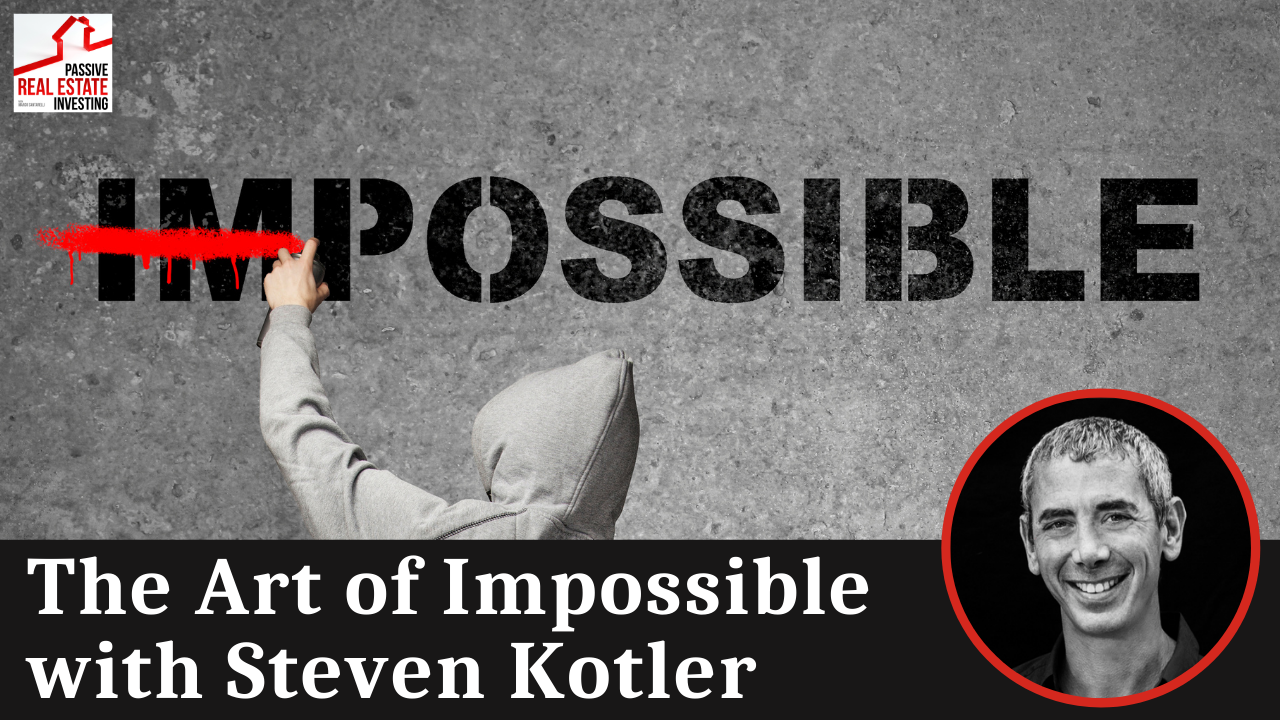
Hello, my friends. And welcome to another episode of Passive Real Estate Investing. Yes, I’m your host Marco Santarelli. Thank you for joining me here this week. You know, interesting concept. I love the concept of personal development, and I’ve always been interested in reading books about self-development and personal development. And the whole concept of performance peak performance has fascinated me and there’s a lot of good content and material and books out there about it. But I wanted to bring on someone who is at the core of peak performance and personal development, who has been studying it for many, many, many years. And he is very knowledgeable. He’s written so many books on the subject and specifically about the concept of flow. I thought it would be great to have him on the show to talk to you about peak performance and the concept of flow, which is the topic of his latest book, which is in my opinion, a collection of all his previous works put together.
It really is the culmination of all of his previous books. So what’s interesting is we are capable of so much more than we know, and that’s really the message at the core of the book, The Art of Impossible and building on cutting edge neuroscience in over 20 years of research that he’s put in Steven, a bestselling author and an expert in peak performance has laid out the blueprint for extreme performance improvement. And it’s just a fascinating read. So if you want to aim high, this is the playbook to make it happen. It’s an inspirational book. It’s aspirational, it’s pragmatic, it’s accessible. The Art of Impossible is actually a life changing experience disguised as a how-to manual for peak performance. And anyone can use this book. Anyone can shoot for the stars. Of course, there’s no space suit included with the book, but it is a good read.
If you want to learn more about peak performance and how you can get into a state of flow and achieve more with less time something I call compressing time. So with that, let us get to our interview today. And I hope you enjoy my guest.
FREE copy of The Ultimate Guide to Passive Real Estate Investing.
If you missed our last episode, be sure to listen to Building Wealth with Wendy Papasan
SUBSCRIBE on iTunes | Stitcher | Podcast Feed
Well, it is my honor today to welcome Steven Koler to the show. Steven is a New York times bestselling author, an award willing journalist and the executive director of the flow research collective. He’s one of the world’s leading experts on human performance. He is the author of many books, 13 books, actually nine of which are bestseller. Actually, I stand to correct myself there because he just told me that he just released a new book three weeks ago. So the total’s now 14 books. So 14 books nine of which are best sellers, maybe 10 pretty soon here, but that will include The Art of Impossible, which is a fantastic book. The future is faster than you think the rise of Superman and one of my personal favorites. Abundance. If you haven’t picked up the book abundance, please do. So. It is an incredible book. His work has been nominated for two Pulitz surprises translated into over 40 languages and has appeared in over 100 publications, including the New York times magazine wired, the wall street journal time and the Harvard business review. Steven it’s an honor to have you on the show. Welcome.
It is good to be with you, Marco.
Well, I was looking forward to this interview for a very long time because I discovered the concept of flow years ago from Roger Hamilton, who was someone I’m in business with very interesting guy. I’ve learned a lot from him and he mentioned the concept flow and I’ve never heard of it before. And I wasn’t sure what it meant, but I intuitively I kind of had an idea of what it was because I know when I’m in my own flow. So I want to talk about that today because I think our audience is gonna be very receptive and interested in this concept before we get into all of that, your second latest book, which is last year’s book, The Art of Impossible. You titled at The Art of Impossible, which I found very interesting because it’s really more of a science book. Is it not? Why did you call it art instead of the science of impossible?
It’s a great question. So the art of IPO, the book is about the right, the neuroscience peak performance and how we can use the neuroscience and peak performance, what would learn that way to tackle really hard challenges. And that is a science, the application of that science in our day to day lives is in art. It’s wildly different for everyone and in the face of like real world, scary, it’s complicated and is very much of an art form. So the science I think the science makes the art a lot easier, right? Like it gives us tools that we’ve never had before. And they’re incredibly powerful, but it’s still an art form when you’re implying it a new day to day life.
Interesting. Okay. That’s fair. So when you go through the book, you find that it’s really at the end of the book that you find, you know, the core of everything, which is flow. Let’s break this down into the most simplest building blocks. So people understand what we’re talking about. Let’s start off by talking about flow. What is flow? Because some people just don’t understand that whole terminology.
Do you mind if I back up one step and actually start with peak performance?
Absolutely.
Thank you. I just think it’ll be easier. So when I say peak performance, when we’re talking about peak performance, I’m nothing. I mean, nothing more or less fancy than getting our biology to work for us rather than against us. Now, most of what that book is about in a lot of my work has been on cognitive peak performance. And when you look at cognitive peak performance, there’s actually four biologically there’s four components to cognitive peak performance. There’s a, a set of skills that fall under the heading of motivation. Another set of skills under the heading of learning, then creativity and finally flow and flow is a technical term. You may have synonyms being in the zone, being unconscious runners high. If you’re a standup comic, you call it the forever box. If you play jazz, you’re in the pocket, the lingos endless flow is a technical term.
Scientifically it refers to any of those moments of wrapped attention. And total absorption gets so focused on the task at hand. Everything else just starts to disappear. Self self-consciousness it’ll diminish significantly. Time’s gonna pass strangely. Sometimes it’ll slow down and get a freeze frame effect much more frequently. You just get so sucked into what you’re doing. That five hours go by in like five minutes and throughout all aspects of performance, both mental and physical go through the roof. And the important thing about all of that is flow is how evolution shaped human beings to do peak performance. We are all hardwired for flow. So everybody listening to me can get into flow. Anybody anywhere can drop into flow, provided certain initial conditions are met. And so that’s sort of the full suite with flow as, as the capstone in a sense.

So how is flow different than focus then? Because it sounds like they are very similar.
So focus is a fairly amorphous term. There are lots of different kinds of focus. Flow is a very specific kind of task. Oh my God. Task specific focus, right where you’re totally focused, good concentration on the task at hand, that is one particular kind of focus. And it’s a focusing skill in a sense like meditation is a focusing skill and you have to learn it in a specific way flow the same thing. But if you look under the hood what’s going on in the brain, there are signatures for traditional focus. Flow meets a couple of them, but there’s also huge differences cuz flow is an altered state of consciousness. So normal brain function is different.
So when you’re in a state of flow, you’re already focused on something, but it happens to be that what you’re focused on is this is the part I struggle with. It’s something that resonates well with you and you are operating at an optimum state of consciousness. Is that a fair way to describe it?
No, but I appreciate so when psychologists describe flow, right? How do you know if you’re in a flow state? How do I know if I’m in a flow state? How do we know if a group, a team is in a flow state, there are six core psychological AKA phenomenological characteristics that define this state. Phenomenological is just a fancy word for, this is how the state makes us feel when we’re in flow. There is, as we’ve been talking about complete concentration on the task at hand, there is a merger of action and awareness. There is the tion of self-time dilation. We don’t experience peak performance. If I was looking at you and you were in flow, I I’d be like, oh wow, he’s really kicking right now. What we feel is just this enormous sense of control. Like we can control things in our lives.
We normally can’t control. And this could be, you know, me as a writer doing things with language that are just really extraordinary. This could be a business leader, running a meeting and the meeting is going incredibly well and the ideas are sort of bouncing off the wall and everybody’s really into it. All the, it could be a team and a fourth quarter comeback, all those sort of qualify. And finally the experience is euphoric. It’s joyous. It’s autotelic is the technical term. Well, something is autotelic, it’s an end in itself. It means once the experience starts producing flow, we’ll go really far out of your way to get more of it. Now you asked us there’s a second part to your question, which is you have to be really passionate flow, follows focus. So it only shows up when all our retention is the right here right now, flow states have triggers.
These are pre-conditions that lead to more flow. There’s 22 that have been discovered. There’s probably way more, but that’s what we know. And they all do things like drive attention into the present moment. They do it a bunch of different ways. Neurobiologically but passion turns out to be a flow trigger for the obvious reason that when we’re passionate about something, we pay way more attention to it. And interestingly passion and autonomy, especially if we’re passion, you know, we’re one who’s driving that passion. Autonomy is a coupled system with attention. So like when we’re driving the boss, the brain really cares where the bus is going. We pay way more attention to it. So you are right in your diagnosis, just a little more technical and split apart than the way you were laying it out.
So let me throw one more at you here. There’s another term that I use from time to time and I call it the superpower. Like I know what my superpowers are. I know what I’m really good at. And those happen to be the things that I love to do. And when I do them, everything else around me just kind of fades into the background and, and that’s where I find my flow. So, so for me, my superpower is where I think I find my flow is, is there a connection there or are those one in the same?
Yeah, if there is it’s it’s so this is not research. This is not my original research. This was research that was originally done by Martin Saligman and Chris Peterson, two of the godfathers of positive psychology movement. And they were wrote a whole book on it, but it turns out that when you are working on your strengths, like, you know, especially true if you’re using like two or three strengths at the same time and combining them in novel ways, or you’re using a new, an old strength and a new way, but both of those are absolute triggers for flow. We love that. You know, it’s, it’s really fun to like build on our strengths. There’s other things that go into, we can talk about additional flow triggers, but yeah, you’re absolutely correct working in your strengths breed spot, build flow.
So if someone’s in flow, how does that impact their mental or even physical performance? Cuz this is the thing you talk about all the time. Okay.
So when we’re in flow, I’m gonna just throw a bunch of numbers at you. And I’ll give you this study, who did the studies? Sure. Lot like all aspects of physical and mental performance. As I said, go through the roof and it’s all aspects. So cognitively we see focusing attention, spike, enormously motivation and productivity spike so much that McKinsey the business consultancy. They did a 10 year study and it’s a self-reported study. So I always say great in assault, but like it went around the globe for a decade, talking to CEOs and, and leaders of huge organizations. How much more productive are you in flow? The average was 500% more productive. That’s an enormous spike. We see the same thing with creativity, with innovation. Those are complicated. There’s a lot of aspects to creativity and innovation, whatever, but we see some of them will spike 40%.
Some of them will go up to 400, 700% depending. There Mobley Harvard figured out that heightened creativity without last to flows date by a day, maybe two the department of defense learned there’s huge spikes in learning and memory. When we’re in flow 240 to five, 600% cooperation, collaboration, empathy, nature, relatedness, or what’s sometimes called ecological awareness. Our ability to see perceive and really care about the natural world really important in the face of evolution or environmental challenges goes up. Grit goes up and on the physical side, strength goes up, stamina increases fast Twitch muscle response increases. And our sense of pain decreases
Interesting. One of the things that I think people think about, but is not talked about all that much in the media and even in groups and friends is the concept of meaning and purpose. And I know that ties in with.
Yeah, let so huge. Huge. Let me ask, let me just ask you a question. Kick this off. When you’re working in your core strength and dropping into flow, your life feels more meaningful afterwards, doesn’t it?
Absolutely. Yeah. I feel like I’m accomplishing something, not just for myself that I enjoy, but I’m impacting other people.
Yep. That is a very standard response. So we know, and this is one of the most actually well established facts in psychology. There is so much research on it’s overwhelming. The people who score off the charts for happiness, overall wellbeing, life satisfaction, meaning and purpose. These are always the people with the most flow in their lives. In fact, positive psychology now defines three tiers of happiness. There’s happiness. How do you feel right now? Moment by moment. And there’s not a ton you can do there cuz we’re level set by like emotional set points. You gotta high, you gotta low and you live your life in between those get set up early childhood experience. They can shift, but it’s slow above that is what’s they call it enjoyment. It’s literally a high flow lifestyle. So sometimes this could be you or me who gets a lot of flow from their work, but these could be action.
Sport athletes, action sports are packed with flow triggers. There’s a lot of flow. This could be musicians, artists just living in such a way that what you’re doing all the time drops you into flow. And as you pointed out, the highest, the best we get to feel on the planet is purpose. It’s when the thing that produces the most flow is tied to something greater than yourself. When you’re helping the world, you’re helping others, making the planet in a better place. That’s the best we get to feel the most sustained happiness. In fact, even more peculiarly, most flow states about 90 minute experiences. And there’s a bunch of neuro biological reasons, burns out and it’s a cap, but there’s a altruism based flow state known as helpers high. I was discovered by Alan Lukes. Who’s founded big brothers, big sisters it’ll last a day, maybe two. And nobody’s entirely sure why that helpers high lasts so long, but it, you know, flows the best we get to feel on earth. It sort of means from an evolutionary perspective, we’re hardwired to help others because the best we get to feel is when we’re helping others.
That’s very interesting. And I find it surprising that there isn’t more, maybe there is a lot more talk and research out there and I’m just not seeing it or reading it, but it’s, you know, I understand performance and I understand the benefits of being in flow, but it’s just interesting that we don’t talk about, you know, those higher levels of the pyramid.
You know, where it shows up Marco and you’re familiar with it. You’ll go, oh yeah, I just didn’t. You didn’t put it. I mean, Martin Seligman writes about this chick sent me high rights about this. A lot of like deposits psychology community has, has written about this extensively. There are, you know, over my right shoulder that bookshelf with the big, all the blue books, that’s an entire shelf of flow textbooks. So there’s so much work on flow at this point that we’ve got a shelf of textbooks that also pointed this, but where you’ve seen, it’s just not as obvious is the correlation between happiness at work productivity. Like we see right? You see high flow jobs produce way more happiness, joy at work. And you see the downstream impact of that. When they talk about productivity, all the links between happiness, they’re just not drawn the correlates from flow to happiness. Cuz that those definitions are a little harder to come by,
Right? Yeah. It makes sense. So it’s clear that being in the state of flow will impact your mental and physical performance. That’s clear, you know, the advantages are increased, motivation productivity, your learning and memory improves your creativity increases. It ties into meaning and purpose. Your ability to collaborate goes up and, and I believe in increased empathy and awareness is improved.
Is that a ecological awareness? What’s called nature relatedness.
Okay. So, so I’m listening to this. People are listening to you. And I think the question that some people are asking is, well, how do I achieve flow? How do I get into a state of flow? You mentioned like 22 sum triggers. So why, why don’t we talk about how do you get into that state of flow?

The Art of Impossible, the book you mentioned is absolutely the playbook, right? It’s the cuz it’s the full suite of peak performance tools. But I mentioned there are 22 flow triggers. If you want more flow in your life, these are your toolkit, right? There’s more going on than just flow. But the, these triggers are your toolkit. And I said that all the triggers work the same way. They work by driving attention into the now. And some of these things are gonna be really familiar. We talked about passion. Curiosity is another flow trigger. You pay more attention to stuff we’re curious about. Risk is a flow trigger, mental risk, physical risk. Emotional is social risk. Obviously we pay more attention, novelty, unpredictability, complexity, all these things and grab and hold our attention. There’s also, you know, really obvious stuff. Complete concentration is its own trigger, right?
And so you wanna manicure your workspace for completely concentration. When I start by workday, we mean very specific things by complete concentration. Also let’s go let’s drill. This is also the best place to start. If you wanna know, where do you start? Here’s where you start complete concentration on the task at hand is mandatory for flow. So what does that mean before I get into my workspace? Right? I start working in the morning. I like to get up early and start writing the night before I’ve practiced distraction management. I’m not gonna beat my devices. They’re gonna win. So I turn off email, I turn off messages, all my alerts, everything goes away. The phone off, my wife knows not to disturb me there. You know what I mean? Like I’ve done all, I’ve manicured the space, right? And then I have also created a 90 minute block for rocker concentration.
Now you can start by starting. You can do whatever you want. But 90 minutes I said peak performance is getting our biology to work for us rather than against us. We have a focus and awake and pay attention slot. That’s about 90 minutes long in the brain. Like we have a REM cycle that’s about 90 minutes long. We’ve also got a focused waking cycle. That’s that right? So manicure the space ahead of time. 90 minutes of uninterrupted concentration. And the goal when you’re sort of focused on the stuff is you wanna stay task specific, not you wanna keep the ego quiet in this stuff. So don’t think like when I’m writing, that means I gotta be like into the words, but not thinking, what am my readers gonna think? Are they gonna think I’m crazy? Like once I do that for a bunch of reasons, it basically turns back on the voice in my head and blocks flow. I could talk about the neuroscience behind that and everything else, but that’s really what the problem is with it. And so complete concentration is a, is a flow trigger when used properly like that.
Okay. So I need to ask you this because you’re making me think about the concept of time blocking. I’ve had a couple of guests over the years where we got into a conversation about increasing productivity and focus. We know we’re talking about flow, but one of the things I keep hearing and themes that keep coming up time and time again is the whole concept of time blocking, you know, Cal Newport wrote a book called deep work. And you know, he talks about that whole thing. How does complete concentration, what you are talking about tie in with time blocking?
We’re habit machines, humans are habit machines, right? Right. And we move by habits. One of the reasons time blocking is so effective for people is, well, one, it’s got a flow portion in it, in that. So we didn’t talk about uhno another very important flow trigger, clear goals, clear goals is nothing more or less than a daily to-do list. Structured in a very specific order and clear goals is the emphasis. And this is one of the reasons time blocking is helpful when goals are clear, right? I wanna write 500 words today in my new book. And when I’m done, I want, when my reader reads it, I want them to feel excitement, right? Like that’s a very clear goal. I know what a win looks like. It’s a process goal, not an outcome goal, right? Like it’s not, I’m gonna write 500 words a win the Nobel prize.
It’s I want to, I know when I’m done with 500 words, it’s when you start some, I know I’m gonna start my day automatically writing. It’s always time blocked for me. It’s the fir for me, it’s the first four hours of my day that I time block for writing actually three and a half. And it there’s no, I can know what I’m focusing on. I don’t have to wonder it’s this set of blocks. I know what my clear goal is. I know exactly what I’m doing and it really keeps us present in the moment that’s part of it. The other part of it is in the same way that we see professional athletes have their like little routines before they take the field. Most peak performers and business requires peak performance. Of course do the same thing a little bit with, you know what I mean?
We have our own little routines and it’s helping us drop into the moment and maintain focus and time blocking is really useful for that. I, all one thing I will say, and this is very, very clear in the research and one of the reasons like why do I start my day with three and a half hours for uninterrupted concentration? When I said 90 minutes is what we’re blocked for. One of the reasons is when you’re doing really creative work, you want non-time, you want to remove as much time and stress as possible nor epinephrine, which is the stress. One of the main stress hormones, and time stress is one of the major stresses we face blocks, creativity, the more kind of anxiety in your system, the more the brain wants to be logical. It wants to be tried. It wants to be true. So writing is a very creative act.
And I find like sometimes when I get stuck, I have to be to say to like the voice of my head. Okay. Okay. Calm down. If it takes me two hours to write this one sentence who cares? It’s non-time, it’s like four o’clock in the morning. Who’s gonna call me anyways. Right? My wife’s asleep. It doesn’t matter. And that allows me to calm down, right? I couldn’t it’s nine 30 in the morning. My phone’s ringing. I’ve got a company to run. There’s no way I’m taking four hours or two hours during a sentence. I go nuts. But it’s really important to have that. Non-Time and also, especially with creativity being alone, our lives are very busy. There’s a lot of people in our lives these days. And for similar reasons you need that sort of quiet upstairs. So if you’re doing something really creative, Tim Ferris pointed this out years ago, he said, you know, I like to focus like in 90 minute blocks, but if I have to do something creative by like four hour blocks and I found the exact same thing.
Yeah. Because you’re in a state of flow and you know, that’s kind of your peaceful state of, of productivity and time flies by. I mean, you don’t even feel the four hours.
Never. I never feel the four hours, which is the, which is usually the funniest thing. It’s usually my dogs poking me under the table and I’m like, oh crap. Okay. Somebody needs to go for a hike. I have my bat. Right. Sorry guys.
<Laugh> very cute. I’m actually surprised to hear that complete concentration almost sounds like it trumps clear goals cuz I would’ve ranked clear goals at the very top of that list or maybe even purpose and passion.
The art impossible start you, you took us to the end to flow. There’s a reason the art impossible starts with motivation and motivation starts with extrinsic motivation, meaning money basically, cuz the research is really clear. If you wanna maximize focus. If you’ve got financial stress, if you’ve got, you know, if you’re facing, you know, food issues, basic safety and security stuff, it’s too overpowering. It’s too distracting. You gotta solve those challenges first. Then you can start to for pre performance and the research is really clear. You wanna start with curiosity, you wanna build your curiosities into your passion. You wanna link your passion to purpose. Once you have purpose, the system wants autonomy. The freedom to pursue that purpose. Once you have autonomy, you want mastery the skills to pursue the purpose. Well, autonomy and mastery are flow triggers cuz by the time you’ve got all that stuff right now, you’re starting to drop into flow.
But like that’s sort of how the system is designed to work. And as you pointed out, it’s a hell of a lot easier. If you go in that order, you can definitely go out of order and you can also get into flow, doing stuff like if for anybody who’s listening, who’s got a boss or you know, I always say in the real world’s, you’re always somebody’s. <Laugh> there’s always somebody who you’re, you know, you may not have a boss, but you’ve got a boss for an hour. And that just is, is always the case. And, and we, we get stuck doing stuff we don’t want to do, which is problematic from a flow perspective. So what do you do? Reframe it, right? I may go, okay, I’ve got this huge presentation. I’m not really interested in it, but this little bit, I’ve gotta polish like my sales skills or my, whatever it is. And that feeds my greater purpose. And that’s a skill I want to get better at. So you reframe it so you can find the autonomy and the mastery and the opportunities for passion and purpose inside something you don’t want to do cuz it’ll maximize focus and help you drop into flow, which will also help you get through the thing that you don’t wanna do faster.
<Laugh> right. Well that was very well said, but that now begs the question. What is more important? Internal or external motivations?
Oh, it’s definitely internal. And the research is really, really, really clear. In fact this is Daniel con did the foundational research on this money and external stuff is a motivator up until you basically make enough money to take care of your bills and have a little leftover for fun. It’s it’s not even a lot what the research shows and this is go back 10 years different economy, but it was about $70,000. A year was what the research showed. You know, you’re definitely over the poverty line and above, but it’s not a ton of money. You’re still like, you know, it’s, it’s a lower middle class income in a sense, once you get above that money and happiness completely diverse, there’s no commonality. So there’s no, it stops doing that for sure under there. And this isn’t to say we won’t work hard for more money or new houses or whatever. Of course we will. But if your interest is especially it’s creativity and happiness and meaning and purpose, it’s money alone. Isn’t gonna get you there at all. You, you sort of, you, you hit an upper limit for what money, the value can add to the equation.
What year was that study? The $70,000 per year. About how long ago?
It had to be back in the nine, maybe it’s back in the nineties at this point. It, it was either the nineties or the early two thousands.
Yeah, because I, it I’m listening to the…
I wanna say that I, you, I, yeah, it’s actually probably 25 years old at this point. So it’s probably much, it’s much bigger than that at this point. It’s probably over.
Nine. Yeah. I was just gonna say that break. Point’s probably over a hundred thousand, especially with the rate of inflation over the last few years, you know, it’s yeah.
For sure. That’s just increased stress on more people because they’re just not making ends meet and it’s just gotten worse for so many. So let me roll back here. You mentioned risk and I don’t wanna gloss over that because as you know, my audience is made up. I mean, I refer to them all as investors, but they are entrepreneurs, they’re business people. They are professionals they’re all over the, the board and risk means different things to different people. But you mentioned risk is one of those triggers. How I don’t understand how risk is a trigger to achieve flow.
So let’s talk neurobiology. Okay. Okay. For a second, we gotta go one level deeper. We’re at the psychology and psychology is squishy. We’re using psychological pairs and they’re squishy. And I always say this, this is one of the big, this is a prob, this is why I like the neurobiology. Cuz the psychology is squishy and it’s useful metaphorically. It’s easier to communicate, but it gets so what under the hood, what do the flow triggers do? They do one of three things or they do multiples of these things. They either like clear goals, lowers cognitive load, cognitive loads, all the crap you’re thinking about at any one time, right? When you export your goal list, you calm down a little bit. It quiet upstairs your brain, this liberate some energy, which your brain immediately reposes for paying attention to the task at hand or the triggers release neurochemicals, dopamine and neuro epinephrine are, are the two big ones.
These are focusing chemicals. They are they’re multi tools in the brain. Meaning neurochemicals do a lot of different jobs, but no epinephrine and dopamine, both drive focus. No epinephrine is a little bit of curiosity. A lot is anxiety. Easy way to think about that. Dopamine is more about happiness and excitement and pleasure, but we get dopamine whenever we encounter anything novel, we get dopamine. Whenever we encounter overwhelming complexity. When you look up at the night sky and you see perceptual vastness and everything pauses for a second, you get sort of sucked in it’s dopamine. That’s that’s sucking you and it’s focusing your attention. Striving, excitement. Think when we take a risk, this is Greg burns’ original research to prepare us for taking that risk. The brain releases a bunch of dopamine. So it’ll drive focus into the presence that we’re focused on the risk. We’re taking less chance of injuring ourselves. We also get dopamine from pattern recognition when you link together two ideas. So creativity is a flow trigger, or if more familiar everybody’s had this experience, you do a crossword puzzle of Sudoku. You get an answer, right? That little Russia pleasure, right? That makes you focus a little bit more. That’s dopamine as well.
Interesting. That’s a big one for me. I’m a creative type. I’ve done many different personality profiles and they always come back to creativity, being a visionary and a creative. And I find that when I’m doing something creative and I’m designing or mapping something out, I’m in a deep state of flow and I could stay there for hours and hours. That’s why I like strategy more than tactics. I’d rather come up with the ideas and drive the vision rather than be deep in the weeds, executing on the tactics of, of that strategy. That’s my flow over there. So, but you know, that’s my focus and you talk about flow, follows focus. I don’t know if you’ve drilled down enough on that. If you wanna touch a little bit more on that.
Well, I mean, it’s it, it’s quite simply that the state literally cannot show up when with all the attention isn’t focused on the task at hand, right? So it’s, you know, that’s sort of a deal breaker.
Okay.
When it comes to flow trigger.
So you have to be right.
I, so let me take it one step further. We do at the flow research collective, we’re a research and training organization on the research side, we’re partnered with folks at USC and UCLA and Imperial college London. And we study the neurobiology B performance on the training side, we work in 130 different countries and we do a ton of business to business work. And we work with, you know, most of the major fortune 500 companies at this point. And the first thing I always tell organizations we work for them is if you cannot hang a sign on your door that says, off, I’m flowing. You cannot do this work. Right? And I use that language cuz it gets everybody’s attention, right? This means open office plans suck for flow. They’re a disaster that should have not happened. In fact, even in meetings, you wanna wall to maximize flow.
You wanna wall the group, that’s meeting off, off from the rest of the organization as much as you can. And I always say like, the reason you wanna have, when you hang that sign on your door, you also want to have your conversations ahead of time. You need to talk to your colleagues. You need to talk to your coworkers, your bosses, your friends, your wives, your spouses, your kids were still working at home. Say, look, this will make me more productive. I’m going to have more time for you later. <Laugh> but I gotta, I, I need this time now. So the quality of my work will be great and I can get shit done. So then I can go take you to the park or you know what those conversations take place.
I think, well, if you don’t mind, I’m gonna put that on a coffee mug and a t-shirt. Okay, great. I think people need to read it.
You got it. You can quote me but feel free.
Okay. I will. <Laugh> that’s funny. So I have to ask you this question because it’s not so much for me, but for my audience, you know, they’re entrepreneurs, they’re investors and they’re probably wondering, you’ve got 22 triggers of those 22 triggers, which are the most important triggers for an investor or someone who is deep into their…

No answer to that question. And the reason is this, okay? Every the triggers are worked on BI are biological. They’re gonna work for everybody which triggers you’re most susceptible to. That’s very individual. Now, remember I said, it’s the application of this stuff is an art. So this is a very individual thing. And the reason is this, some of the really foundational things that you’re gonna need for peak performance, where are you on the introversion to extroversion skills, right? What are your risk tolerances? These are often genetically hardwired or set up by early childhood experiences. You can change them, but not very quickly. So, and where your risk tolerances are, tell you exactly how much, how little risk you could. Like a lot of the flows triggers depend on sort of the, that stuff. It’s very individual. So there’s no one trigger that’s gonna work best for you.
They’re all gonna be different. And they’re gonna be different depending on your energy levels and the situation you’re in and where you are in your life. In the stages of adult development and the kinds of challenges you’re facing and all that kind of stuff. The only thing I’d like to mention cuz entrepreneurs and investors can screw this one up a little bit is I always say it’s easy to use risk as a flow trigger. If you’ve got really high risk tolerances in your hard charger, I think, and this goes physically, as well as mentally. I like to use creativity to get me in the flow. And once I’m in flow, once I’m performing my best, then I’m gonna start taking risks. I find it as an athlete, I found the easiest way to go to the hospital is to try to take risks, to get me in the flow <laugh> then I’m chasing the state.
Like I, you, I more broken bones from that one than anything you possibly imagine, but I also find it can be you, you wanna be cautious about it sort of intellectually as well. The other thing to know when we’re in flow pattern recognition is very amplified. It’s great. Like you definitely notice more patterns. Why creativity spikes long term planning is dialed back, quiets down a little bit in flow. Why does, so we talked about time passing strangely in flow. You ever wonder why time passes strangely in flow? Because as we move into the state the brain shuts down. A lot of structures in the prefrontal cortex is pretty brain that’s right back here. It’s an energy exchange. The brain wants more energy for focus. So it shuts down noncritical areas. And some of those areas are in the prefrontal cortex. Why does time pass change inflow?
Cause time’s a calculation. It’s a bunch of different structures in the prefrontal cortex working together. And as parts of it wink out, it’s like a network. The whole network will go down and we lose the ability to separate pass from president future. And we’re plunged into this like deep. Now this elongated present, same thing happens to self and self-consciousness. But when that’s part of the brand goes down long term planning goes up. I mean, as a result, creativity, spikes, risk taking spikes, but there’s a little bit of a trade off. So I always tell people couple of like words, like never go shopping at a deep flow stake, cuz everything’s gonna look good. <Laugh> you’re gonna like come home and go really. And like two hours later, you’re gonna be like, I Simon, I wanted to reinvent seventies disco, fashion. But they always, I think like, what is this shirt?
Right, right. Like you don’t want to, you wanna do that? And you know, cert, I always say like have the inspiration of the flow state, right? Big inspiration of the flow state. When you drop out a flow, do some research into it. You know what I mean? I’d write grade and flow, but not every sentence is fantastic. You know what I mean? I’ve gotta make errors too. And, but I feel so good. You don’t notice them as well. So I like to like flow is a huge spike, but some of the things the really inspiring, oh my God. Things. I like to do some research afterwards to make sure, you know, I was, I was on the right pitch and I actually there’s a, you know, flow is a cycle. So after you come out of the flow state, there’s a recovery state. It’s a, it’s a quieter, deeper state. And I always think inflow, all this feel good. Neurochemistry shows up and it’s not there in the recovery phase. It goes away. And I always think this is an evolutionary benefit. Like I think this happened for a reason because like we know by the way they talk about the stages of creativity and the last stage, it’s never the inspiration. It’s like, you wanna hammer on your inspiration afterwards and make sure you got it right. And I think evolution designed that recovery stayed on the back, end the flow for that very purpose.
So I’m to you. And I’m thinking about my 14 year old daughter, at what point or at what age can an individual or a parent of a child figure out what those triggers are for them and what puts them into flow because I know what my daughter likes to do and what she doesn’t like to do. So I can probably guess as a parent, you know, when she’s in the state of flow, but how can I put this on her to figure out, you know, what is..
So kids are developmentally prone to flow for a bunch of different reasons. They’re prefrontal cortex isn’t fully developed until they’re 25. So it’s easier to turn it up. There’s a bunch of other reasons. And certainly during deep play that’s flow, right? So kids are dropping the flow during, during that stuff. What I have found. So this, I mean, you just tell her how the triggers work to, you know what I mean? Talk, walk her through like how motive our curiosity becomes passion, passion becomes purpose, right? Which is covered in the art impossible mm-hmm <affirmative> in, in great detail. Those things are really important. The thing I find most powerful with kids, we haven’t talked about this. Exactly. We talked about recovery on the back. End of flow. We back up and say, this flow is not a light switch. It’s not a binary like in the zone, outta the zone.
It’s a four state cycle heart bends in a Harvard map, the biology of the cycle first. But like it starts with a struggle phase. This is a loading phase. You’re loading the brain with information skills, acquisition. It’s gonna be learning to like, keep your eye on the, on the ball when you swing the bat and step into the pitch and shift to it, all those myriad of things. Or, you know, it could be me at the front end of a writing project, doing all my interviews and all reading, all my books and all the research and all that stuff. Or, you know, my company about to launch a new initiative. And you, we, we all know what that looks like. That’s a struggle phase. You’re learning the skills and you’re, and it turns out in struggle. It’s called that for a reason.
You’re actually gonna get frustrated. It’s built into the experience. And that frustration is actually your friend. In fact, research shows that the more frustrated you get trying to learn something in struggle, the better chance a you’re gonna actually learn it and the better chance of getting to flow later on. And even if it’s not a long protracted learning curve, there’s even, there’s always gonna be a moment of like, I sit down to write in the morning, right? And I’m not, I’m not really in struggle, but I’m not quite awake. And I’m starting by reading what I wrote the day before and I’m just sort of editing. And then I come to the first big problem where I got something wrong and I’m like, oh. And I fixed that. <Laugh> and there’s a second big problem. And I’m like, oh crap, this is gonna be hard.
And I, you have to lean in. It’s gonna be, even if you’re not in struggle for a long time, that leaning in that, ah, it triggers the fight response for millisecond, but you needed the front end of the flow state cuz there’s testosterone there and a little bit of cortisol epinephrine, which actually primed the brain for learning and for action. And so it’s beneficial. So what I find when you’re talking to young people, nobody ever tells them that frustration is actually a sign that they’re going in the right direction. Most of us think, oh, this bad feeling inside means I’m doing something wrong. I’m going in the wrong direction. And we don’t actually know it’s a sign that doing, you’re doing everything right. And that you, you know, you wanna struggle is followed by a release phase where you take your mind off the problem, right?
You’ve been loading your brain and struggle. Now you just wanna like walk away a long walk in the woods is great for this low grade. Physical exercise seems to work the best. Just gets your mind, not the problem. This could be gardening. This could be a gentle workout, restorative yoga walk in the woods. I like to hike my dogs. Why do I, my dogs nudge me every day after writing it’s because I write. And as soon as that’s done, I go hike my dogs for like 45 minutes up a mountain behind my house. Cause it’s a release activity. Mm-Hmm <affirmative> then I’m primed for flow, which is the next stage in the cycle. And let’s fall by a recovery phase on the back end.
Yeah. Interesting. Yeah, for me, it’s like taking a, a long walk late at night, nine, 10 o’clock at night when it’s quiet, peaceful, it’s dark. There’s no traffic. I don’t have to hear anybody nobody’s calling or texting me. I just go for a walk. And I find that I’m in some sort of state of flow because my brain just goes off and fixes problems and comes up with solutions to problems that I can’t think of during the day. And it just happens almost organically and naturally.
Yeah. And you’ll find by the way, that you’ll find that the more you overload your brain during the day and the more sort of edgy frustrated you get the better your brain will unsolved those problems at night. There’s a lot of research. Colleen Seeley’s work predominantly. She was the one who started at the university of Michigan. The brain has a special holding area for unsolved problems. And that the more kind of like you really like think about something and like the, the better chance you’ll get stuck in that holding area and have connections outward. That’s how you end up solving that problem. So it’s just, I always, I lean in for another like two minutes next time. You’re super stuck and then quit.
Interesting. Okay. Well let me start wrapping things up with you here because I also want you to tell, you know, our audience more about how they can find out more about you get your books and all that other stuff. But I also want you to mention your latest book that came out three weeks ago. I don’t wanna wrap up today without you being able to talk about it or plug it, but here’s kind of my last or maybe my second last question I’m always thinking about, okay, how do I increase my mental and physical performance? Cuz I love the topic of performance and maximizing my abilities to produce more and less time. I want to compress time. And the only way to do that is to be on your best mentally, physically, emotionally, spiritually, whatever it may be. So what would you recommend to people to increase their mental and physical performance as it relates to the art of impossible? And I think you talk about this as there’s two sides, physical and mental. So I’ll just let you kind of take it from there. Was that too much? <Laugh>
Well I could do it. It’s just so there, this is a very long answer. I think like there are peak performance basics. You want, you need energy for flow for peak performance. So nutrition hydration, right? Seven, eight hours of sleep a night and robust social networks. That’s the physical side and mental side. You gotta make sure you’re getting rid of anxiety. Anxiety’s gonna block, flow’s gonna block peak performance, right? So there are three great ways to do that on a daily basis, a daily gratitude practice, a daily mindfulness or you know, breath, work, meditation practice or regular physical exercise. And I, you know, in normal conditions, not that stressed pick one under, you know, high stress conditions do all three in a, in a, in a day. So that’s sort of like, I think of that as like, this is like 30 years of positive psychology has come up with these six like peak performance basics. They just it’s how you manicure the system.
So on the physical side, you’re talking about sleep hydration, nutrition, social groups, social support support. Yeah, yeah. Mental side. It it’s gratitude, exercise, meditation.
Yeah. And a gratitude practice take about five minutes. The research shows for stress meditation. You need about 12 minutes a day or exercise when you’re exercising for anxiety, it’s usually about 20 to 40 minutes depending on your fitness level. So those are your options in terms of de-stress in the system, those are the most potable fools gratitude practice. I will say, don’t sleep on it. The neuroscience of gratitude’s amazing and people who have a regular gratitude practice are more flow prone.
Interesting. I hear a lot about gratitude all the time and there books written about gratitude and I think there’s just a lot more there than we actually are aware of or even know, well, let’s wrap it up there. People can pick up the book, The Art of Impossible and learn all about this. Like you called it the playbook. And I think that’s a great description for the book. So talk about your new book for a minute or two and it’s kind of a departure from everything else you’ve been doing. So I find it very interesting.
It Isn’t, it, it isn’t it isn’t. So we talked about how flow expands, environmental awareness, ecological awareness, nature perception in a really profound manner. That’s sort of a little bit at the heart of this book. I write cyberpunk thrillers near future sci-fi thrillers. And from a big perspective, I’ll just give you a quick, big theme overview. It’s a cyber punk thriller. So it’s a page Turner. It’s a Paul’s founder. It’s a blast. It’s fun. It’s funny. It’s mind blown. But the big idea is this it’s really important to me. I don’t think if we could, if we can’t imagine the future, we don’t get to create that future. And the research is pretty overwhelming on why and we, so I am, I’m a, I’m a very environmentally minded person. I I’ve spent my life working on environmental causes and animal rights causes animal welfare causes my wife and I run a dog sanctuary.
We do hospice care and special needs care for, for older dogs and done this for 20 years. I wanted to imagine a world where the big environmental challenges we are up against currently climate change and species die of species extinction had been solved and I didn’t want didn’t. I don’t want a perfect utopia. I, you know, and I mean, I knew solving those challenges were gonna create no problems, but I wanted to create a world where those challenges been solved. And then I asked myself, well, what are the changes in society that would have to take place technologically, but internally like as people, how we would have to change for that future to really come into place. And that’s what the thriller is really about. It’s set in this sort of world 15 years, hence where we’ve sort of tackled these big environmental challenges. And it really sort of looks at like what had to shift to get us there.
And the title of the book?
The Devil’s Dictionary. So one of the biggest drivers of species extinction is the introduction of exotic species. And we are getting to the point that we have artificially intelligent agents driven sort of CRISPR technology, where you can literally start sort of, you can, we’ve got this, this, we have already AI where you can, we have drug discovery, AI highs, where you can say, Hey, I want a new drug that, that does this and doesn’t do this. And doesn’t have these side effects and it’ll start working on the DNA code and, and spitting it out. We’re getting to the point that that’s gonna get attached to CRISPR technology where we’re writing DNA code and we’re using this stuff now to create new viruses and things along those lines, but it’s gonna get bigger and bigger. So when we have an AI that can create artificial life from scratch and we can sort of speak it into an existence, that’s an introduction of thousands of new exotic species. That’s the devil’s dictionary. It’s an AI that can create life from scratch. Interesting that has the entire genetic cookbook for life at its disposal.
And that’s available now on Amazon and everywhere else to purchase?
Amazon and everywhere else.
Cool. Okay. Well, very interesting. I’ll have to pick up a copy of that. The Art of Impossible, great book. So anybody listening here, should I recommend pick that up? Tell our listeners how they can find out more about you flow research collective and any other resources you wanna share.
Stevenkotler.com is me. The flowresearchcollective.com is, is the flow research collective. If you’re interested in training with us, Zero to Dangerous is the name of our flagship training. We start you at zero. You, you leave dangerous. It’s, it’s a rigorous training and it’s eight weeks long. It’s digitally delivered. You go through the PhD, neuroscientist or psychologist as a coach. And just as a, as a we measure flow pre and post using all this sort of standard instruments. And on the back end, we’re seeing on average about a 70% boost and flow. So this stuff is really trainable. We’re all hardwired for this. And, and you can go a, a long way with a little bit of information. So that’s my shameless pitch.
Who would you recommend that for? Like, I, I would imagine that it’s probably for most people.
We literally, I mean, we, like we trained, I mean, corporation wise we’ll train it. We’ve trained everybody from like Audi to a century to Facebook. So we worked with, you know, and on individuals, we work with everybody from like, you know, C-suite leaders of fortune 100 companies through, you know, spec ops, Olympic athletes, all those folks to the general public. And I mean like the general public, we do soccer moms in Indiana and insurance broker in deli and coders in New Jersey. And like really we train everybody. I think we’re the largest peak performance based training company in the world at this point. So cool. It’s, you know, over a quarter million people, it’s a lot of bodies. We’ve got lots of data on what works. It’s really the big point.
Love it, Steven. Thank you so much for taking the time. You’re a wealth of knowledge and information. So I’ll put all those links and whatnot in the show notes. So it’s, it’ll be easy for people to get there. And once again, thank you for taking the time today.
My pleasure. Thank you. It was good hanging out.
All right, Steven, we’ll talk to you again soon.
Take care.
Well, that is it for today. I hope you enjoy today’s episode. Download your free report on our websites. The Ultimate Guide to Passive Real Estate Investing. It is a free download and I think you would greatly appreciate it. It is a good primer for you. If you are looking to grow a real estate portfolio, or if you are just getting started and remember to subscribe, takes all of three seconds and that way you never miss a future episode, that is it for today. Thank you for listening. And we will see you all on our next episode.
Download your FREE copy of: The Ultimate Guide to Passive Real Estate Investing.
Get your FREE coffee mug by leaving us a Rating and Review on iTunes. Here’s how.
See our available Turnkey Cash-Flow Rental Properties.
Please give us a RATING & REVIEW (Thank you!)