
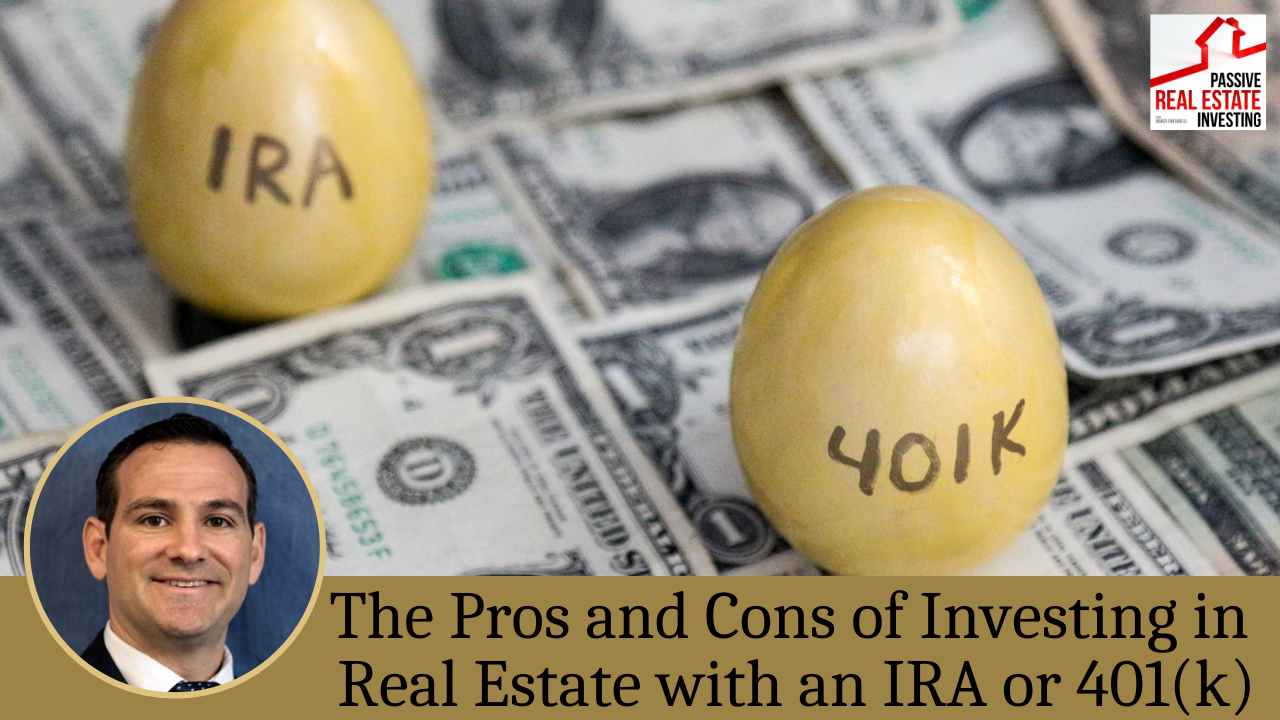
Hello and welcome to another episode of Passive Real Estate Investing. I’m your host Marco Santarelli. You know a lot of people, maybe most people don’t fully understand the power of a self-directed retirement account and how you can use it to compound your returns, whether it be from promissory notes or real estate or equities, trades or whatnot. The ability to be able to defer or even eliminate your tax impact gives you the ability to take those returns and use them to further your investment activity and compound or accelerate your returns. So my guest today is someone who is incredibly knowledgeable, smart, smart guy, and I’ve had some great conversations with him. So I’ve decided to bring him on the show for at least one episode, but it’ll probably be two, maybe three, to talk about self-directed retirement accounts like the IRA and specifically as it relates to investing in real estate.
So that is what we’re gonna talk to John today about, and we’ll talk about the pros and the cons. Now granted there are some cons, but it’s mostly pros. There are moer advantages than there are disadvantages. In fact, very few disadvantages of using or investing within one of many self-directed retirement accounts. So with that, let us get to our interview with John Bowens. I hope you enjoy it. Now, there’s a lot of good nuggets in here. It is a bit of a longer episode closer to I think 55 minutes, but stick around because there are golden nuggets throughout the entire episode. And enjoy.
FREE copy of The Ultimate Guide to Passive Real Estate Investing.
If you missed our last episode, be sure to listen to The One Minute Millionaire with Robert G. Allen
It’s my pleasure to welcome today, John Bones to the show. He is the senior Director of education and client Success for Equity Trust. And if you don’t know equity trust, they are the largest trust company in the country and I’ll let him tell you more about that. But he has been in the self-directed IRA business for 15 years and has trained over 60,000 investors. John is also an active investor himself. He’s focused on single family residential, both on the rental side as well as the private money lending side. So with that, John, welcome to the show.
Thank you so much Marco. Thanks for the invitation. Well,
It’s great having you on. You’re a super smart guy. I’ve had the pleasure of meeting you not too long ago at our Lake Tahoe Power Room Mastermind event and sat down with you a number of times and got to know you. I just love your depth of knowledge, which is something that I’d like to tap into a little bit today. Why don’t we just take a minute here. If you can just quickly tell us a little bit more about yourself and your involvement with Equity Trust to give some context for our audience.
Sure, absolutely Marco. So again, thanks for having me. Really excited to share this information and education with your audience. My background is, is in real estate. I’ve been in real estate for, for 20 years now, and I stumbled across this concept of being able to use retirement plans to invest in real estate about 15 years ago. And what I was able to do is, is take my background in passion in financial planning and couple it with real estate. Again, I’d been in real estate for 20 years and I was working for a commercial real estate company and we went from, you know, a 95% occupancy rate to about a 60% occupancy rate in the great recession. And I spent my days going from where I was putting new tenants and new properties to locking tenants out and moving those individuals onto their next venture.
And so I, I stumbled across equity trust during that time period and I decided to make a, a little bit of a career adjustment, which I’m very grateful for coming across equity trust company and making that career adjustment. Because what it opened me up to is the ability to take full control of my IRA, 401k or other retirement plans. So what I was always taught brought up in in finance school, in financial planning, in financial advisory is you put money in an IRA or you put money in a 401k, you get a company match maybe you don’t get a company match, but you have these retirement plans and then you take these retirement plan dollars and you put them into generally mutual funds. If you can self-direct a retirement plan, it’s generally going to be self-directed into stocks and mutual funds, maybe ETFs, possibly some publicly traded real estate investment trust.
But you’re not going to be able to invest in actual real estate. So you’re not gonna be able to buy a single family home and rent it out or make a private money loan. Now that was my background and that was what I was very passionate about. And so when I stumbled across equity trust and my eyes were opened up to this whole concept and capability of being able to use my retirement plan to invest in real estate, I was 100% all in. And so I got started 15 years ago and then I immediately started training investors across the country. So I developed a, a particular skill set with regard to creating education and information and I’ve been doing it ever since. So very privileged to be a part of equity trust company. We’ve been around since 1974. Our founders of our company, the Desich family, are well known as the pioneers of the industry.
So I was very fortunate to grow up in Cleveland and find a Cleveland based, self-directed IRA company that’s the largest in the industry, fell in love with it, fell in love with helping investors create what I call compounding interest in the absence of taxation. And that’s what I do today. I spend my days educating folks on how they could use their IRAs in 401ks and other retirement plans to invest in real estate, whether it’s a single family residential rental or a fix and flip transaction or a real estate joint venture or a real estate partnership investment or maybe buy a property turnkey from a turnkey operator. We see a lot of that type of activity. So anything related to real estate is what my focus and passion is.
That’s a great story and background. I didn’t know that that’s where you actually started. What was interesting about what you said is you actually labeled someone who is in the corporate world and maybe has a W2 job with a company based IRA or 401K as being self-directed. I’ve never called that self-directed to me that’s having one or maybe both hands tied behind your back because you’re given a very, very limited menu of options, which is usually in the equities market or maybe some mutual funds. And even though that, you know, you could technically call that self-directing, but it’s self-directing within a very limited number of options. But when you truly have a self-directed retirement account, IRA or otherwise, pretty much everything out there with a few exceptions, which we can talk about in a few minutes here, is open to you as an investment option. So it just kind of struck me that you called a self-directed retirement account, a self-directed when it’s actually part of your employer’s benefit package.

That’s correct. And you have to be careful with that. Marco, I, I’ll caution the audience because a lot of folks will go to their traditional financial institution there where they’ll have an IRA or even a 401k and they’ll say, Can I self-direct this plan? And they’ll say, yes, you can self-direct it. And technically that’s a self-directed account. But the items or the investment opportunities that you can self-direct into are gonna be very limited in scope. They’re gonna be limited to, I think you said it well, Marco, which is a menu of mutual funds or a menu of ETFs. Maybe you have a self-directed brokerage account where you can trade individual equities. In terms of real estate, the closest you’re gonna get to real estate is a publicly traded real estate investment trust. And a lot of the investors that I spend time with, the folks that are part of my tribe, they don’t wanna be exposed to the traditional financial markets.
Even in a real estate investment trust, there can be exposure, there can be correlation to the traditional markets. So when Jerome Powell gets on TV, like just not too long ago in the market plummets by, you know, three, four, 5%, whatever that is, most likely even your portfolio of publicly traded real estate investment trust is going to have some exposure there. So that’s not financial advice by any means. That’s just, you know, pointing out the obvious of what happens in the traditional financial markets and why investors look to hold hard assets like physical real estate or possibly an investment in like a real estate partnership, a syndication or buying a property potentially turnkey. Or last but not least, other exposure to real estate would be a private money loan. So making a loan to a real estate investor like a real estate flipper secured by their property.
Okay, so John, before we deep dive into some of the stuff here, my audience knows, I like to start at the very beginning with the most basic of basic things. Just take 30 seconds or a minute to give us a very quick overview of IRAs and other self-directed vehicles because there are different vehicles out there, although they have similarities. So we can cover every level of sophistication in our audience from beginner and newbie all the way up to sophisticated. Let’s just quickly take a look at the lay of the land of what there are for retirement vehicles out there.
So there are seven tax advantaged investment accounts and when you hear self-directed, that just indicates that you have the ability to self-direct into real estate. It’s an industry term. So for anybody out there that’s getting caught up with what, how we introduced our session here and talking about self-directed versus non self-directed, if you have any skepticism or you’re working with a financial advisor or CPA that’s skeptical of this, you can go directly to the IRS website irs.gov and search in the FAQ box or in the search box real estate faq and you’ll actually see where it states in black and white that real estate is a permissible investment in an IRA, but IRA trustees are not permitted or are not required to allow you to hold real estate in your IRA or your self-directed account. So it’s not a matter of legality, but rather a matter of choice custodians like equity trust, we are geared, we’re tooled, we have personnel, we have support systems, we have technology to accommodate these alternative investment.
So that’s really, really important for everybody to know. So there are seven tax advantage investment accounts. The first two accounts, the traditional IRA in Roth IRA, one is tax-deferred and then one is tax free. Tax-Deferred means when you put money in, you get a tax reduction, it grows tax-deferred and when you take money out, that’s when you have to pay taxes opposed to a Roth IRA where a Roth IRA you put money in after tax, it grows tax free, you take money out, you don’t pay any taxes. So Roth can be highly advantageous for real estate investors and entrepreneurs and I’m sure we’ll get into that in a little bit more detail. There are then three small business, or we can just call them self-employment or business retirement plans. The SEP IRA, Simple IRA or solo 401k. You hear the solo 401k talked about a lot in the real estate investment arena or real estate investment space.
So if you’re a real estate agent, you’re self-employed in any facet of real estate, you have active earned income, meaning income that you’re paying Medicare and social security tax on, then you’re gonna be eligible for one of these business retirement plans SEP IRA, Simple IRA or solo 401k. And the key takeaway with these types of plans is that you could potentially contribute much higher amounts, much greater amounts on an annual basis compared to an IRA. And then the last two accounts that I should mention before we move on Marco, is the Health Savings Account and the Coverdell Education Savings account. So again, that’s a total of seven tax advantage investment accounts. So the HSA and the CSA, those don’t fall under the retirement savings purview, but they are tax efficient tax advantage investment accounts. So for example, with an HSA plan, if you have a high deductible healthcare plan, you have an HSA, you get triple the tax deductions or triple the tax benefits.
So you get a deduction putting money in, it grows tax free, you can use it to invest in real estate, you can make private money loans, you can invest in private companies, you can do all different types of things with these plans. And then the HSA, when you take money out and use it for qualified healthcare related expenses, you pay 0% tax. So ultimately these seven tax advantage investment accounts, the key benefit to using these plans is the ability to either defer or completely eliminate taxation. So with a Roth IRA in particular, the ability to be able to get your taxes outta the way now get your taxes outta the way in the seed, grow it tax free and then take the money out and pay 0% tax is incredibly powerful. And that’s where I come up with this concept of compounding interest in the absence of taxation, which for a lot of the students that I’ve worked with over the years and clients I’ve worked with, it’s helped them get to their retirement goals and their financial goals in a shorter period of time because they’re eliminating that variable of taxation. If you eliminate the variable of taxation and your overall financial equation, it’s gonna have magnifying effects on your long-term returns.
I think what you just said is more than golden. And if there was no other takeaway from today, that’s probably one of the most important things that you will have said. The fact that you are compounding your returns by the fact that you are not paying taxes on the returns within your retirement account. I don’t know if you wanna expand on that at all, but that is incredibly powerful.
Yeah, I’ll give you a personal example. So I, I have hundreds of thousands of case studies, real investor examples. I, I’ll give you one example from my personal portfolio and it’s a recent example. So in 2020 I bought a property right outside of Cleveland, Ohio here. It was a rental property and I bought it from a distressed landlord. So this was a landlord that was getting up there in age, she was in her seventies, she was having trouble, I’ll say handling, dealing with the tenants. So she had tenant issues and she also had a lot of deferred maintenance on the property and there were some improvements that needed to be made. So I recognized this as a good value add opportunity. There were two units in the single family residential property and upstairs and downstairs unit, both tenants were paying 750 a month.
So we bought the property in 2020 with our self-directed IRAs and we actually had two self-directed accounts involved, Marco, we had our traditional IRA and our Roth IRA. When I say we, I’m talking about my wife and I, I consider my IRAs, her IRAs as well. Okay? That’s the one thing I learned getting married, right? I learned that her, her IRAs are my IRAs. So we, we partnered our, my two self-directed IRAs together. We bought this property and we bought it for $63,000 in March of 2020. We put about $15,000 worth of work into the property over two years. We took care of all the deferred maintenance, we took care of the tenant issues, we got new leases in place and we packaged up the property about two years later and we sold it. That was about two months ago and we made a $35,000 profit in our self-directed IRAs.
Now that $35,000 in profit went back into our self-directed IRAs. So IRAs paid for the property, IRAs paid for the expenses, rental income was flowing back in throughout the course of the two years. And then when we sold the property, the funds flowed directly back into the self-directed IRAs. That’s really important for everybody to understand when your IRA buys real estate is for the benefit of the IRA. So IRA buys it, IRA pays for expenses, profits go back to the IRA. Now this $35,000 in profit, we paid 0% tax on had we bought the property outside of our IRA. So using our non IRA bucket money had, by the way I call ’em buckets. I got my taxable bucket, I got my tax deferred traditional bucket and I got my tax free Roth bucket. So for the remainder of the podcast, everybody can think of three buckets, taxable tax deferred and tax free raw.
And so when we sold it, we made the $35,000 that went back into our tax free buckets. Had I done that in our taxable buckets, we would’ve paid $5,000 in taxes of 15% long term capital gain tax rate. So that would’ve left us with $30,000 instead of 35,000. Instead we had $35,000 in our self-directed accounts. We then took that money four days after we got it back, we combined it with our other funds and we made a private money loan to a real estate flipper, a hundred thousand dollars loan that were charging 13% interest. So we had $5,000 more in capital, more buying power, more investing power to be able to put into a future deal. That’s the power of compounding interest in the absence of taxation. That’s why I’m such a big believer in this and why the folks that we work with part of our tribe are such big believers in this is because it helps us get to our retirement goals and our financial goals in a shorter period of time.
The best analogy to paint the picture for everybody is think of a snowball rolling down the mountain. So snowball’s rolling down the mountain and if it’s a taxable snowball non IRA snowball, our taxable snowball, it’s going to pick up compounding returns. So snow is gonna compound, it’s gonna increase speed, right? We’re gonna keep going down the hill, but what a lot of people aren’t factoring in is we have the sun beating down on that snowball. So every year as it’s picking up snow, a percentage of that snow that it picked up is gonna get melted away. That’s taxes. Think of the sun like the IRS. And so our IRA snowball as that’s rolling down the mountain, we have a shield that we put in between the sun in our snowball and that’s our, that’s the shroud of the tax advantaged account, the self-directed account. And so with that shield we don’t have that erosion effect.
So at the end of the mountain, at the bottom of the mountain, our IRA snowball is inevitably gonna be much larger than our non IRA snowball and add a Roth IRA in. So a Roth IRA we get 100% of that snowball at the bottom of the mountain. If it’s a tax-deferred account like a traditional IRA or a tax-deferred 401k, then at the bottom of the mountain we’re gonna have to take pieces of that snowball off and pay it in the form of taxes to the IRS. So that’s the best way for people to understand this whole compounding interest in the absence of taxation, how an IRA is tax free. Just remember my example, $35,000 profit tax exempt in the accounts. Had I done it outside of the ira, I would’ve paid $5,000 in taxes.

That’s a really good example and a great illustration of how you can quote unquote compound your gains into more gains and get further ahead. It’s basically a way to accelerate your returns over a long period of time and get much further ahead. And if anybody understands the power of compounding, this should be, you know, pretty straightforward. Let me just quickly close the loop on something we were talking about five minutes ago about what self-directed really means because you explained it, but just for the sake of clarity, someone who is employed and has an employer provided retirement account that is somewhat self-directed is not truly fully self-directed. So if someone says to me or you or tells me that the retirement account is self-directed, what does that truly mean? That you have the option of everything other than let’s say arts and collectibles maybe define what a truly self-directed retirement account is.
Yeah, so to have a true self, and I like the way you say that, Marco, a true, a real self-directed IRA, not the, you know, call it foe self-directed IRA that you can have with a company that you know, maybe only let you invest in in traditional stocks, bonds, and mutual funds. Again, you can self-direct into a menu of those investments, but a real self-directed IRA, you have to find the right custodian. So Equity Trust is a custodian in full transparency. There are others out there. So you can do research and you’ll find a list of different true self-directed IRA custodians and these self-directed IRA custodians like equity trust, we have the education, we have the personnel, we have the support, we have the technology, we have the, the infrastructure, let’s call it the infrastructure that allows you to hold real estate and other real estate based assets in a IRA.
Doesn’t always have to be an IRA. Remember there are seven tax advantage investment accounts. It could be a Roth IRA, it could be a Traditional IRA, it could be a solo 401k, it could be a Simple IRA, SEP IRA or it could even be a Health Savings Account or a Coverdell Education Savings account. So just remember that self-directed is just an industry term. You’re not gonna find self-directed and internal revenue code 408 or 401 or 4975. You’re not gonna see it in any publications, but you will, as I mentioned, if you go to the IRS website irs.gov and you search in the search box real estate FAQ, IRA FAQ, you will see that it says that real estate, and I’m paraphrasing here, but you’ll see where it says that real estate is a permissible investment in an IRA, but due to the administrative burden, financial institutions are not required to allow you to invest in real estate.
So they can restrict you from investing in the assets that you know like and trust. That’s what really drove me to Equity Trust company 15 years ago is I was incredibly frustrated with the fact that I was, I’ll call it brainwashed. I mean I went through some of the most advanced financial courses in in academia and I was brainwashed into thinking that the only way to diversify a retirement for portfolio was the old 60-40 model. 60% equities, 40% fixed income. John, if you do 60-40 for the rest of your life, modern portfolio theory, everything’s gonna be fine. Well guess what? In 2007, 2008, I had family members reaching out to me struggling to make ends meet because their portfolios of 60-40 were down by 15% or greater and they were looking to me to say, Hey, what do I do here? There’s nothing I could do to help folks in that position.
I’m getting those same phone calls you can imagine Marco right now. So the person that was at the family function that told me I was crazy for owning real estate in my IRA is now calling me, asking me for advice. And the first thing I say is, you know, Marco, I can’t get financial advice. I’m not a licensed financial advisor. I’m here to provide education and information and education information only. So needless to say, if you wanna take control of your retirement savings, if you don’t want to stay to the call it traditional wealth management or wealth management consultant type plan, you have to look to a self-directed IRA and you have to be willing to take control of your financial retirement plans and make decisions on your own behalf rather than relying on a third party wealth management consultant or financial advisor. Yeah, that’s just not gonna be able to advise you on investing in real estate because their core competency is the traditional financial markets, not real estate.
Yeah, it’s an interesting choice of word that you used with brainwashing and it’s really not far from the truth because the reality is Wall Street does want to keep you within their farm or their stable of investments because they make oodles and oodles and money off of it, you know, short term and long term. So they want to keep you in the equities market, they want to keep you in the mutual fund space, they want to keep you within their offerings and their portfolio of investments because that’s where they’re gonna make money. If you venture off and invest in real estate as an example or even crypto or anything else for that matter, they have nothing to gain. They do not benefit from it. So it’s almost like there’s a bit of a conspiracy between corporate America and Wall Street to keep you within, you know, that limited list of investment options.
So exposing this on this podcast episode and just getting basic education about all this is really an eyeopener for a lot of people. It’s kind of like taking the red pill in the matrix. You all of a sudden get to see everything that’s available to you out there and your options are just so much more. So anyway, I kinda like the brainwashing analogy that you use. Well since we’re talking about real estate quite a bit here, one of the big questions I get and I know my team gets is that it doesn’t make sense to invest in real estate within a self-directed retirement account because you quote unquote lose that depreciation. It’s there but you can’t take advantage of it. And rather than put the words in your mouth, I’m gonna let you explain this as to what you are actually losing by investing in real estate in a self-directed IRA and whether that’s good or bad.
It’s a great question, Marco. A very common question. So common that I created a YouTube video and if you don’t mind me plugging that for for a second. Sure. We have a YouTube video specifically answering this question and the reason why I did it is because there were so many folks that were coming to me that wanted to own real estate in their IRA, but their CPA was telling them or their other financial consultant was telling them that, well it doesn’t make sense to own real estate in your IRA because you lose depreciation. And what they weren’t looking at is what’s the upside or the opportunity for the IRA? It’s not the IRA versus non IRA funds. I call it a rising tide. So I invest in real estate outside of my IRA and I invest in real estate inside of my IRA. Some deals are good for my IRA, some deals are not good for my IRA, some deals are just better for outside of my IRA. And then as you know Marco, some deals are not good for my IRA or outside of my IRA, right when I say….(inaudible)
Away from that, that is true.
But this is a very common question and to cut to the chase here, you don’t lose depreciation. Your IRA we have to remember is tax exempt. So there’s no taxable income in each incremental year as we’re growing the account. Now in a traditional IRA, we’re growing at tax deferred so there’s no taxable income, it grows tax deferred. When we take the money out, we don’t pay taxes. One of the main characteristics of an IRA that a lot of people don’t think about when it in terms of owning rental property is you don’t get depreciation when you sell the property. There’s no long term capital gains and there’s no recapture depreciation. When we talk about depreciating real estate and losing depreciation, as we said with an IRA, there’s no taxable income, therefore there’s no income to offset. So depreciation is irrelevant. When we sell a property and we’re using non IRA funds, we have to look at all that depreciation that we accumulated over the years and that gets recaptured.
So we take that accumulated depreciation and we reduce that amount by our cost basis and then we have to pay taxes on that chunk. In other words, we take our accumulated depreciation and we have to pay taxes on that amount when we sell the property. But with a self-directed IRA, in particularly a self-directed Roth IRA, it’s all tax free. You will find that investors prefer to own rental property in a Roth IRA because they get the taxes outta the way, now they grow it tax free. They don’t have to worry about a Schedule E, they don’t have to worry about reporting any of the income. It’s incredibly clean from a reporting perspective. Then when they sell the property, they don’t have to worry about long term capital gains tax, they don’t have to worry about recapture depreciation. And when they take money out of the Roth IRA, they pay 0% tax and better yet, when they leave it to their children or grandchildren, their children or grandchildren will pay 0% tax.
And this is when I get into what I call pillar three. Pillar three of self-directed investing is all about the preservation of wealth and legacy planning. I have a client here to give you an example, Marco, he has over a million dollars in property and cash and he has four grandchildren and his legacy for his four grandchildren are properties. And so he has four separate Roth IRAs and he has two to three houses in each one of these Roth IRAs and then a whole lot of cash. And he has each of his four grandchildren as a beneficiary to each one of those Roth IRAs. When he passes away the inheritance IRAs avoid probate by the way, it’s one of the most powerful features of an IRA that is not mentioned. IRA’s avoid probate. Easy as that…
That true for 401ks as well?

Yes, absolutely. Okay. Raised 401ks to avoid probate. So the IRA goes to the grandchildren, they pay 0% tax, they can continue to use it for 10 years. Now at 10 years they do have to take everything out, but it’s still tax free to them. So a Roth IRA owning rental property. Going back to your question about depreciation, you don’t have to worry about depreciation because there’s no taxable income in the account to begin with. What you wanna be looking at is not a tax deduction play, but how can I take this IRA money and start growing it in excess of what I can make in the traditional financial markets? So think of it as a yield play, not a, not a tax play, but like we talked about the Roth IRA in leaving it to the children or grandchildren, there’s certainly a a tax play that shouldn’t be underestimated there.
That was a really good way to describe the loss in depreciation. You know, it’s one of the reasons I say you never sell real estate. If you ever have to sell it, it’s only because you need to because of an emergency. But for most investors, the reason they sell real estate is to do a 1031 tax deferred exchange into another piece of real estate or a larger piece of real estate. So you’re essentially leveraging up or upscaling the size of your portfolio so you’re not selling it and taking profit or having to pay taxes. So the recapture of that depreciation never actually happens to me. It just never makes sense to ever, ever, ever sell real estate. You always hold onto it and you pass it along or you, you sell it to do a 1031 exchange up. So your answer to you know, the depreciation loss is actually very sound.
You know, the whole thing with depreciation too is that some people actually need that depreciation as a tax write off, if you will, because they have so much other income that they want to lower the tax impact on that. In some cases, if you’re a professional real estate investor, you could take it against, you know, all your income, active and passive. But that’s where that depreciation actually comes in useful. But what you’re saying is that it’s irrelevant if you’re investing in self-directed IRA because it’s being offset by the gains and the fact that you may have to correct me on this, but that quote unquote lost appreciation is actually not lost because you will never have a tax impact down the road because you either are tax deferred or you have no tax impact. Did I say that right?
Yes, that’s correct Marco. And you know, there are some real estate transactions that that don’t make sense for an IRA. You know, the the pros and cons of of self-directed IRAs, the pros, we’ve, we’ve talked about the tax free gains, the no recaptured depreciation leaving a legacy to your children or grandchildren. But you brought up a great point Marco, which is you can own real estate in a non-IRA environment and create a legacy through step up basis. So as long as that continues into the future, I know there was some threats to that in one of the past proposals, luckily that didn’t happen, but there’s step up basis, there’s 1031 exchanges. If you have other passive losses, you can write off those losses. Professional real estate designation there’s all types of things that you can look at beyond that. Where I’ll say it, it might not make sense for an IRA to engage in a, in a rental property.
I’ll give you a great example. I was recently looking at a property here in Cleveland, $110,000 purchase. It’ll rent for a thousand to 1,050, maybe 1100 good cash flowing property if I buy it with a 30 year fixed mortgage. Okay? And I put 20% down mm-hmm <affirmative>. So from a cash on cash return from a yield perspective, great rental property for getting a a conventional 30 year mortgage for my IRA, I passed up on the deal with my IRA because if I had got a loan it would have to be a non-recourse loan. I wouldn’t get a 30 year, it would be at most a 20 year, my interest rate’s gonna be higher from a yield perspective. It just didn’t make sense for my IRA IRA to do that deal. And so that property made a lot more sense for my non IRA portfolio and go out and get conventional financing.
So instead what I focus on with my IRAs to my best stability, although I do own real estate as well, like I mentioned before with my IRAs, I focus on private money loans and so I can make a loan to a real estate investor to do a fix and flip deal and my IRA collects interest income and that interest income is tax free in my IRA. See if I make private money loans with my non IRA funds, that income is attributed to ordinary income, it’s classified as ordinary income, right? And I have to pay taxes based on my ordinary income tax rate. It’s just like a bank checking or savings account that’s paying interest, right? You have to pay ordinary income taxes on that same works when you do a private money loan with your taxable bucket with your non IRA money. And so I focus my IRAs on doing those private money loans, but if the right real estate investment comes up and it makes sense for my IRA, especially like a value add type project that I just mentioned, then absolutely I, I’ll pull a trigger on a transaction like that.
I will say that I do see a lot of investors with their self-directed IRAs by properties turnkey. They will use non-recourse lenders to do so and their goal is to preserve their retirement dollars for the long term. So they wanna hold that property for the long period of time. They wanna pay down the non-recourse loan and eventually have a cash flowing free and clear asset in their IRA. Hopefully it’s, it’s gained value market is appreciated and they can either leave that to their children or grandchildren tax free, avoiding probate like we’ve talked about. Or maybe what they want do is sell it and they don’t have to worry about any long term capital gains or recaptured depreciation at that point because they’ve paid down the mortgage.
Yeah, nice. That’s actually one of the questions I wanted to ask you, which I’m gonna bring up now is financing within a self-directed retirement account of some kind. So financing does exist out there and it has to be non-recourse. Last I checked, the maximum loan to value was 50%. I don’t know if you can actually go higher than that, but those are the basics. There’s not a lot of lenders out there either that do non-recourse lending that you can use to put into your self-directed account to purchase real estate. So number one, maybe talk a little bit about that, but my bigger question is when does it actually make sense to purchase all cash within your retirement account versus actually using some leverage, whether it’s 20%, 50% or something else. Because I love leverage, I love the idea of being able to put less down and control a hundred percent of an asset and take advantage of a hundred percent of all the returns while using other people’s money. So what are your thoughts on that?
Yeah, so first thing for everybody to know is IRAs, when borrowing money, you can’t go to a Bank of America or a Chase Bank or your, your typical mortgage lender to get a loan for your IRA. And that’s nothing against those firms. It’s that those firms have different underwriting guidelines. So when your IRA borrows money, it has to be in the form of what’s called a non-recourse loan. And a non-recourse loan in the context of an IRA means that you personally are not signing a guarantee. See under 4975 C1B of the tax code, it states specifically that you as an IRA holder are considered a disqualified person and you cannot use your credit to obtain a loan. You signing a personal guarantee would be considered an extension of credit and therefore a prohibited transaction. So just so people understand why they can’t get a traditional loan, that’s the reason why.
Now the good news is, is there are some banks out there and I know of a few of them and many of them will do business across the entire country that will make loans to IRAs. And you are right Marco, that 50% is a common loan to value. But I have seen some of these firms go all the way up to 75%. Wow, some folks think that interest rates are gonna be exorbitant. I’ll tell you it’s not hard money loan rates these are reasonable rates. They’re higher than your typical 30 year fixed mortgage because they are generally 20 year mortgages and there’s obviously a little bit more risk there to the bank because they’re loaning to your IRA with no personal guarantee. And so as a result you’re gonna pay a little bit of a premium for that. There’s gonna be just a little higher interest rate, but I’ve seen 20 year some have a 15 or even 10 year product.
And then I also see a lot of adjustable rate products. And what a lot of investors will do with their IRAs is remember you can’t start taking money out of your IRA until you’re 59 and a half, 59 and a half is that required? Or I’m sorry, 59 and a half is the qualified retirement age. And so if you take money out prior to 59 and a half, you have to pay a 10% penalty at ordinary income. So most people are gonna wait till they’re 59 and a half anyways. So if you’re well under 59 and a half, your strategy might be buy a property with a non-recourse loan in your IRA and then every dollar that you can put into the principle pay down. So you, you pay down that principle faster and now you own a free and clear property. Other people like traditional real estate, they don’t make extra payments.
They want to take that cash that they build up and go out and buy another property with a non-recourse loan and that’s okay too. So there are strategies around leverage. The last thing that I should mention, Marco, and this is very important from a disclosure perspective, is with IRAs when you borrow money, your IRA becomes exposed to a little known tax called unrelated business income tax. It’s a special tax on tax entities such as IRAs when they engage in certain activities including debt finance, real estate acquisition. The way it works, the simple version, and we have other training on this, is if I bought a property for a hundred thousand and borrowed 50,000, I’m at 50% leverage. So what the IRS is going to say is that I have to pay taxes on 50% of my net profit. Well here comes where I can actually take advantage of depreciation and operating expenses.
So I know it’s gonna sound a little contradictory cuz I talked about how you can’t depreciate before, but that’s when your IRA owns real estate Free and clear. When your IRA owns real estate with a non-recourse loan because you have tax exposure, you can actually take advantage of depreciation and right off your expenses at that attributed percentage. So if it’s 50% leverage, I can write off 50% of all of my depreciation and operating expenses. So the idea there is pay down that mortgage and then once I have that mortgage paid down and I wait 12 months or greater, I can sell it no taxes, I continue to rent it out, no taxes. So there are still strategies around IRAs buying real estate with a non-recourse loan. I should mention that solo 401ks, and we haven’t gotten there yet, I know Marco, but solo 401ks, you do not have unrelated business income tax as it relates to debt finance, real estate acquisitions providing that the criteria has been met. And generally speaking, regular loans, a non-recourse loan from a bank is gonna end up qualifying for the criteria. And so the long story short is you don’t have to worry about UBIT in a solo 401K when you’re using debt leverage to acquire property.

So if the depreciation schedule is the same on that real estate, when it’s in your self-directed retirement account and you’re paying UBIT tax on the 50% leveraged loan to make that acquisition, I guess theoretically or even practically, you’re not gonna be paying taxes on it anyway because you’ve got the depreciation to put against those gains.
That’s correct. I, I see plenty of investors where their UBIT tax is zero or they actually carry forward a loss and they can allow those losses to hibernate and then offset future gains. So there’s a lot of tax strategies within that specific nuance that can be addressed. You just gotta sharpen the pencil and look at what the, the numbers look like and does it make sense for you to obtain a non-recourse loan instead of buying a property 100% outright as a cash buyer, Generally speaking, rule of thumb is you’re going to increase your yield even after you pay your taxes. If you owe taxes by taking on leverage in an IRA, it just requires a little bit more brain power. Of course.
Yeah. Let’s kind of wrap this episode up with 401ks and solo 401ks cuz I’m definitely gonna have you back on. We can, you know, continue this conversation or maybe talk about something similar or related or unrelated. I mean, there’s dozens of topics we can cover here, but we’ve talked about solo 401ks multiple times. It’s a powerful vehicle, it has larger contribution limits. It’s actually something that’s great for entrepreneurs, especially solo printers, but I think there’s also a lot of hype around it. So maybe talk about what a solo 401k, who’s it for, who’s not for, And if you want to sprinkle in some pros and cons to it, you know, do that.
Yeah, so solo 401k, I’ll hit the pros and then we’ll go onto the cons. So pros of a solo 401k, you can contribute substantially higher amounts to a solo 401k than an IRA. So in 2022, with a traditional IRA or Roth IRA, you could contribute up to $6,000 when you’re under 50, up to 7,000 when you’re 50 over with a solo 401k in 22 if you are paying yourself enough. And we’ll get into that in the cons section, but if you’re paying yourself enough as an employee, you can contribute to a solo 401K up to 20,500 when you’re under the age of 50, up to 27,000 when you’re 50 and over. So you could potentially get upwards of three to four times more into a solo 401k compared to an IRA. Now that’s just as an employee. Remember as a self-employed individual, you wear two hats, you wear an employee hat and you wear an employer hat.
So as an employee, 20,500 went under the age of 50, 50 and over 27,000. Then as an employer you can defer, they called a profit sharing. You can defer up to 20% of your self-employment income if you’re set up as a W2. So like if you have an S Corporation for example, and you have a W2 salary, you’re paying yourself, you would use 25%. So what does this all mean? Let me give you an example. Let’s say you’re a real estate agent and you’re making a hundred thousand dollars and you’re claiming a hundred thousand dollars of your commissions as actual income. So you’re paying Medicare, social security tax, your ordinary income taxes on that a hundred thousand. So you take, let’s say you’re 50 years old, you take your 27,000, you make your employee contribution, then you take 20% of your a hundred thousand and you deferred as a profit sharing.
So that gets you a total of $47,000. So if you make a hundred thousand, you can get $47,000 into this solo 401k. Now here’s one of the most advantageous components I’ll say of a solo 401k. That money that you contribute as an employee instead of putting it into a tax deferred bucket like a traditional IRA is, you can put it into what’s called a Roth component, which is after tax dollars and that can grow tax free for the rest of your life and then you leave it to your children or grandchildren. So it works just like a Roth IRA and a solo 401k. Of course you can invest in real estate, real estate, private equity or private placements notes, everything that you can do with an IRA, it all works the same. And then in addition to that 27,000 my employer deferral, that that profit sharing that I mentioned, the 20,000, I can do what’s called an plan conversion and actually convert that over into the Roth component.
So here’s what I’m telling everybody, if you make a hundred thousand dollars, you can get $47,000 in tax free dollars manufactured in one individual year in with this solo 401K program. Whereas a Roth IRA, when you’re under the age of 50, you can only contribute 6,000 when you’re 50 and over, you can only contribute $7,000. All right, sir, those are the pros of a solo 401k. The Roth is a big one, and just the, the pure amount that you can contribute to that plan an annual basis. So here comes the downside, so to speak, especially for real estate investors. So as a real estate investor, real estate entrepreneur, I am constantly on this quest with my CPA to do what show no income, right? Doesn’t work great for when I try to get a loan, right? Right. Real estate investors face that all the time.
But there’s, there’s other things obviously you can do and the commercial arena and obviously hard money, mezzanine financing, things like that, that’s I assume for another podcast. But the point is, is as real estate investors, we’re constantly trying to show no income. The problem with that is if you don’t have any earned income, and when I say earned income, what I’m talking about is income that you’re paying Medicare and social security tax on think payroll taxes. So if all I have is rental properties, most likely I’m not claiming any active earned income, it’s all passive income. So I’m not gonna qualify for a solo 401k. So if you don’t have any earned income, unfortunately you’re not even allowed to open a solo 401k. And Marco, I will caution your audience here because this is the biggest problem that I see in the self-directed IRA industry.
I take calls every day from clients that say I talk to X, Y, Z firm, I’m not gonna mention any of their names. And I’m not here to, to bash any IRA or 401K administrators out there. And I’m not saying everybody’s doing this, but I’m saying is there’s plenty of firms that I know about there that are telling people, Oh, don’t worry about the earned income, just open up a solo 401k roll over your 401K money. You’re a real estate investor, so you’re good. You can open the solo 401k, roll your money over that way. You can buy real estate with loans and you don’t have to worry about UBIT tax. Or you can invest in this real estate investment syndication that has debt against it and you don’t have to worry about UBIT tax. The problem with that is the IRS says otherwise. So if you go to the IRS website and you search recurring and substantial on 401ks, you’ll see some guidance that the IRS says, I, I’m a big fan of the IRS website by the way, IRS.gov.
I spend lots of time on there. It’s actually very, very helpful. I know a lot of people that come by these types of podcasts probably don’t say things like that, but I gotta give the IRS a lot of credit. They do a really good job with it. All right? Needless to say, if you go to the IRS website, it states in black and white that your contributions to a solo 401k have to be recurring and substantial. Now, recurring and substantial is a facts and circumstances matter, but certainly if you don’t have any earned income, you can’t make a contribution. So if you don’t have any earned income to make a contribution, how in the world would you meet the recurring and substantial test? There’s no way you’ll ever meet it. Which means all of these people that open these plans up without any earnings to make contributions, they’re gonna be considered to be in ineligible plan, which could have a compromising effect on their long term retirement planning.
So that’s really, really important. The next thing that people have to understand is if you have any employees, you can’t have a solo 401k. So you can’t have any employees with the exception of a spouse that is the one exception. So you could have your spouse working for you and they could also participate in the solo 401k, which can be really great. And then last but not least, you have to look out for what’s called a controlled group. This is one of the biggest issues that I see amongst entrepreneurs and business owners. Let’s face it, as an entrepreneur and as business owner, I’m usually not just interested in, you know, one business and doing one thing. I mean, don’t get me wrong, some people are, so if you are, that’s okay. But a lot of entrepreneurs and business owners that I know, they are involved in all types of things.
I, I know some real estate investors that own lots of real estate and then they have technology companies they’re a part of and invest in, or they’re managing and operating designing applications. I mean all kinds of things. And so what can happen is you can be part of what’s called a controlled group and not know it. What that means is if you have a solo 401k and then you’re running a company over here, the Department of Labor is gonna say, Nope, you can’t benefit from a solo 401K over here and not offer a 401K over here to all of your employees that are part of this business. So you gotta be really careful with these rules and you gotta make sure that you’re eligible for a solo 401k. And in my experience, only about 10% of folks are actually truly eligible for a solo 401k. And if you’re not eligible for a solo 401k right now, that’s okay. Maybe a self-directed IRA is better for you right now, and then maybe in the future you wanna look at a solo 401k once you’ve been able to create a structure and a strategy that’s gonna be sound enough for you to have a solo 401K account.
It sounds like the whole area of solo 401ks is such a big topic. I’m wondering if it’s worth having a dedicated episode just to 401ks and solo 401ks. Okay. Maybe what we need to do is just schedule a time where we can talk about solo 401ks because there’s, I know because I have a solo 401k, I know there’s a lot more depth to this topic and you’re just touching on a lot of points, which is good, but there’s a lot more to chew on there. So maybe we should just have a dedicated episode for it. I guess in winding this episode up you know, I was thinking that we are gonna call this the pros and cons of investing with a self-directed IRA or maybe specifically with real estate, but we talked about a lot of benefits and pros, if you will. Are there other cons that we haven’t talked about that you want to throw in there just to kind of round it out?

Absolutely. So you have to be careful in engaging in prohibited transactions with a self-directed IRA, 401k or other type of retirement plan. So the skinny version of this Marco, is there are what are called disqualified persons to your IRA or solo 401k. Disqualified persons would include to your IRA, your parents, your grandparents. Those are referred to as lineal ascendants in the internal revenue code 49 75 lineal descendants. So children and grandchildren. And then any business that you own and operate is considered a disqualified person as well. It’s actually defined if disqualified persons own 50% or more. But not to get too technical, the idea is, is immediate family members are disqualified persons. Now what’s interesting is brothers, sisters, cousins, uncles, nieces, nephews, so people across the family tree are not disqualified persons. What this means is a disqualified person cannot transact with your IRA.
So the very basic ones are easy. Marco, if you own a property personally now, or it’s in an LLC that you control, or maybe a land trust that you control, it’s all looked at the same. You can’t sell that property to your ira. Your IRA can’t make a loan to you personally. So under 4975, the tax code it lists what are transactions, the buying, selling, leasing of property between the plan and to disqualify person the lending of money or extension of credit between the plan and disqualified person. So those are pretty simple, pretty common sense. But then we get into some of the more gray areas, for example, the furnishing of goods, services and facilities. So this is a major con. This is something that I know is not gonna be favorable to some viewers out there. Now, to you and I Marco, we’re probably okay with this, but some people have a little difficulty in, in we’ll call it conceding control to when they own property.
And that is, you can’t physically do the work yourself. You can’t provide services. The rule of thumb is you cannot do the physical sweat equity, but it would be acceptable for you within reason to do the desk work. So desk work should be okay, but the physical work is not okay. Now I will say for that comment that I just made, this was incredibly difficult for me to overcome. Marco <laugh>, when I came into this business, I, I worked in, in construction for years. So I learned how to do all of that. So my first self-directed IRA property investment, I was going nuts because I’m thinking to myself, this is so easy. All I gotta do is strip the floor, pull the cabinets off, I’ll do the demo, but I’ll hire other people to do all the other work for me. Nope. The internal revenue code says I can’t provide services.
So the rule of thumb I use is if I drop my tailgate when I pull up to my rental properties in my IRA, I know I’m in trouble. So I keep the tools away. Does that mean I, I, I can’t physically go to the property. No. I physically go to the property. I talk to tenants, I collect rents, I stick to the administrative duties. Now what I’ve learned over time is yes, my expenses are going to be a little bit higher, especially that last value add project that I mentioned. Yeah, could have I saved $7,500? Had I done some of the work myself? Yeah, I could have. But guess what? I save $5,000 in taxes. So I’m good with the tax savings. In some cases, the tax savings is far greater than the additional expenses that I would’ve paid to have someone else do the property manage the rehab on the property.
And of course it forces me to make sure that I get my time back cuz I recognize how valuable my time is. And Marco, I’m sure you’ve probably done a whole podcast on this, the value of your time and, and hiring other people to do that work for me so that I can take that time and I can use that to go out and find my next investment property or maybe help coach another investor to find success or do something else that’s gonna be much more valuable than me being at that property and physically doing that work myself.
Yeah, what you’re describing as a con is not that big of a deal. If you really think about it, the three words that come to mind are delegated, outsource it, and use a third party. If you do those things, I think you’re safe because you’ve separated yourself from having direct influencer or control over that asset that you should not be materially involved with.
Yeah, and the last thing I’ll say is a con Marco to, to round it out is I work with a lot of real estate developers, a lot of business owners, a lot of folks that are, are taking what’s referred to in the industry as a GP position, general partner position. So they’ll be a general partner in a real estate company and that real estate company is maybe buying apartment buildings. They’re doing value add apartment building projects. And so the mothership is creating subsidiary LPs or LLCs, and then every time they buy an apartment building, they go out and raise capital from investors and they go out and buy the, apartment building, they add value and then they refinance or sell and then everybody gets their money back with their preferred return and the profits on the split. It’s a great model for GPs, but the challenge is, is when that GP wants to use their own IRA to invest in one of their own projects.
So in that instance, they’re likely going to encounter the services issue, the benefiting issues, essentially we call these all in one self-dealing issues. So if you’re a GP out there and you wanna use your IRA, you’re probably gonna have to look to use your IRA to invest in other GPS projects, which I do see come up. But you know, let’s face it, you know, a lot of GPs, they’re very confident in what they do. They’re invested in what they do, they’re passionate about it and they want their IRAs to participate and unfortunately it’s gonna be an uphill battle for them to be able to do that.
Great information. John, I appreciate you coming on. There’s just so much to unpack here. I think you’ve laid it out in a very clear, easy to follow, easy to understand manner. There was a lot that we covered in the last, what, 55, almost 60 minutes <laugh>. So I think what we’ll do is we’ll have another follow up episode or two, whatever it takes to talk maybe about solar, 401ks and 401ks and then whatever other topics you want to cover. But for now, why don’t you tell our audience here where they can find out more about you and or equity trust or whatever resources you wanna share.
Absolutely. I appreciate that Marco, and great to be here. Happy to jump on another call like this. This is what I do all day every day. I, I just love teaching and educating and, you know, do it with his little fluff and his little you know, sizzle, if you will. Just stick to the facts is what we try to stick to here at Equity Trust and myself personally as an investor. If people are interested in learning more our website, real simple trustetc.com, so it looks like trust etcetera.com and you’ll find we’ve been doing this since 1974, a lot of real estate, but you can do other things with your IRA private securities gold, silver cryptocurrency, but we stay very much focused to, to real estate. And you can check us out on YouTube as well. I have a lot of investors that they, they’re, they’re big on YouTube.
I am as well. And so you can go to YouTube and just search Equity Trust Company and you’ll find all types of training videos, everything from the depreciation thing that we talked about to solo 401ks. We even having a video on there that’s, that talks about self-directed IRAs versus solo 401ks. So definitely check us out on YouTube as well. And when you go to our website, you’ll see our phone numbers there so you can reach out to us directly. We have IRA counselors that are here Monday through Friday that will literally just pick up the phone and talk to you about your situation and answer your questions. We’re a non-advisory, non-fiduciary custodian. And so what that means is when you call in and you talk to one of our account executives, it’s a very safe and very non-pressure environment. So we’re not pushing you into a specific investment, we’re just helping you open and fund a self-directed IRA.
So don’t be shy, call us up, ask your questions. That’s what we do all day every day. I manage an entire team here that all they do every day is answer self-directed IRA questions and help take your individual situation and see how a self-directed IRA could potentially work for you. And if it’s not gonna work for you, then we both walk away and hopefully we learn something from each other. So feel free to reach out. Again, Marco, really appreciate you having me on the podcast today and you know, happy to come back anytime.
All right, thanks John. I really appreciate it and we’ll definitely have you back on. And thanks for all the great content. Thank you.
I hope you enjoyed today’s episode. It was chalk full of good information and we could have gone on for another hour or two easily with just all the questions that I could have come up with to talk to John about when it comes to retirement accounts. Anyway, that is it for today. Download our free report, The Ultimate Guide to Passive Real Estate Investing, available as a free download on our website at noradarealestate.com. Also, if you are interested in promissory notes earning 12 to 15% per year or more paid monthly, these are passive monthly income distributions. Go to noradacapital.com and look into our promissory note offering. If you have questions about real estate investing, feel free to drop that over to me through the Ask Marco link at passiverealestateinvesting.com.
I’d love your questions. I like to batch them and then do the occasional Ask Marco episode. So feel free to email me any question related to real estate or investing in general, or even just a personal question. If you just curious about how I do whatever morning routine or whatever travel, how do I book a flight <laugh>, It could be anything you want, but I’m open to all questions. If you haven’t done so already, remember to subscribe, just click the link or the button nearby and you’ll never miss another episode. It’s pretty much every week spread the word. Talk to your like-minded friends, family, and acquaintances and let them know about the show. I greatly appreciate it and I appreciate you. Thank you for listening. We will see you all on our next episode.
Download your FREE copy of: The Ultimate Guide to Passive Real Estate Investing.
Get your FREE coffee mug by leaving us a Rating and Review on iTunes. Here’s how.
See our available Turnkey Cash-Flow Rental Properties.
Please give us a RATING & REVIEW (Thank you!)