
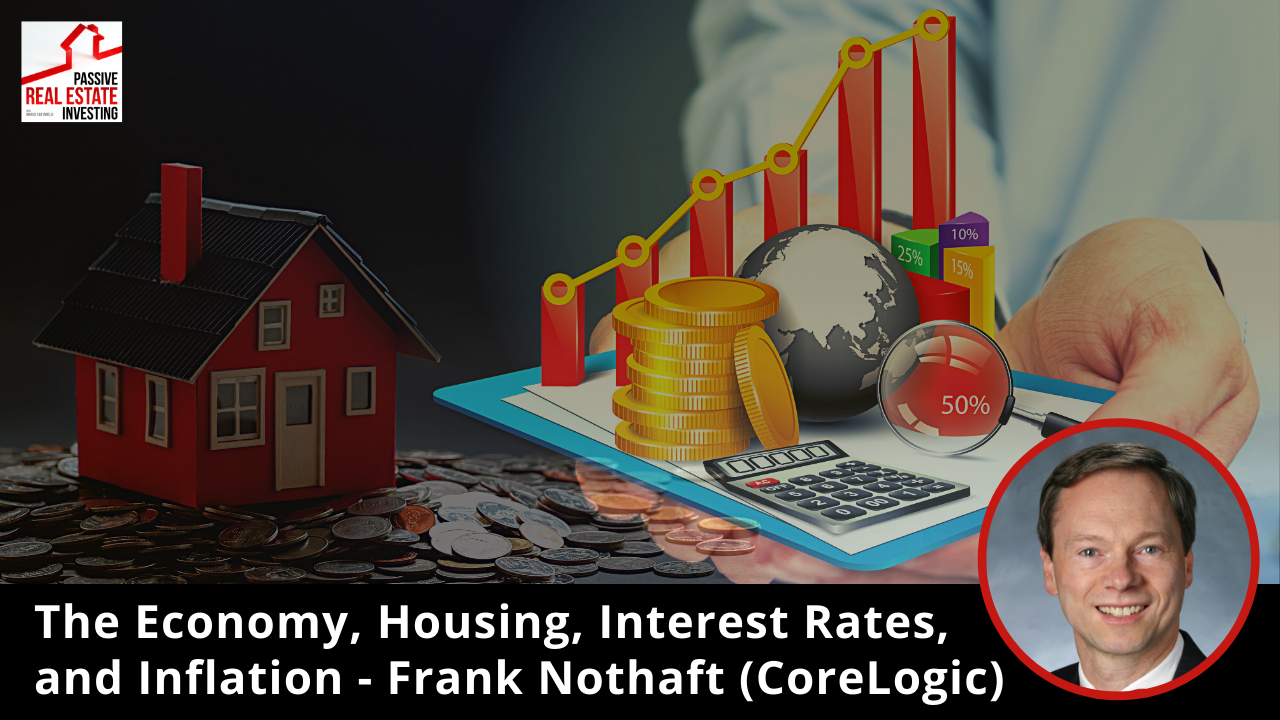
Hello, my friends. And welcome to another episode of Passive Real Estate Investing. I’m your host Marco Santarelli well, you know, there’s been a lot of talk about how the economy, interest rates, especially when they’re going up and inflation. That is a, a big one. And it has been a topic of conversation for many, many months. As we know that inflation has reached 40 year highs and it’s affecting everybody, it’s affecting housing, it’s affecting assets, it’s affecting our purchasing power. And you know, it’s an area of concern. So today we are gonna talk about all of those and maybe a little bit more with my guest, Dr. Frank, Nothaft, who is with core logic. They are one of the biggest data aggregators in the country in terms of the economy and housing. So it’s an interesting conversation, but these are the types of things that I think you need to keep a third eye on.
You want to keep your radar focused on some of these things, because right now, a lot of this is tailwind for you as a real estate investor, but you always have to know when the tide shifts, because when that tailwind becomes headwind, that’s when you need to start making some changes in your investment plans and maybe even your investment strap strategy. And certainly that’s something that we can get into the weeds on, in a one-on-one conversation with my team, because it can become a little bit on the deep side, but also it’s very custom to you. It really depends on your own personal situation in terms of your income strategy investments, your goals, what you’re investing in, what you hold, et cetera, but any way without further ado, let us get to today’s interview with our guest. And I hope you enjoy the show.
FREE copy of The Ultimate Guide to Passive Real Estate Investing.
If you missed our last episode, be sure to listen to Retire Early with Real Estate – Chad Carson
SUBSCRIBE on iTunes | Stitcher | Podcast Feed
Well, it is my honor today to welcome Dr. Frank Nothaft to the show. He is the chief economist for CoreLogic America’s largest provider of advanced property and ownership information analytics and data enabled services. And I have to admit in full transparency. I am a client of one of their divisions. Dr. Frank does lead the economics team responsible for analysis, commentary, and forecasting in global real estate insurance and the mortgage markets. And with that, Frank, welcome to the show.
Hey, thanks for having me today, Marco. It’s really my pleasure.
It’s great having you on. And I was looking forward to this cuz I know the content you put out is always insightful, deep, informative, and I really enjoy your stuff for those listening on the audio, not the video here. I just want to comment and compliment on your tie purple is my favorite color and you’ve got a wonderful bow tie. That is beautiful. Purple. So I love it.
Oh no, thank you so much, Marco.
All right, well, let’s dive in. So let me start with something a little more broad in scope. You know, we’re around March of 2022, and you could say that we’re about two years into this whole COVID mess. If you will. The thing with that is it’s caused so many ripples in the economy. You know, there’s been disruptions in supply chain, there’s been migration changes, labor issues, and the list goes on and on, you know, and this is all outside of any health related issues and consequences. I’m wondering what you think the degree is that this is still impacting housing in the us and the economy in general.
Oh, it is still impacting the housing market. And we see that with the record level of home price growth and the migration of households that we’ve seen across the United States. That’s actually been one of the more dramatic elements of a pandemic. And I’ll give you an example. The census bureau just released its latest estimates on a population by state at the you know, through 2021. And what we saw was that during the first 15 months of the pandemic, so that’s from about April 2020 to middle of 2021. There was big migration shifts within the United States, the states of New York and California, each lost 300,000 in population. And the states of Texas and Florida gained 300,000 in Texas, over 200,000 in Florida. Those are just a couple of examples of some of these big migration shifts that we have seen out of big cities, out of places with high cost of living, to places with lower housing density or less population and places with a lower cost of living.
So I just highlight some examples like that, but that’s been dramatic shifts in where people live and it’s been facilitated by the fact that they can work for them home. And it’s been facilitated by their desire, their need, their preference for more space. So we’ve seen at least in the first year of the pandemic, people moved out of high density structures, which generally are in the downtown center city. They moved out of the high, high rise, apartment buildings, the highrise condos. They moved out to the suburbs. They moved out to the excerpts. They moved to a different part of the country where they could move into either buy or rent, single family homes, preferably single family, detached homes, relative to the high rise apartments that they had been living in. Single family. Detached gives you a lot more space, square foot of living space inside the home.
And it gives you social distancing from neighbors. And that was something that was in huge demand during the pandemic. And we’re continue to see them ripple effects on the housing market. One big question that a lot of economists and analysts are trying to sort through is what happens with this work remote phenomenon that’s been in place, right. You know, prior to the pandemic, most estimates said, oh, maybe about 5% of the workforce work remotely. Well, that increased multiple times during the pandemic. And the question is, what will we see once this pandemic finally subsides and people start her to much more normal life, will we see everyone return to the office environment? Or is it gonna be a very, very different type of office environment, longer term, maybe with flexible working schedules or maybe with a much higher percentage of the workforce that’s permanently working remotely. And that’s gonna have big implications, not just for commercial real estate, but also for residential real estate, especially where people live and where people work,
Right? There’s a lot to unpack there. And actually your last comment is something I was thinking about is what kind of relapse or backlash that might there be with all the people that have moved out of the, some of the larger cores, especially in the tier one markets, the larger markets out to the suburbs and exurbs. How many of those people do you think are gonna come back to repopulate some of that residential real estate that is more inter core? I would imagine that those properties have been hurt in terms of monthly rent and maybe even price. So I don’t know if there’s been much of a depreciation and price in the larger cities and inter core, but if there’s a rush back because people want to actually go back, you know, what impact is that gonna have on these markets?
Well, I tell you Marco, that’s what we saw in the first year of the pandemic. You know, this Exodus from high rise buildings from the center cities moving out and rents and values fell in many communities, inner city, you know especially high end high rise structures. We saw a lot of decline in property values and rents during that first year of the pandemic, things started to change though, as we got to you know, the middle of 20, 21 and later because people started to return to the city. In fact, they saw that things seemed a little more affordable than they had been in some of these high cost markets and rents and property values started to pick up once again in the latter part of 2021. Now sustaining many of these markets longer term is the fact that we do have gen Z, which, you know, are, are the folks in their early twenties now coming out of school, starting jobs, thinking about where they may wanna live longer term and for young adults, they wanna be where the action is and where a lot of the action is in terms of social interaction and events.
That’s still in the cities. It’s not in the exurbs. So as gen Z continues to come, you know, come out of school and graduate and look for their career jobs. Many of them are looking to move into the city to be where the action is to be where the opportunities are, both for jobs, but also for social events.
Yeah. Gen Z is like a pig and a python. And we’ve got approximately 80 million of these people that are now starting to leave home and they want a place to rent or maybe a place to buy. And so they’re adding more demand pressure to the market that was already there.
No, absolutely. Yeah, absolutely.
So before we jump into that, just to go back to one other point you made, you know, you, you were talking about migration patterns between states, which, you know, certainly can affect markets. Florida definitely is a huge recipient, Texas. You know, many of the Southern states, we already had strong demand pressure and lack of supply in these states. Now we’re, you know, stacking another two or 200, 300,000 people come into these states, which has certainly been driving prices up. We’ve seen that over the last 12 to 24 months, do you think that is going to continue? Or is that something that is transient? And these people that have moved to those states are, some of them are gonna move back out back to where they came from, or maybe choose other locations. And this could be partly due to mobility in the job market, you know, labor being so much more mobile today, but just wanted to get your thoughts on that.
I think a good portion of it is gonna be permanent. Now there’s no question. Some of it is transitory temporary move because of the course of the pandemic. And in some cases, their employer will say, gee, I, I really need you to be back in the office is we’ll work out a flexible work schedule, but I still need you in two days, three days a week. So, you know, in those cases, you know, people will need to move and be closer to where their job requires them to be. But in many cases, I think people have relocated permanently. And in those cases, even if their employer says, no, I want you back in the office, they’ll say, oh, well, you know, it was good to know you. No, thanks. I’ll find you all the job here. Right? and that’s part of this. So-called great resignation that we have heard so much about over the last year where quit rates are up significantly. And many employers are having a lot of challenges, retaining skilled workers and hiring skilled workers.
So that’s an interesting point. How is that going to affect housing?

Well, I think it adds to the demand, especially for larger homes, because if you want to work remotely, that means you need, need to have additional space though. You have the office at home. And if you’re spending that much additional time in your home, well, you probably want a bigger kitchen. Yeah. A bigger, you know, bigger restroom or just more space elsewhere in the home. Cause you’re spending so much of your time there. And that is actually what we’ve seen over the last year. And if you look at how home builders have responded to these changes in consumer preferences, what we’ve seen is that over the last year, the average size of new new homes built has gone on in terms of size, in terms of square foot of living space. That’s up over the last year because builders have recognized that demand that need that home buyers are looking for.
So we’re talking about well least we’ve mentioned it a few times supply and demand, and that’s been part of the conversation a lot here over the last, let’s say three to six months. I I’ve been talking about it more on the show. I’ve been listening to other people in the industry, talk about supply and demand, the lack of equilibrium, maybe comment on what you see happening right now in terms of housing, supply, housing demand and the trends, because that really plays, I think, heavily into decisions being as far as where to invest as a real estate investor.
Absolutely. And you’ve probably heard this comment about economists, how do you train an economist? Do you teach a parrot to say supply and demand? So you know, that, and in truth, it is some of our favorite tools that we like to, to look at. And that’s in large part, what’s been driving some of the trends in the marketplace. It’s, what’s been driving the 20% rise in home prices that we’ve seen in our national CoreLogic home price index. And in some markets, the price growth has been even greater 30%, percent in Phoenix, 30 per percent in Austin, Texas 30% in Boise, Idaho. And that’s again, reflecting this imbalance between demand and supply. And in some of that demand is coming from these migratory shifts. These population shifts, I didn’t mention the state of America, but Arizona comes right after Texas and Florida in terms of population growth.
Arizona had a hundred thousand increase in population over the past year. Number three of all the states in terms of population growth in the past year many of them are to Phoenix going to Tucson and they’re going to other communities in Arizona, but that’s, that’s a huge increase in demand. And, you know, builders are trying to step up and provide that additional supply. So when we look at, at new home construction across the United States, so big surprise that much of it is concentrated in Southern states, especially in those states that have seen the largest amount of population growth. In fact, Marco of the, of the 10 metros last year that had the largest increase or the largest number of new home sales, the 10 largest metros, four of the 10 were in the state of Texas, four of the 10 top of the list is the Dallas Fort worth. Metro second is Houston. And from San Antonio in Austin, those were the four metros in Texas that were in the top 10 nationwide in terms of the number of new home sales last year Phoenix was in the top 10 too. Just doesn’t have to be in Texas.
Yeah. Wow.
Ah Tampa, Orlando. We’re in the top 10 as well. Again, Florida was a, and number two state were attracting population growth.
So let me flip that question around. If you look at the states that had net losses in population, in other words, outbound migration, I’m still seeing prices increasing for the most part, like take California example last year, as I understand, it was the first year in a very, very, a very long time that we actually had a true net negative migration, but prices are still going up virtually everywhere. And it’s estimated to still go up somewhere between six to nine, maybe 10% this year. I have to imagine that’s largely if not entirely being driven by the lack of supply that is still in the system, local housing markets. Is that the case?
Oh, absolutely. There’s a huge shortage of homes in California, especially for affordably priced homes. It’s a lower price, tier homes, price, you know, roughly median price or lower where there’s just a, a shortage of inventory. And that’s where you see the strongest need and the strongest demand. And that’s continuing to push prices up now, you know, if we, we, if we look at migratory trends within California, what we do see, for example, in the SoCal region, see that there’s, there has been a shift in population with people moving out of downtown LA and where are they moving to? Well, if you wanna stay in SoCal, you move out to Riverside, San bar Bernardino. You know, the cost of living is one half what it is in Los Angeles, us just in terms of the home prices.
And you can still stay in the SoCal area to be close to the amenities, to be close to other family members. That’s important, especially if you have the opportunity to work remotely or work a flexible schedule. It’s one thing if you need to commute to the office five days a week in, in downtown LA versus maybe commuting maybe twice a week, well then if you’re commuting just twice a week, being in Riverside or San Bernardino, where the price of housing is one half, what it is in Los Angeles looks a lot more attractive. And so that is what we’ve seen. We’ve seen these shifts outside of the, you know, really densely populated areas to some of the suburban communities still close in, but that tend to be a lot more affordable and where you can buy just a lot more home for the of money.
Now, you’re right. We have seen prices still continue to rise in Los Angeles and San Francisco, but a lot slower than what we’ve seen in other markets. A lot slower than prices are up in LA, but a lot less than they are up in, in Orange County, a lot less than Ventura, a lot than Riverside and San Bernard. But they are up. But if you put it in terms of comparing it with what happened with inflation last year, inflation was up around 7% in the United States last year. So even if home prices are up seven, 8% were you live, that means you you’re just keeping up with inflation. You didn’t gain in terms of real inflation adjusted home value. And that’s what we’ve seen in a lot of densely populated communities in high cost markets in LA, San Francisco, Seattle New York Chicago, we saw price we’re up. Yeah. But when you measured against the inflation yard stick, basically the values were just barely keeping up with inflation last year.
I’d like to touch on inflation here in a couple minutes. I, I want to kind of close the loop on a couple things here. If I’m in a real estate investor or, or anybody listening to the show right now, as real estate investors are listening to this, you know, strong demand, lack of supply. These migration patterns are, in my opinion, tailwind, they’re, they’re helping us out being in the market or getting into the market. I’m having a hard time seeing what kind of headwinds there might be today or coming up. If so, if I was a real estate investor, what should I be looking out for or watching in the years to come in my best interest as an investor?
You mean in the residential market?
In the residential space. Yeah.
Well you know, things to, to, you know, keep an eye on is whether or not markets are getting for a local market is getting overvalued, you know, the economy’s doing very well right now. House prices are up really a lot, but what happens if it turns out that the federal reserve has to be a lot more aggressive in terms of restricting monetary policy in order to fight inflation, supposed to Fed fees, inflation is running hot throughout 2022 and maybe early 20, 23. Well, the Fed’s gonna have to Jack up interest rates a lot more. So if they Jack up interest rates a lot more than we all are expecting, and if they do it sooner than we expect, then that means that it could really put a chill on the housing market and these home prices that are up 20% or more in some communities over the last year may suddenly take a real jot. They may appreciating. And in some cases, in some communities they may come down. So that’s something to keep an eye out for. You know, is the local market that you are working in or looking to invest in? Is it overvalued? How much is of it is at risk? If there is an interest rate shock that perhaps even figures of recession.

I mean, this is something we could probably debate, you know, for days with 10 different economists in my mind, there’s kind of a tug of war or an arm wrestle between the imbalance between supply and demand and interest rates going up. You know, the question is, is who’s gonna win. You could raise rates. I mean, we’re already seeing it and there’s probably gonna, or rate hikes this year, but I come of school of thought or the belief that the Fed has painted themselves into a corner and they can only raise rates so much without crippling the economy. And they certainly don’t want to hurt the housing industry because it makes up, you know, a very large percentage of our GDP. So yes, rates, I think will go up in my opinion, probably for the next couple years. But the question is, is how much could they possibly raise rates before they jeopardize, you know, the US economy and really just affect jobs and housing and everything else?
Well, that’s a concern among a lot of us economists, will the Fed make a policy mistake? Will they perhaps act too swiftly into harshly and trigger a recession, even though perhaps they didn’t intend to. And that’s a policy mistake now, Chair Powell certainly remembers a lot of the economic pain that occurred in the early 1980s under Chair Volcker, right, who was confronted with double digit inflation. So the inflation rate when Chair Volcker took office was about double what we are seeing right now. And Paul Volcker put in you know, really intense shift in the monetary policy regime at the Fed and led to double digit interest rates. We had the Fed funds target over 20% for a period of time. Mortgage rates got up to 18% for 30 year fixed rate mortgages, a lot of pain, and a lot of pain felt throughout the economy, but especially in the housing market.
Now, I don’t think it’s gonna come to that with chair Powell. The inflation rate is only about one half of what it was when Paul Volcker took over as chair of the Fed. Nonetheless, we could see some much more significant increases in the Fed funds target in the coming two years in order to wrestle inflation and bring it down to the Fed target. The Fed target is 2% per year. We’re running at about 7% or maybe a little higher right now. So we’re clearly well above that. And, and that question is how tolerant will the Fed be of inflation running hot for you know, how long in 2022.
Do you think it makes a difference that today compared to back in the early eighties with Paul Volcker, that we have $9 trillion on the Fed balance sheet, 2 trillion of that is mortgage backed securities. And we need a way to be able to affordably if that’s a, a possibility affordably pay that debt, or at least the debt service on that debt. So raising rates to me is like, you know, shooting yourself in the what foot.
Well you know, it’ll slow the economy. That’s for sure. And that’s, that’s typically a page in the Fed playbook. Yeah. If inflation’s running hot, then that means we’ve got to slow down the economy. We wanna slow down demand relative to supply. So we’re going back to demand and supply. Once again, that’s the page right out of the Fed playbook in order to reduce inflation in, in order to reduce the pressure on prices, we gotta slow down demand relative to supply, and you slow down demand by jacking up interest rates that’ll reduce the inflationary pressures in the economy.
So since we’re talking about inflation, I know you don’t have a crystal ball. We would all love to have crystal ball we’d be billionaires, but if you were to make a prediction on what the real rate of inflation might be over the next 12 to 24 months, what would you say to that?
Gee, over the next 12 months, I’m afraid that we’re still gonna see about 4% inflation. So I guess the good news is that it it’s less than what we have right now with 7%. Okay. But it’s still clearly well above the 2% target that the Fed has announced. Right? So, so I think we’re probably gonna run 4% over the next year less in 2023. My concern is that it could take us to 2024. When we get back to a 2% target, will the Fed be patient that long? Are they willing to let inflation run above its target for that long period of time? If not the Fed’s gonna Jack up rates sooner, perhaps trigger a recession and perhaps have you know, effects across the economy, but especially in the housing market, cause it up mortgage rates.
Do you foresee a recession in the next couple years? I mean, we’ve been running hot for a very long time.
We have, we have been employment has not gotten back to the level. It was pre pandemic, even though the unemployment rate is almost back to that level. So the unemployment rate in January was 4% back in February of 2020, the last full month before the pandemic was declared. The unemployment rate rate was 3.5%. So we’re almost back to that level. And I do think that the economy’s gonna grow strongly in 2022. And we will see the unemployment rate get back to about three and a half percent somewhere toward the end of this year toward the, in the second half of the year. We’ll see it get back to that 3.5% level. So that’s, that’s great. The labor market looks great. So I don’t think we’ll see a recession at all this year, even with the Fed, pushing up interest rates. I think it’s unlikely in 2023 but it does depend how high inflation is running and how aggressive the Fed has to be, to take steps, to reduce the inflationary pressures, the economy.
I sometimes question the 3.5%, you know, unemployment rate because there are a lot of people correct me if I’m wrong that have essentially checked themselves out of the labor market. You know, they’re not employable, unemployable choose to not be employed. And they’re just doing other things elsewhere or maybe just living off employment, insurance, whatever it might be. So how real is that three and a half percent?
Well, it’s, it’s pretty real, especially if you talk to employers, looking to hire.
I guess.
So they’re finding that it’s really hard to fill that vacancies that they have, even when they offer additional compensated and benefits. So it is a very tight labor market, but you’re also absolutely right that the employment levels are still below what they were pre pandemic. And some of it is that there are older baby boomers who decided to take retirement perhaps retire sooner than they were planning on because they didn’t want to deal with, with working during a pandemic. So some of the reduction employment is, you know, older baby boomers who have retired and, and left the labor force at least temporarily. But some of it is also you know, young mothers who are home because their kids in many places are still at home and not back in the classrooms. So that’s affected labor force participation, especially among young mothers. And I think it’s gonna take a while before they feel comfortable to come back into labor force as much as they had in the past.
Yeah. So quick point about mortgage rates was so we’re seeing mortgage rates going up and they’ll probably continue to go up for the short term, the foreseeable future. I mean, they’ve gone up twice on me already on, on a refi and I can’t seem to catch up to it, but at some point I’m thinking there might be a bit of a tipping point where mortgage rates get to a point where housing starts to plateau. I don’t know what to call it. I wanna say cool off, but I don’t want to imply that, you know property values are gonna come down. Cause I still think demand is far far outpacing supply at the moment that we’re not gonna see prices drop. Cause there’s always gonna be somebody who can afford to buy in the various markets around. Where do you think that tipping point is in terms of mortgage rates or, or is that just a really impossible question to answer?
Well, I, I would put it this way. It depends how quickly rates go. Well, if we see a gradual rise in mortgage rates, then we could see mortgage rates gradually move up above 4% up to four and a half percent. And certainly the housing market will slow, but it doesn’t necessarily trigger a recession if that increase in mortgage rates. It stretched out over two years or longer mortgage rates still currently for 30 or fixed rate are still just below 4%. Now the average 30 year fixed rate mortgage rate in the decade prior to the pandemic ask, do, do you know what it was Marco the average in the decade prior to the pandemic, the average rate for 30 year fixed rate.
Seven percent?
A good guess it was higher, higher than, than it is right now, not that high. So between 2010 and 2019 for a prime credit for a prime credit borrower for 30 year fixed rate mortgage, the average rate was about a 4.1%. Now during the pandemic, you know, we got down below 3% for most of the time mortgage rates were at rock bottom levels. Now they’re up, but they’re still below 4%. So in, in my scorebook mortgage rates are still low. Yeah, sure. That as low as they were last year they’re up, no question about it. But compared to where rates have been pre pandemic rates are still really pretty low. Now, if rates should get above 4% in the next couple of months, if they get up to four and half percent this year, well then I’m, I’m really concerned that we are gonna see, you know, slow down and perhaps a recession in the housing market. Maybe not the economy, but in the housing market, because that’s a very steep rise in mortgage rates over a very short period of time and put, puts mortgage rates above where they were pre pandemic. However, if the Fed is much more gradual rates gradually creep up, don’t get above four and a half percent for, I don’t know, maybe two years. Well then I think it’ll be a much more of a soft landing. We’ll see a little slow down on housing activity, but no recession.
Yeah. It’s a tight wire that they’re walking because they can’t be too hawkish or dovish because they’re, they gotta control inflation. Well, at the same time, not crushing the economy. So I, I wouldn’t want to be in their shoes at this point in time.
Bingo.
Yeah, exactly. So, you know, the thing about the rates that I was thinking of is, you know, as the rates continue to go down, property values continue to go up because of rates lead to better affordability. And that affordability allows people, more people to get into the housing market, which that demand pushes prices up. So I like to say, or at least like to think that the increased value in housing is baked into the cake because we’ve had lower and lower rates. So if mortgage rates start to go up, you know, one or two things that can happen, housing price have to come down to coincide with that rate increase, or we just get to a point where fewer people can afford housing. And we dry up that demand and we reach a point of equilibrium and housing just stays where it is, whatever that price level might be.
I agree with you mark though, it’s a real challenge. If mortgage rates go up with home prices being up as much as they are, it really erodes affordability in particular for the first time home buyer. So, you know, just thinking about it very simply, if prices are up 20%, then your typical first time home buyer has to have a nest egg. That’s roughly 20% larger than it was a year ago because they gotta make the down payment close costs and have a little cash in reserve. So that nest egg’s gotta grow 20% in one year as well. Now, if you layer on top of that higher mortgage rates, then that means not only is the nest egg gotta be bigger, their income has to be substantially higher too, in order to manage those additional, a higher level level of monthly principle and interest payments.
So it’s a real challenge for first time home buyers. And I, and I don’t wanna say it’s not a challenge for the, the repeat or the trade up buyer. It’s challenging for them too. A big difference though, is that the existing homeowner has seen this enormous increase in home equity wealth over the last couple of years. And they, if they are looking to trade up, they can always sell their home, take that boku amount of home equity wealth that they have and use that as the source of their down payment to buy their next home. So then the affordability impact on an existing home owner, who’s looking to trade up or maybe downsize is very different than the, the pinch that the first time home buyer is seeing in the current marketplace. Yeah. Now again, first time home buyers, if they’ve been fortunate, they’ve seen their incomes go up 20%, maybe they invested well or, or be well in the stock market. So, so are there, unless they go up 20% hope, that’s the case for those perspective, first time home buyers they’re well positioned to buy. Unfortunately, most first time home buyers will not be in that position.
Yeah. Unfortunately.
The other thing I wanna mention is, and, and I, I agree with you with, you know, higher interest rates. Generally we see cap rates rise. And so, you know, if you’re an investor and you’re thinking about investing in residential real estate, some of the things you want to think about is what’s happening to cap rates and what’s happening with the rental flow, the cash flow that you would get on an investment that also is what determines value. So not just higher interest rates or higher cap rates, which would reduce value, perhaps rents are rising. So if rents are rising sufficiently so that your net operating income is growing as fast or faster than a cap rates to rising property values could still rise. And indeed, one thing we’ve seen in the rental market is that rents are up a lot in the last year. Operating costs are up to operating costs are up to, but rents are really up. So at CoreLogic we have a single family rent index, so we can measure single family rent growth. And what we’ve observed over the last 12 months average across the concrete is that single family rent are up 12% in the United States. And in some markets are up a lot more, but on average, across the us 12% increase in single family rent.
Yeah, the reports and the data that I’m looking at, show the exact same thing, very, very strong, some markets, you know, 20% plus in fact, some of the markets that I’m in that I have property and I’ve seen 20% and greater price increases. What’s interesting about the number you just gave. The 12% that is consistent with a recent survey that I was looking at where those tenants that have been renewing their leases have own 13% increase in their income over the previous year. So they are making more money. People are getting raises and, and having higher incomes. And you can see that as the new rental applications are coming in, they’re showing that their incomes are up 13% on average. So that’s pretty consistent, at least that’s encouraging, but for anybody get into the market, it’s gonna be tough.
Oh, absolutely. And certainly an encouraging sign, especially if it’s just, you know, an individual applicant who’s seen their income rise that much. Now, in some cases, you know, if it’s a couple, it may be that one of the couple may only worked part of the year in 2020 because of the pandemic, because the restaurant was closed or, you know, the retails are always closed or whatever it may be. So some of that percentage growth and income could be re reflecting the fact that 2020 was just really a lousy year for jobs and for income. So, but if it’s a real increase of 13% for the tenant applicant, wow. That’s, that’s great news. That means that they are well positioned to be able to afford that higher rent.
Well, they don’t have to upgrade or downgrade their lifestyle and is gonna stay pretty consistent.
Absolutely.
So let, let’s just wrap up with a couple questions since we’re talking about, you know, rents and rent growth and whatnot, if you were to forecast, I don’t know if core logic does this, but if you were to forecast where rent growth is going to go over the next year, in terms of new homes and resale homes, what would your forecast be in terms of rent growth?
We’re, we’re still expecting some pretty strong rent growth over the course of the next year. As I mentioned over the last 12 months, we’ve seen rent on single family rise, about 12% on apartment rents high rise apartments. There are up maybe even a little bit more than that in terms of percent growth over the last 12 months, there is still a relatively low rental vacancy rate in the rental market. And so you’ve got a low rental vacancy rate and you’ve got increasing numbers of gen Zs coming into the marketplace and forming households. There’s gonna be some strong demand or rental homes, whether it’s single family or whether it’s multifamily apartments. So between that strong demand and the very low vacancy rates, that’s gonna continue to press rents higher in the next year. I don’t, I’m not projecting a 12% rise in rent next year, but I do think it will continue to run much higher than the overall inflation number.
So we, you know, we could still see rents rising somewhere in the maybe five to 7% range over the next 12 months. Likewise, we’re expecting the home prices to continue to rise too, but not as rapidly as in the last 12 months. So in the last 12 home price index, we’ve seen home prices up 19% close to 20% in our national index. We do expect home price growth to remain strong here in the first part of 2022, but then moderate over the course of the year with prices up from December to of December, roughly about 5%. So again, really strong growth, double digit growth the first several months of 2022, but then slower growth in the second half of 2022. Why? Because I do think the erosion of affordability for home buyers will finally start taking a toll between the higher home prices and now higher mortgage rates. And that’ll start to really take a bite out of home buyer activity in the fall and as we get toward the end of the year, and that’s what leads the moderation and home price growth.
Right? And even with those predictions, it continues to show that housing is still a very strong inflation hedge.
It, it is. And, you know, I tell you, it’s, it’s remarkable how low the vacancy rates are. We are at a generational low in housing vacancy rate in the us. That’s a sign of an underbuilt housing market. And if you have an underbuilt housing market home prices and rents are gonna continue to rise and rise probably a little bit faster than inflation.
Yeah. Yeah. I agree. So here’s my last question, cuz you actually answered my last question without me asking you, so, so I’m gonna throw one at you here. You mentioned gen Z multiple times and I’m, you know, kind of keeping my eye on, you know, that demographic, but what about gen Y what impact are they having right now and will continue to have in housing? You know, they were the pig and the python prior to gen Z. So what impact are they gonna have?
Millennials are having a huge impact already. So when you look at the millennial cohort by single year of age, so be the oldest millennials, they’re turning like 40 right now, but if you look at it by single year of age, the biggest number of millennials are those that are age that around 30, 31 years of age, that’s kind of like the peak of the millennial cohort. Well, that’s the prime age of transitioning from rental into home ownership. So that’s where we typically see the biggest numbers of first time home buyers. And in fact, the median age of a first time home buyer in the us is a, is about 32, 33 years of age. So we’ve got this really large number of millennials who are just transitioning at this time from rental into first time home ownership. So they’re gonna have a big impact as well and are going to be a powerful headwind, continuing to support home price increases in the coming couple of years.
Interesting. Very good. Well, let’s wrap it up. Do you have any final comments for our audience who are mostly real estate investors from mom and pop all the way to professionals before we talk about core logic here.
You know we’ve seen really strong single family investor activity in the marketplace over the the last year and single family investor activity dipped early on in the pandemic and, and no surprise because there was so much uncertainty with the economy with the housing market is, you know, house prices gonna collapse. You know, you couldn’t evict tenants, you know, gee who wouldn’t in housing, if you can’t invest tenants, right? So, you know, single family investor purchase activity really plummeted in the early months of the pandemic. What is so interesting is that as we got to the end of 2020 and into the beginning of 2021, things really started to turn around and investors made up for that lost time in 2021. And they came back and they increased their purchase activity in the single family marketplace. So single family investor purchases in 2021, but the highest that we have seen in over a decade and the portion of it are investors who are investing to the long haul, but some of them are investors who are looking to make improvements and then flip the property. And very interesting when we did analysis on core logic data, what we found was that roughly about 20% of the investors are these flippers. They’re making some home improvements, they are making investments. And then within six months they’ve resold a home to either a home buyer or, or, you know, someone else.
But then they’re still back in the market, they’re out looking for their next rental or their next purchase. So they’re still in the housing market and they’re just adding more inventory hopefully to the housing stock. And which could be argued that a lot of that distressed inventory is pretty much dried up. So now we’re having to rely on home builders to make up that inventory that we don’t have.
Well, absolutely. There’s a big need for home builders to continue to step it. Now, 2021 was a very good year for single family home building. It was the largest number of single family homes built in the us since 2007. So that’s, that’s great. That’s great, but we need even more, we need more single family homes. We need more attached homes as well because the attached home home market, the town homes, the row houses, they tend to be more affordable. And so we need to also build to that entry level segment as well, who can afford to transition to home ownership with a townhouse condominium, a rowhouse.
Yeah, for sure. Frank, this has been amazing. Thank you for your time. You’ve been very gen please share with our listeners, where can they follow you, find your articles and any other content that you wanna share and let our audience know.
Oh yeah. And I’ve really enjoyed our time together, Marco. So Twitter I’m at Dr. Frank Nothaft, and you can follow a lot of the material puts out at Core Logic, Inc. I N C and then we post a lot of material on our website on our webpages. So you can go to corelogic.com/intelligence. And that’s where we put up a lot of our intelligence research logs that describe different trends and finding that we have on the housing market. In addition what you’ll find there is some of our special reports too, like our home price index, our loan performance indicators and our single family rent index and our home equity report. Those will all be up on the chronologic webpages.
Perfect. And I’m going to make sure that all of that is in our show notes and on our website. So it’s easy for people to find it, click and go. Also, your last name is actually spelled N O T H A F T. You don’t need to write that down. I’m gonna put it in the show notes, but it is pronounced Nothaft. So don’t want people to try and search and find you, and then they can’t find you.
Yeah. Thanks for that clarification. You’re absolutely right. Yes. Yeah, for sure. Thanks,
Mark. Good stuff. Well, Frank, thanks for coming on. We’ll probably you know, have you on in the next six to nine months just to see where we’re at with housing and what changes have happened.
Hey, that’s excellent. I look forward to that, mark.
All right. Well, thanks for coming on and we’ll talk to you soon.
Okay. Same here.
Well, I hope you enjoyed today’s episode. I think it was great. I like covering this economic and housing information because sometimes you have to look at the big picture and just see where markets are headed and what’s going on in the economy and in the macroeconomics. So that’s an important thing, but anyway, I hope you enjoyed today’s episode. Download your free report on our website. The Ultimate Guide to Passive Real Estate Investing. It is free. It’s been downloaded probably 20, 30,000 times now. Great primer for real estate investing. And it’ll help point you in the right direction if you’re looking for some guidance, but anyway, there’s more in there than just basics. That is it for today. If you want a strategy session with my team of investment counselors, by all means go to our website at noradarealestate.com and just request your free strategy session.
One of my team members will get back to you within 24 hours. If you have a question about real estate investing, go ahead, send it to me. I will cover that in an Ask Marco episode. I am due to do a couple of them here very, very soon, but I love the questions. Some of them are great. Very insightful. Remember to subscribe, just click that button. It’ll only take you one second. Spread the word with your friends and family about the show, cuz we want to help other people understand real estate investing the economy and personal development. That is it for today. Thank you for tuning in and we will see you all on our next episode.
Download your FREE copy of: The Ultimate Guide to Passive Real Estate Investing.
Get your FREE coffee mug by leaving us a Rating and Review on iTunes. Here’s how.
See our available Turnkey Cash-Flow Rental Properties.
Please give us a RATING & REVIEW (Thank you!)